
ILF Longbows: Takedown Longbows Explained
What an ILF longbow is, how longbow ILF limbs pair with risers, why riser length changes bow length and draw weight, and how competition rules treat them.

By Archery Insider Editorial Team
· · 5 min read
In this article
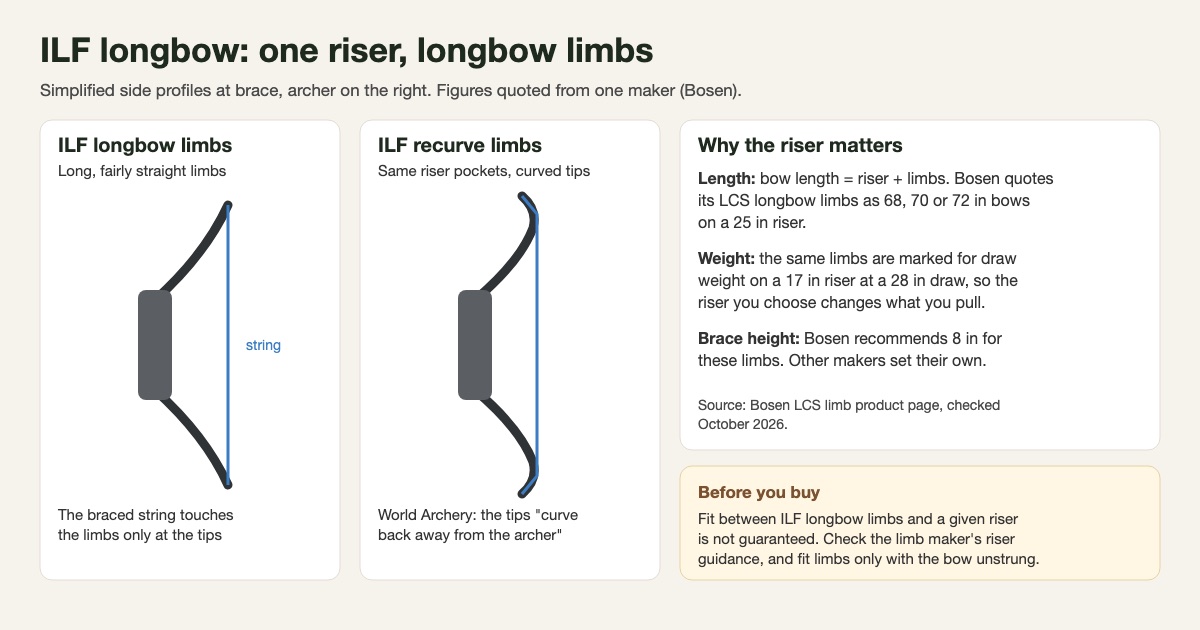
An ILF longbow is a three-piece takedown longbow: a riser with standard ILF (International Limb Fitting) pockets, fitted with long, fairly straight longbow ILF limbs instead of recurve limbs. It gives you a longbow-style shooting feel with a bow that comes apart for travel and lets you change limbs. Whether a given set of limbs suits a given riser, though, is something to check with the limb maker.
What an ILF longbow is
A traditional longbow is usually one piece, or two pieces joined at the handle. Its limbs are long and close to straight when unstrung, and the braced string touches them only at the nocks. A recurve is different: World Archery describes recurve limbs that "curve back away from the archer at each tip."
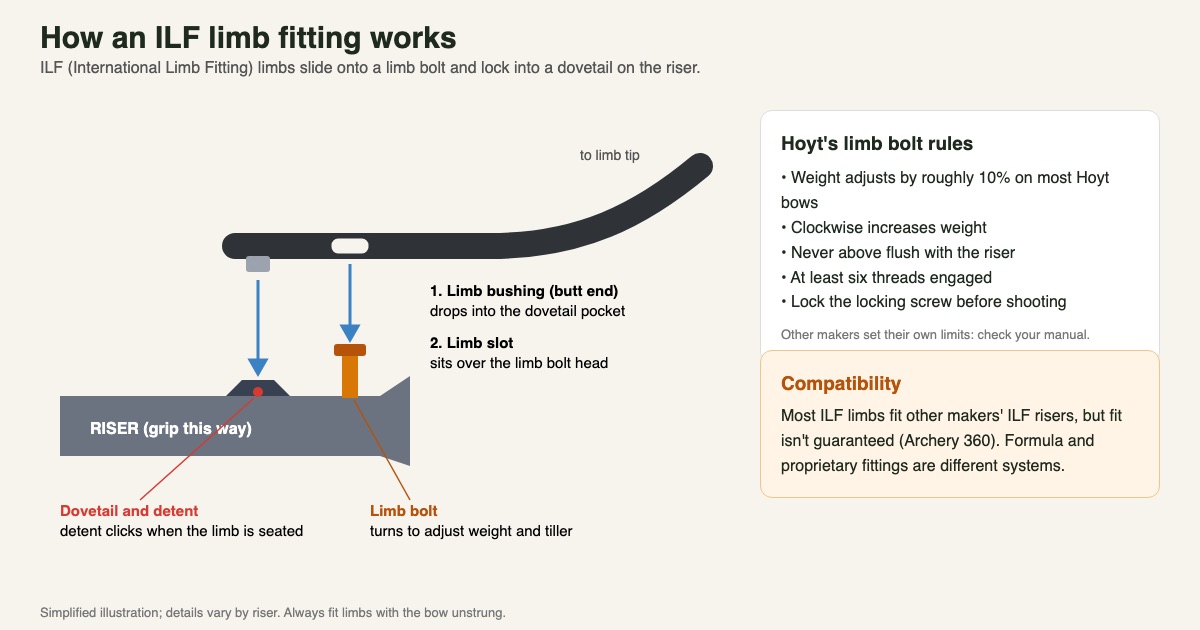
An ILF longbow borrows the modern recurve's modular design, where World Archery notes the limbs "often detach for transport or storage." The ILF system standardises how they lock on: each limb's butt slides into a dovetail pocket and sits over a limb bolt.
Swap recurve limbs for longbow ILF limbs and the same riser becomes a takedown longbow. Our longbow vs recurve comparison explains how the two styles shoot differently.
Which riser and limbs go together
ILF is a widely shared standard, which is why our guide to choosing a first recurve recommends ILF risers for upgrade options. For longbow limbs, be more careful. The fitting may lock on, but the riser's length and geometry still change how the bow behaves.
One maker's product page shows why. Bosen sells its LCS longbow limbs in ILF or Formula fittings, with bow-length labels of 68, 70 or 72 in, "based on a 25-inch riser and a 28-inch draw." Yet it says "marked weights use a 17-inch riser at a 28-inch draw." Its page warns: "Bow length and draw weight use different reference risers. For other setups, confirm the fit and ratings before ordering."
Before you buy, check:
| Check | Why it matters | Bosen LCS example |
|---|---|---|
| Fitting type | Bosen notes that "Formula uses a different fitting" | Offered in either |
| Riser length used for bow length | Bow length = riser + limbs | 25 in riser |
| Riser length used for marked weight | A different riser changes the weight you actually draw | 17 in riser, 28 in draw |
| Recommended brace height | Sets your starting point for tuning | 8 in |
| Draw-length range | Limbs are designed for a range | 24–31 in |
If the maker doesn't list your riser, ask before ordering; Bosen invites buyers to send their riser model and length.
Tuning and poundage
Most ILF risers have limb bolts that let you adjust draw weight and tiller within a range the riser maker sets. Your riser's manual gives the limits.
Start at the limb maker's recommended brace height and adjust from there. The marked weight applies only on the maker's reference riser and draw length. A shop can measure what you really pull.
String and unstring the bow with a stringer, as you would a recurve; our guide to stringing a recurve safely shows the method. Archery 360's recurve care advice is a sensible baseline too: "don't leave your bow strung for long periods," never leave limbs in a hot vehicle for long, and never store the bow standing on one limb.
ILF longbows in competition
Competition rules may not treat an ILF longbow as a longbow. A 2026 World Archery article explains that the longbow class requires a bow that is "either a one-piece or two-piece design where the string only touches the nocks at each end." A riser plus two limbs is three pieces, so check with the organiser before entering one in that class.
The same article says the traditional class riser "must have a wood-based construction, but can use ILF limbs of any type." On that wording, longbow ILF limbs on a wooden riser could fit the traditional class, while a metal riser would not. National bodies write their own rules, so check yours.
You can browse ILF longbow limbs on Amazon. Bosen, quoted above, is one example to consider.
Frequently asked questions
Do longbow ILF limbs fit any ILF riser?
They use the same fitting, but fit and performance aren't guaranteed on every riser. Riser length changes bow length and draw weight, and makers rate limbs on specific reference risers. Check the limb maker's riser guidance, or send them your riser details, before ordering.
Is a takedown longbow as good as a one-piece?
A takedown longbow packs down and lets you change limbs, while a one-piece longbow is simpler and fits longbow-class rules more easily. Neither style is guaranteed to shoot better, so choose on how you'll use, store and transport the bow.
Can I put longbow limbs on my recurve riser?
If your riser has ILF pockets, longbow ILF limbs use the same fitting, but check with the limb maker that they suit your riser. Its length changes the bow's length and draw weight, so the marked weight on the limbs may not be what you actually draw. A shop can measure it.
Related articles
 Comparisons
Longbow vs Recurve Bow: Differences for Traditional Archers
Longbow vs recurve compared: limb shape, draw feel, hand shock, speed, length, accessories, competition rules, hunting and which traditional bow suits you.
Updated September 30, 2026 · 6 min read
 Guides
The Japanese Yumi: Length, Draw Weight and Kyudo
The Japanese yumi: why it is over 2 metres long and gripped below centre, the draw weight of Japanese bows in kilograms, and how kyudo differs from archery.
Updated October 6, 2026 · 5 min read
 Guides
What Type of Bow Is Best for Beginners?
What's the best bow for beginners? Choose by goal: a light takedown recurve for most learners, a compound for hunting. Plus why fit matters more than type.
Updated October 6, 2026 · 5 min read