
Bow Stringers: Types and Why You Need One
What a recurve bow stringer does, double-pocket vs pocket-and-saddle types, longbow fit, why makers warn against step-through stringing, and what to inspect.
By Archery Insider Editorial Team
· 4 min read
In this article
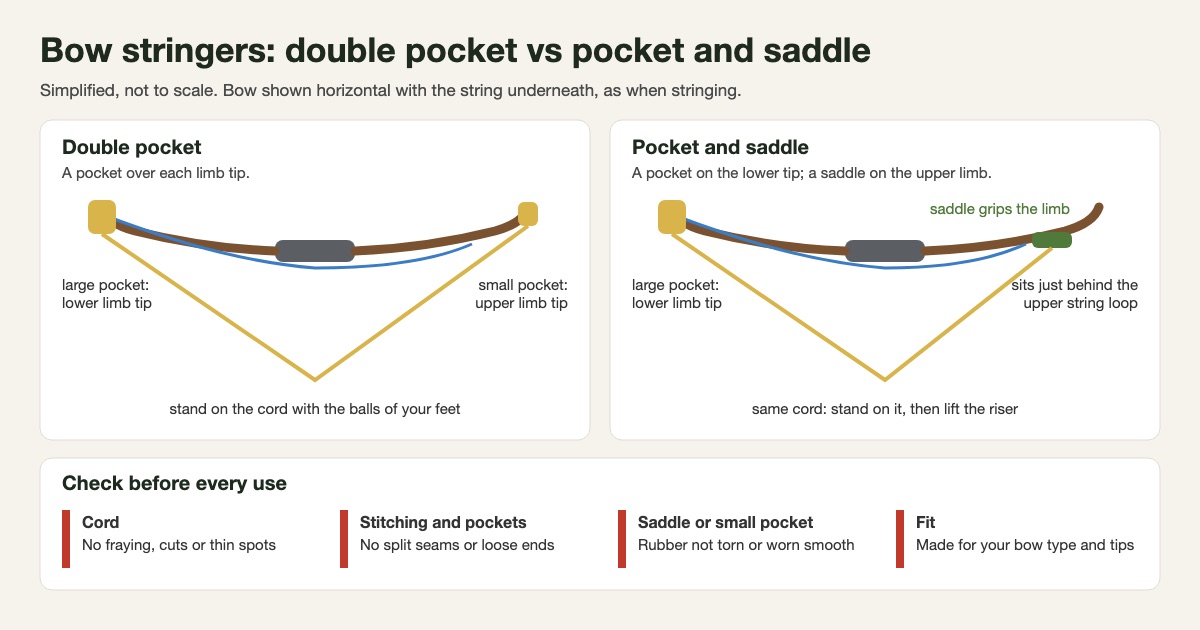
A recurve bow stringer is a cord with a pocket at one end and a pocket or saddle at the other. You stand on the cord and lift the riser, and the limbs bend evenly so the string loop can slide into its groove. Bow makers treat it as the standard tool: Hoyt's recurve warnings say "always use a bowstringer when stringing or unstringing a recurve bow."
Why makers insist on a stringer
A stringer bends both limbs evenly, in the direction they were built to bend, while your face stays away from the tips. The Wyke Archers club guide explains the risk of other methods: "injury from the recoil of the limbs if control is lost," or "twisted or splitting the limbs due to misaligned pressures."
You may hear of the step-through method instead. We won't describe it, because makers warn against it. Bear's traditional bow manual says Bear "does not recommend the 'push-pull' or 'step-through' methods, as these could result in injury to the archer or damage to the bow." The same manual excludes "damage caused by mishandling, abuse, improper stringing" from its warranty. 3Rivers Archery is blunter: step-through "is totally unsafe for you and the bow, and should NOT be done, even in a pinch."
Stringers are for recurves and longbows only. A compound needs a bow press for string and cable changes, and Hoyt says only Hoyt-approved presses should be used on its compounds.
Double pocket vs pocket and saddle
The Wyke Archers guide describes "two basic designs, double pocket or saddle type." Both share a strong cord and a large pocket that "fits over the bottom limb tip."
| Design | Upper end | How it holds the upper limb | Typical use |
|---|---|---|---|
| Double pocket | A small pocket | Over the upper limb tip | Recurves whose tips fit the pocket |
| Pocket and saddle | A rubber or leather saddle | On the limb, just behind the string loop | Longbows and recurves; less dependent on tip shape |
Archery 360 describes the same split: an enclosed pouch for the bottom limb tip and an open, flat saddle for the top limb. 3Rivers recommends pad-type stringers such as the Selway Limbsaver models, with "a moveable rubber pressure pad on the top limb and a non-moving cup or pocket on the lower limb," and says they are "designed for both longbows and recurves."

Sizing and fit
Match the stringer to your bow type and tips. Some makers sell separate versions: Bear's range includes the A100RS recurve stringer and the A100LBS longbow stringer. With a double-pocket design, the small pocket has to fit your upper tip snugly. With a saddle, it has to sit behind the upper string loop without slipping.
The cord also needs to be long enough to stand on comfortably. The Wyke guide says to stand on it with "the ball of one or preferably both feet," never the arch, "as this will allow the cord to slip," and recommends that children use both feet. Takedown ILF longbows use a stringer too, so check the fit.
Our recurve stringing guide shows the full sequence.
Inspect the stringer every time
A stringer holds the full stringing load, so check it before each use:
- Cord: no fraying, cuts or thin spots.
- Stitching and pockets: no split seams, torn leather or loose ends.
- Saddle or small pocket: rubber not torn or worn smooth.
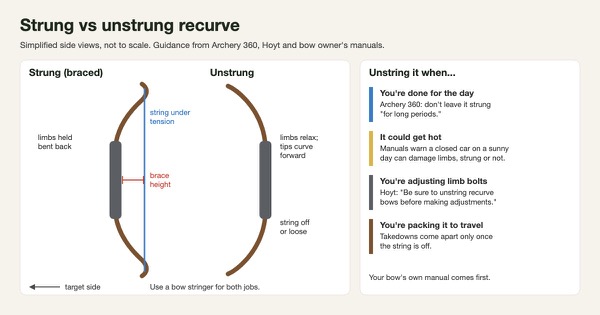
After stringing, Archery 360 says to check that "the string is secured in both string grooves" and to measure brace height. Our guide to leaving a recurve strung explains when to take the string off again.
You can browse recurve bow stringers on Amazon. Examples to consider include the Bear Archery A100RS Recurve Stringer and, for longbows, the Bear Archery A100LBS Long Bow Stringer. Check which bows each one suits.
Frequently asked questions
Do I need a bow stringer for a recurve?
Yes. Hoyt says to "always use a bowstringer when stringing or unstringing a recurve bow," and Bear's traditional manual gives the same instruction. Bear warns that step-through and push-pull stringing risk injury and damage to the bow, and excludes damage from improper stringing from its warranty.
Can you use a recurve stringer on a longbow?
Often, yes, if it fits the tips. Pocket-and-saddle designs grip the limb rather than the tip, and 3Rivers says the Selway Limbsaver pad stringers are designed for both longbows and recurves. Some makers sell a separate longbow version, so check the listing.
How do I know if my stringer is worn out?
Look for a frayed or cut cord, split stitching, torn pockets or a saddle worn smooth. Any of these can let the stringer slip or fail while the limbs are bent, so replace it rather than risk a limb snapping back.
Related articles
 Training
How to String and Unstring a Recurve Bow Safely
How to string and unstring a recurve bow with a stringer, why step-through stringing twists limbs, post-stringing checks, brace height and string care.
Updated February 1, 2025 · 8 min read
 Training
Changing a Bowstring: When You Need a Press
Changing a bow string without a press works on recurves and longbows with a stringer. Most compounds need a maker-approved press. Here's how to tell.
June 23, 2025 · 5 min read
 Guides
Can You Leave a Recurve Bow Strung?
Can you leave a recurve bow strung? For a session, yes. What makers and coaches say about storage, heat, travel and limb adjustments, and when to unstring.
Updated October 6, 2026 · 4 min read