
Paper Tuning for Left-Handed Archers
Paper tuning for a left-handed archer: a mirrored tear chart, why left and right tears flip, the same vertical-first order, and mistakes to avoid.

By Archery Insider Editorial Team
· · 5 min read

In this article
Paper tuning for a left-handed archer works exactly as it does for a right-hander, except that the left and right fixes are mirrored. Vertical tears get the same fix on either bow. For horizontal tears on a left-handed bow, a nock-right tear means move the rest toward the riser, and a nock-left tear means move it away.
Why the chart flips for left-handers
Most tear charts are written for right-handed bows. Gold Tip's chart on 3Rivers, for example, says a left tear means "move rest/center shot towards riser (right-handed bow)" and a right tear means move it "away from riser."
A left-handed bow is a mirror image. The arrow sits on the other side of the riser, so as you look downrange the riser is on your left rather than your right. Left and right swap; up and down don't. Easton's tuning guide makes the same point about finger shooters: "Left-handed finger release archers will have the opposite pattern."
Our right-handed paper tuning guide says it in one line: for a left-handed bow, swap left and right. The table below does that swap. Lancaster Archery's guide gives the same left-handed directions, but this chart is derived by mirroring, so check every change on fresh paper.
The mirrored tear chart
Read each tear from the shooter's side of the paper.
| Tear (as you see it) | Right-handed bow (our chart) | Left-handed bow (mirrored) |
|---|---|---|
| Bullet hole | No change | No change |
| Nock high | Lower the nocking point or raise the rest | Same |
| Nock low | Raise the nocking point or lower the rest | Same |
| Nock left | Move the rest toward the riser (to your right) | Move the rest away from the riser (to your right) |
| Nock right | Move the rest away from the riser (to your left) | Move the rest toward the riser (to your left) |
Look at the bracketed directions: they match. That's why the one rule holds for both hands, and only the riser wording flips.
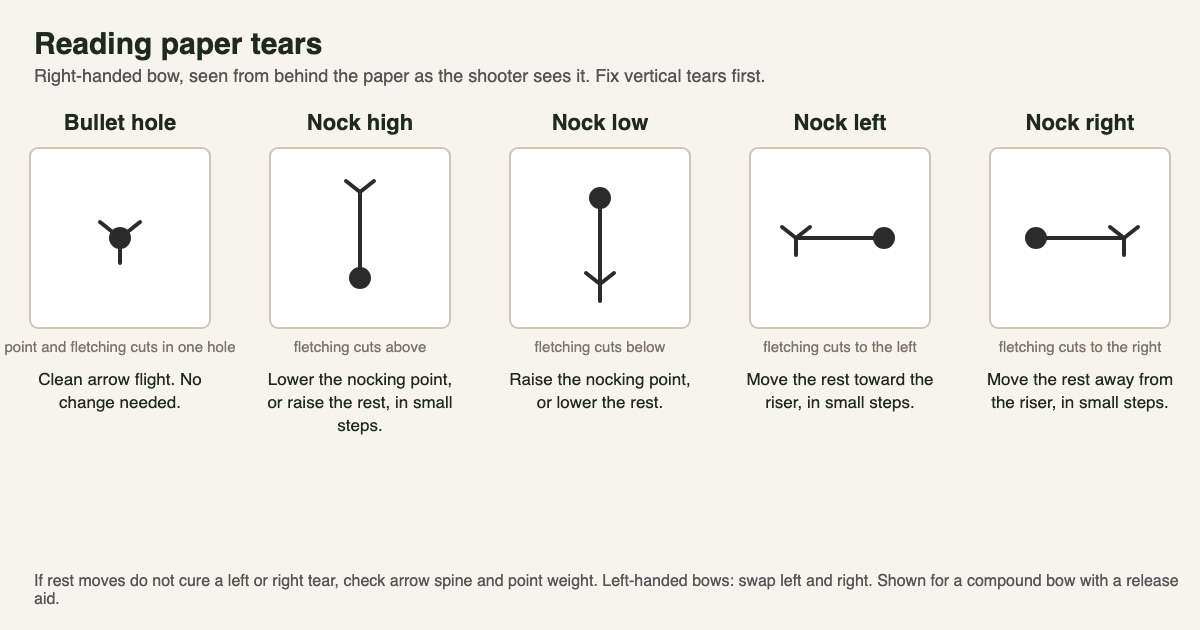
If rest moves don't close a horizontal tear, Lancaster points to spine. On a right-handed bow it links nock left to an arrow that may be too weak and nock right to one that may be too stiff. Mirrored, a left-hander's nock-right tear hints at weak spine and nock left at stiff.
Same fix logic, same order
- Set up. Gold Tip's method: "Shoot arrows through a suspended sheet of paper at a distance of 4 to 6 feet and observe the resulting tear."
- Fix vertical first. Gold Tip says to "make vertical adjustments prior to horizontal adjustments to avoid getting a false reading due to vane clearance issues."
- Then fix horizontal with the left-handed column, in small steps, shooting fresh paper after each change.
- Confirm farther back. Once you have a good tear, Easton suggests moving back another six feet, to make sure the arrow wasn't just recovering at the first distance.
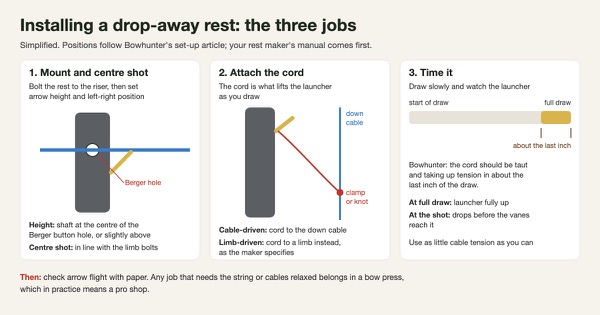
Left-handed finger shooters may get clearer answers from bare shafts (see the FAQ). Our drop-away rest guide covers centring a rest before you start.
Common confusion
- Reading a right-handed chart literally. "Toward the riser" on a left-handed bow is the opposite physical direction. If a tear grows after an adjustment, go back.
- Reading from the wrong side. Viewing the paper from the target side swaps left and right a second time.
- Expecting every bow to follow the chart. Easton notes that some rest and release combinations can produce tears "contrary to those indicated", although it's uncommon.
You can browse paper tuning frames on Amazon. A home-made frame with tight paper works too.
Frequently asked questions
Is there a left-handed paper tuning chart?
Most published charts are right-handed. To make a left-handed version, keep the vertical fixes and swap the riser wording for horizontal tears: nock right means move the rest toward the riser, nock left means away. The chart at the top of this page does exactly that, mirrored from our right-handed chart.
Do left-handed archers read paper tears differently?
No. Read the tear from the shooter's side: the hole is the point and the fletching cuts show where the tail went. Only the fix changes. Whichever hand you shoot, move the rest the opposite way to a left or right nock tear, and always fix vertical tears before horizontal ones.
Should a left-handed finger shooter paper tune?
You can, but tears are harder to read. Gold Tip recommends paper tuning for release-aid shooters and bare-shaft tuning for finger shooters. Easton also notes that left-handed finger archers show the opposite pattern to right-handed finger archers, so use a chart written for finger release.
Related articles
 Training
Paper Tuning a Bow: How to Read Tears and Fix Them
How to paper tune a bow: what it shows, frame setup, reading nock-high, low, left and right tears, the order of fixes, and when to see a pro shop.
October 8, 2026 · 10 min read
 Training
Nock Tuning: Rotating Nocks for Tighter Groups
How to nock tune arrows: number and shoot each shaft, rotate a flyer's nock one vane position, re-test, and avoid the vane clearance trap.
Updated October 8, 2026 · 5 min read
 Training
How to Install and Time a Drop-Away Rest
How to install a drop-away arrow rest on a compound bow: mounting, centre shot, cable or limb cord, timing and paper checks, plus when to use a pro shop.
Updated October 8, 2026 · 5 min read