
How to Install and Time a Drop-Away Rest
How to install a drop-away arrow rest on a compound bow: mounting, centre shot, cable or limb cord, timing and paper checks, plus when to use a pro shop.
By Archery Insider Editorial Team
· · 5 min read
In this article
To install an arrow rest on a compound bow with a drop-away design, you bolt it to the riser, set the arrow's height and centre shot, attach its cord to the down cable or a limb, then time it so the launcher is fully up at full draw and drops as the arrow leaves. The details are brand-specific, and many archers let a pro shop do it.
Before you start
A drop-away rest holds the arrow while you draw and aim, then falls clear at the shot. Archery 360 explains that the rest "falls away from the shaft and vanes or fletching before the arrow clears the riser," and that drop-aways "are more complex to tune than other options." If you'd rather keep things simple, a full-containment rest is the low-fuss alternative, and our Whisker Biscuit review explains how that style works.
Read your rest's manual first. The steps below follow Bowhunter's general set-up article.
Step 1: Mount the rest and set centre shot
Bolt the rest to the riser's mount with the supplied screws, leaving the adjustment screws loose enough to move the launcher.
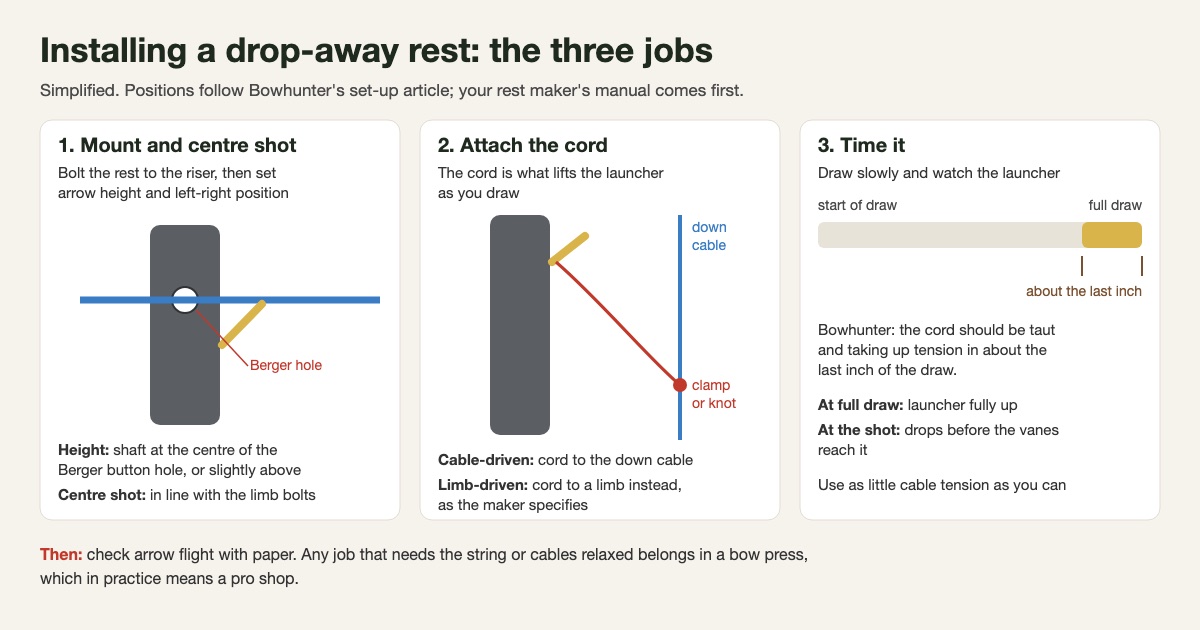
Arrow height. Bowhunter's set-up guide says to adjust the launcher height so the arrow shaft sits in the centre of the threaded Berger button hole, or slightly above it for extra vane clearance.
Centre shot. This is the left-right position of the arrow. Bowhunter says to line the arrow up with the centre of the bow's limb bolts, "or as indicated by the manufacturer."

Check that the vanes will pass the launcher and riser cleanly; our feathers vs vanes guide covers why fletching contact matters.
Step 2: Attach the cord (cable-driven vs limb-driven)
Archery 360 explains that "manufacturers make two types of drop-away rests: limb-driven and cable-driven."
| Type | Where the cord attaches | What to watch |
|---|---|---|
| Cable-driven | The bow's down cable, with a clamp or a knot | Use as little tension on the cable as possible |
| Limb-driven | The top or bottom limb, as the maker specifies | Cord length sets how the launcher sits at rest |
For a cable-driven rest, Bowhunter describes fixing the cord to the down cable with the supplied clamp or a knot, leaving some slack at first, then serving above and below the knot once the timing is right. It warns to keep cord tension on the cable as low as possible.
For a limb-driven rest, Bowhunter says to attach the cord to the limb the maker specifies and tighten it until the launcher lightly touches the riser's shelf at rest, then secure it.
If your instructions call for threading the cord through the cable's strands, the cable must be relaxed first: bow-press work.
Step 3: Time the rest and check it
Draw slowly with an arrow on the rest and watch the launcher. Bowhunter says the cord should be taut and taking up tension in about the last inch of the draw. At full draw the launcher should be fully up and holding the arrow. At the shot, it should fall quickly so the vanes pass cleanly.
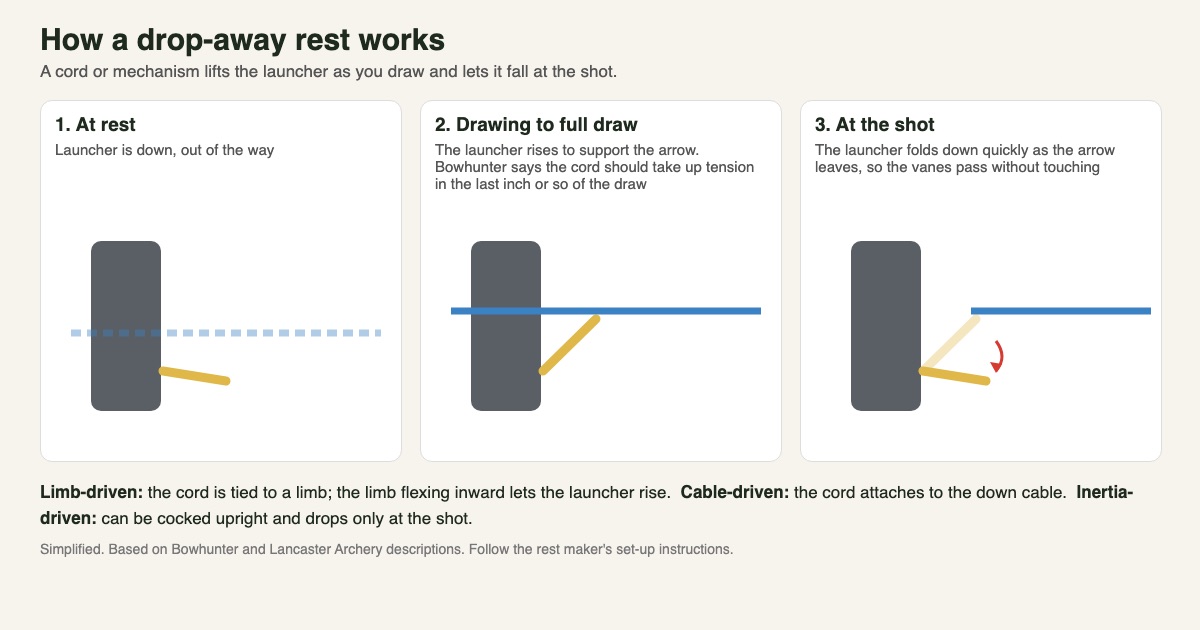
In general, a launcher that rises too early has a cord that's too tight, and one that rises late or not fully has too much slack. Adjust in small steps and re-check. When it's right, finish the cord as your manual describes.
Then shoot through paper. Bowhunter's final step is to "check for straight arrow flight by paper tuning." Our paper tuning guide explains how to read tears and what to move.
If you're shopping, you can browse drop-away arrow rests and a small Allen key set for the adjustment screws on Amazon.
Frequently asked questions
Can I install a drop-away rest without a bow press?
Often you can mount the rest and fit a clamp-style cord without one, if the maker's instructions allow it. Anything that involves relaxing the string or cables, such as threading the cord through the cable or re-serving, needs a press. If you're unsure, ask a pro shop.
How do I adjust an arrow rest that's out of tune?
Change one thing at a time. Height and centre shot are set with the rest's adjustment screws; timing is set by cord length. After each change, shoot through paper again. Bowhunter's article and your rest's manual give the starting positions to return to.
Limb-driven or cable-driven: which is easier?
Neither is hard in principle. A limb-driven rest keeps its cord off the cables, while a cable-driven rest needs care to keep cable tension low. Follow your rest maker's instructions for either type, and ask a pro shop for help if the timing won't settle after a few small adjustments.
Related articles
 Training
Paper Tuning a Bow: How to Read Tears and Fix Them
How to paper tune a bow: what it shows, frame setup, reading nock-high, low, left and right tears, the order of fixes, and when to see a pro shop.
October 8, 2026 · 10 min read
 Reviews
Trophy Ridge Whisker Biscuit Review: The Full-Containment Rest
Trophy Ridge Whisker Biscuit review: how a full-containment bristle rest works, sizes and versions, set-up, vane wear trade-offs, and who it suits.
Updated September 3, 2025 · 6 min read
 Gear
GearBow Stands and Kickstands: Keeping a Bow Off the Ground
Compound bow kickstand or recurve bow stand? What each type does, how they attach, why fit and weight matter, and the range etiquette for resting a bow.
Updated October 6, 2026 · 5 min read