
How to Hang a Tree Stand Safely, Step by Step
How to hang a tree stand safely: harness, lineman's belt and lifeline first, then sticks, stand and straps, plus how to cover a tree stand and take it down.

By Archery Insider Editorial Team
· 9 min read
In this article
How to hang a tree stand safely comes down to one rule: stay connected to the tree from the moment your feet leave the ground. Put on a full-body harness, climb on a lineman's belt while you set your sticks, fix a lifeline above the stand, and only then hoist and strap the stand itself.
Here's that sequence for a hang-on stand and climbing sticks, drawn from the Treestand Manufacturers Association (TMA) guidelines, Millennium's manuals and American Hunter. Your own stand's manual comes first.
Our tree stand safety guide covers harness fit, climbing and what to do if you fall; this article is the hanging job itself.
Tools and materials
Here's what the manuals and guidelines call for, and why.
| Item | Why you need it | Where the rule comes from |
|---|---|---|
| Full-body fall arrest harness | Stops a fall; must meet TMA-recognised standards | TMA guidelines |
| Lineman's (climbing) belt | Holds you to the trunk while your hands work | Millennium M50 and M-250 manuals |
| Lifeline with prusik knot | Keeps you connected from ground to stand and back | Millennium M50 manual, American Hunter |
| Climbing sticks or ladder sections | A TMA-compliant way up, installed before the stand | Millennium M50 manual |
| Pull-up (haul) rope | Raises sticks, stand and bow so your hands stay free | TMA guidelines, Millennium manuals |
| Second ratchet strap | Locks the platform to the trunk | Millennium M50 manual, American Hunter |
| Small hand saw or pruner | Clears branches so the stand sits flush | American Hunter |
| Phone, whistle and light on your body | So you can call for help while hanging | TMA guidelines, Pennsylvania Game Commission |
| A partner | Millennium requires "two (2) adults" to install its climbing sticks | Millennium M-250 manual |
Choose the right tree
The TMA says to "select a live, healthy and straight tree that is within the size limits recommended by the manufacturer" and to "never select a leaning tree." The Pennsylvania Game Commission's 2026 season release adds: choose "trees that are alive and will support their weight."
Size limits are model-specific, so check yours. Two examples from Millennium's manuals:
- M50 hang-on: a straight, healthy tree at least 9 inches (23 cm) and no more than 22 inches (56 cm) across at installation height. The ratchet strap needs at least two wraps on its spool; if you can't get them, the tree is too big.
- M-250 climbing sticks: a tree of 12 to 20 inches (30 to 51 cm) at seat height, "devoid of branches, vines or other obstructions."
American Hunter's Jeff Johnston looks for a trunk that "extends straight up or leans slightly back from the ground", which helps the platform sit level.
How to hang a tree stand, step by step
This sequence follows the Millennium M50 manual, the TMA guidelines and American Hunter's method. If your manual says something different, your manual wins.
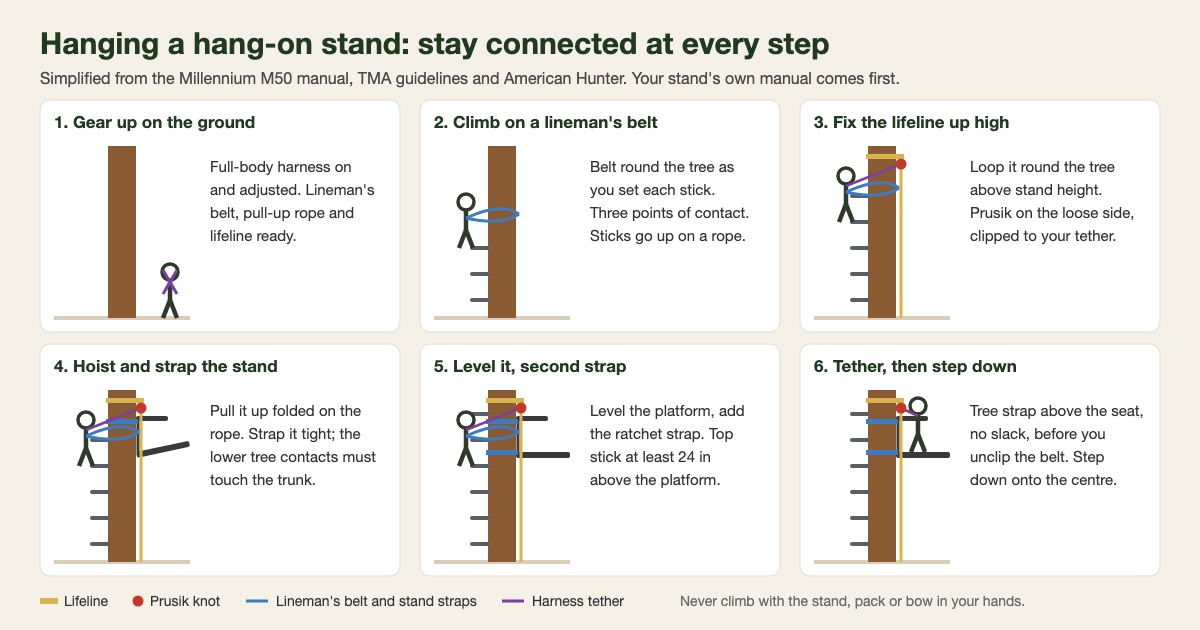
- Practise on the ground. Millennium says you "must practice installing, setting-up and using this product(s) at ground-level" first. The TMA adds: learn what it feels like to hang in your harness at ground level.
- Gear up at the base. Adjust the harness over your hunting clothes, attach the lineman's belt as its instructions describe, and tie the pull-up rope to your belt, not your hands.
- Set the first stick. Strap the lowest climbing stick at a comfortable height; Millennium's M-250 manual says "typically around 15-inches." Pull the strap "as tight as possible" and press down to seat it, because "a small amount of slippage is normal" before it bites.
- Climb on the lineman's belt. With the belt round the trunk, set each stick in turn; your partner hands them up until you're too high, then use the rope. Keep three points of contact, which the TMA defines as "two hands and one foot (or one hand and two feet)", and move "no more than ten to twelve inches at a time."
- Fix the lifeline above stand height. Loop it round the trunk, pass the knot end through the loop, and let the rope fall to the ground with the prusik on the loose side. Clip the prusik's carabiner to your harness tether and lock it. American Hunter calls getting the prusik through the loop "very important!"
- Hoist the stand. Climb down and tie the stand to the haul rope (American Hunter uses the lifeline's tail), folded so it can't open on the way up. Climb back up sliding the prusik ahead of you, then pull the stand up. Never carry it.
- Strap it to the trunk. Fit the receiver or main strap with the stand facing the right way, remove the slack, then ratchet it tight. On the M50 you then seat the stand in the receiver and fit the R-clip; Millennium warns that skipping it "will lead to treestand failure."
- Lower and level the platform. As the platform drops, the lower tree contacts "MUST be in firm contact" with the trunk, says Millennium; if they aren't, take the stand off and start again. Then adjust the platform until it's level.
- Add the second strap. Wrap the ratchet strap round the platform and trunk, keep it level and untwisted, and tighten it "until it firmly secures the standing platform" without overtightening.
- Check the stick height. Millennium says the climbing system must reach at least 24 inches (61 cm) above the standing platform, so you step down onto the stand with "a firm and secure hand-hold."
- Clear lanes and climb down. Trim branches that stop the stand sitting flush, then descend sliding the prusik down and keeping it "above your head at all times." Tie the lifeline tight to the trunk at the bottom so the prusik slides easily.
Getting into and out of the stand
Hunter Safety System says "86% of treestand accidents occur while ascending or descending the tree or getting into or out of the stand," and Millennium's M50 manual makes the same point. Slow down for the transfer.
- Connect before you move. Millennium says to attach the harness tree belt "at a location above the seat" while still on the lineman's belt, so both are attached "at the same time." Only then unclip the belt.
- Step down onto the centre of the platform. If you feel any looseness, step back onto the sticks and reinstall the stand.
- Keep the tether short. The TMA says it "should have no slack when sitting," so you can climb back on if you slip.
- Keep the prusik high. Millennium says to slide it "as high as possible" once you're in the stand to limit any fall.
- Raise your bow last. The TMA wants your bow up on a haul line "once you have reached your desired hunting height." A bow hanger keeps it within reach without leaning.
How to cover a tree stand
Concealment is mostly about the tree you pick and what you trim. This is practical advice, not a rule from our sources.
- Choose cover behind you. A trunk wide enough to break your outline, with branches at or above head height, hides movement better than a bare pole.
- Trim little and early. American Hunter trims only what stops the stand sitting "flush against the tree", then notes shooting lanes to clear from the ground. Big clearings draw a deer's eye to the stand.
- Check public-land rules before cutting branches, using screw-in steps or leaving a stand overnight. Rules vary, and some land managers restrict all three.
Once the stand is up, range your landmarks from it. Our guide to yardage markers shows how. If a tree stand won't work on your ground, compare it with a ground blind.
Taking it down, and the two-week rule
The TMA says to "never leave a treestand installed for more than two weeks since damage could result from changing weather conditions." Plan your hangs around specific hunts.
To remove the stand, reverse the sequence with your lineman's belt on: fold the stand, tie it to the rope, lift it out and lower it gently. For sticks, Millennium says to climb to one section below the one you're removing, and "NEVER STAND ON THE CLIMBING SYSTEM SECTION YOU INTEND ON REMOVING."
| Item | When to replace it | Source |
|---|---|---|
| Harness | After any fall; Hunter Safety System recommends every 3 to 5 years | TMA, Hunter Safety System |
| Lifeline | After a fall, signs of wear, or more than two weeks in bad weather | Millennium Safe Link instructions |
| Stand or sticks | Damaged parts the maker can't repair, or past the expiry date | TMA guidelines |
If you need the safety kit, you can browse full-body hunting harnesses or tree stand lifelines on Amazon. Check that any harness meets TMA-recognised standards, and follow its instructions exactly.
Frequently asked questions
How do you hang a tree stand by yourself?
American Hunter describes a solo method: climb on a short safety rope looped round the trunk, fix a lifeline above stand height, then hoist the stand on the lifeline's tail. Millennium's climbing-stick manual requires two adults, so read your gear's manual. Going alone, tell someone your exact location and when you'll return.
How high should a tree stand be?
No source we read sets a height, and the TMA advises: "If you start thinking about how high you are, don't go any higher." Lifelines have limits too: Hunter Safety System's reflective Lifeline fits stands up to 30 feet. Higher stands also make shot angles steeper, so most bowhunters choose a moderate height.
How do you tree stand safely once you're up?
Wear your full-body harness with the tether attached above you and no slack when seated. Keep your phone, whistle and light on your body, not in your pack. The TMA also says to let others know "your exact hunting location, when you plan to return and who is with you."
How long can you leave a tree stand up?
The TMA guidelines say never leave one installed for more than two weeks, because weather can cause damage you can't see. Millennium also says to replace a lifeline that has been exposed to inclement weather for more than two weeks. Check any stand thoroughly before each use.
Related articles
 Guides
Tree Stand Safety for Bowhunters
Tree stand safety for bowhunters: wear a full-body harness from the ground up, use a lifeline and haul line, inspect your stand and plan for a fall.
October 12, 2026 · 10 min read
 Comparisons
Tree Stand vs Ground Blind for Bowhunting
Tree stand vs ground blind for bowhunting deer: view, hiding your draw, scent, shot angle, safety and setup compared, with when to choose each.
Updated October 6, 2026 · 5 min read
 Gear
Bow Hangers for Tree Stands and Ground Blinds
Deer hunting bow hangers explained: screw-in vs strap-on for tree stands, public-land rules on tree damage, ground blind hangers and haul line safety.
September 5, 2026 · 5 min read