
Yardage Markers for Bowhunting Stands and Blinds
Bow hunting yardage markers: range landmarks around your stand, when flagging or stakes make sense, public-land rules and how shot angle changes the number.
By Archery Insider Editorial Team
· · 4 min read
In this article
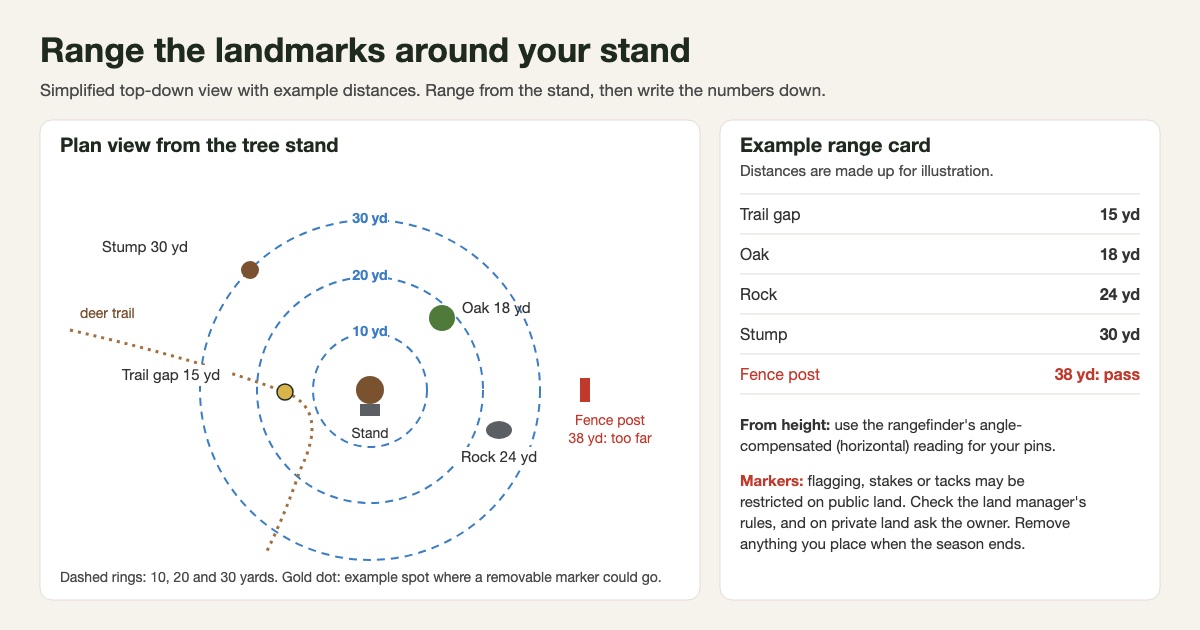
Archery yardage markers are known distances around your stand or blind: landmarks you've ranged, or small markers you've placed, so you know whether a deer is at 15 yards or 30 before you draw. The simplest version costs nothing: range a few trees, rocks and trail gaps when you settle in. Placed markers such as flagging can help too, but only where the landowner or land manager allows them.
Range your landmarks when you arrive
Once you're settled and safely clipped in, range four to six objects where a deer is likely to appear: the trail, a gap in the brush, a tree at the edge of your shooting lane, and one object at or just beyond your maximum distance.
The official bowhunter education course says "the average hunter has a maximum effective range of 30 yards," and that most bowhunters shoot game "from a much closer range." Our guide to how far you can shoot a deer with a bow explains how to find your own number.
Pick landmarks you can see in poor light, such as a pale stump. No rangefinder yet? Our article on using a golf rangefinder for bowhunting covers what works and what doesn't.
Markers and stakes: what to use and the rules
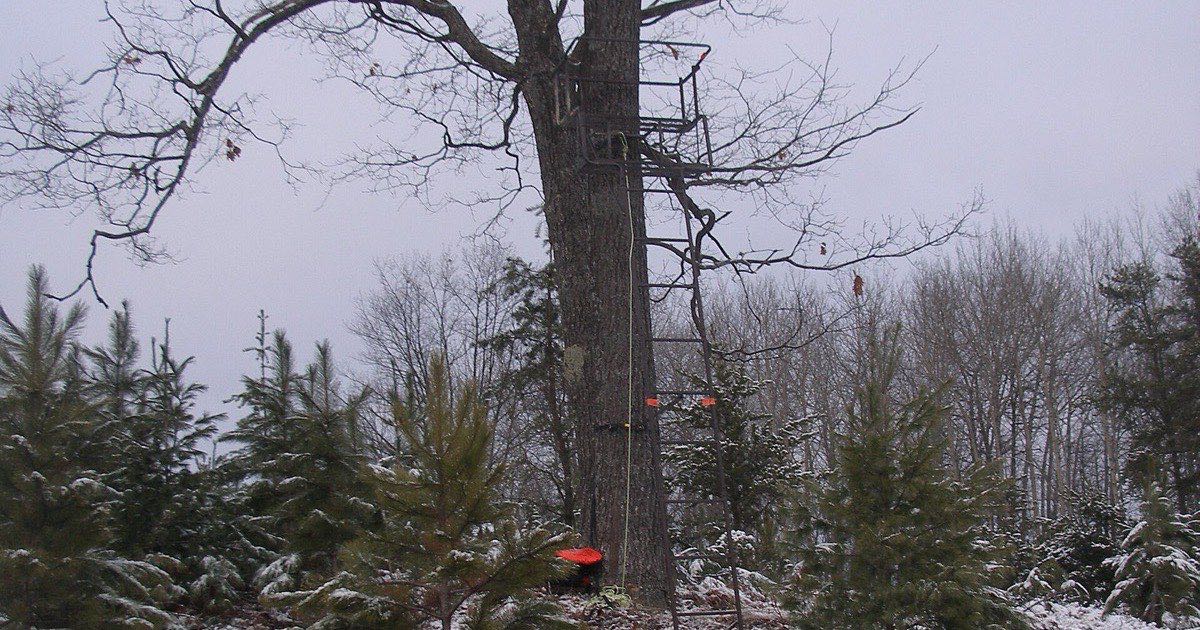
Placed markers fill gaps where there's nothing natural to range, such as an open field edge. Whatever you use has to be legal where you hunt, easy to remove and harmless to trees.
| Option | Good for | Watch out for |
|---|---|---|
| Ranged natural landmarks | Any land, any season | Hard to see in low light; pick distinctive ones |
| Flagging tape on a branch | Open edges with few landmarks | Can be restricted on public land; remove after the season |
| Tacks or anything fixed to a tree | Rarely worth it | May damage trees and may be prohibited; check first |
| A written range card | Every setup | None; keep it where you can glance at it |
Public land is where you need to be most careful. Pennsylvania's State Game Lands regulations, for example, make it unlawful, without written permission, to "construct, place, maintain, occupy, use, leave or abandon any structures or other tangible property," with an exception for portable stands and blinds whose use "may not cause damage to trees." That rule doesn't name flagging, so ask before leaving markers there. Every wildlife area, national forest and refuge sets its own rules: check the land manager's rules before you place anything, and on private land, ask the owner.
Build a mental map and time it right
The useful part is the map in your head. Many hunters picture rings: inside the first landmark is a close shot, and anything past the far marker is a pass. Some match marker colours to their own sight pins, so a gold flag sits at the gold pin's distance.
Timing matters too. Placing markers means walking where deer travel, so a common approach is to do it well before the season or during a midday setup, not on the morning you hunt.
The angle effect from a tree stand
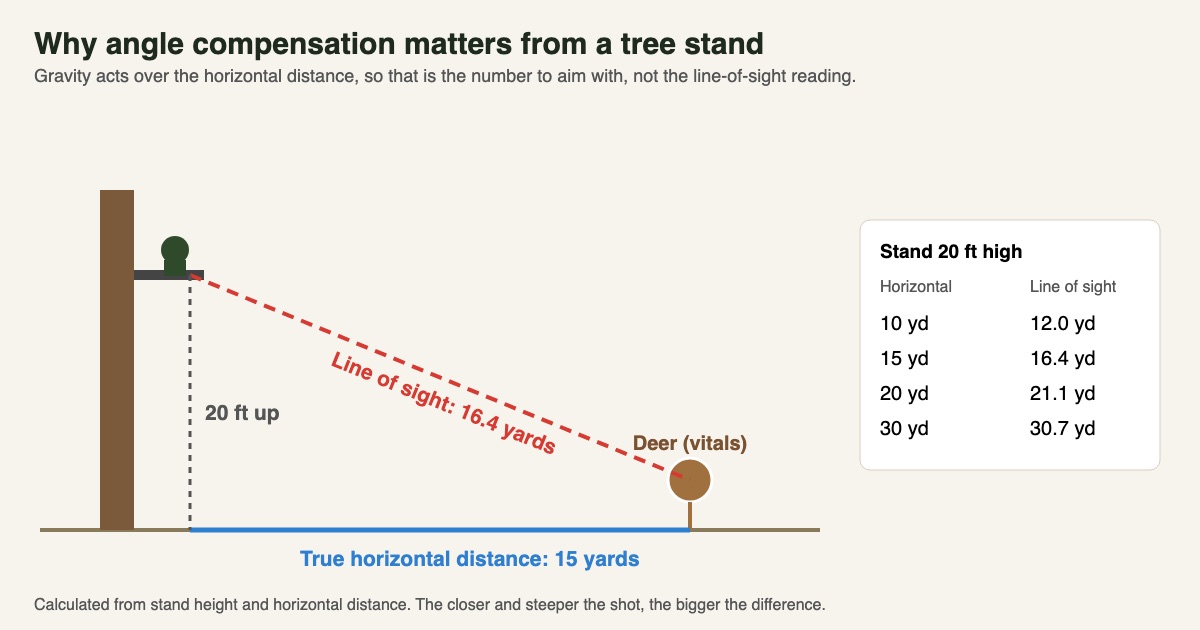
From height, your line of sight to a deer is longer than the ground distance. Gravity acts over the horizontal distance, so that's the number to aim for. As a simple calculation, from a stand 20 feet up, a deer 15 yards away along the ground is about 16.4 yards away in a straight line. Use your rangefinder's angle-compensated mode if it has one, or range from the base of the tree.
Missouri's conservation department advises practising "from an elevated platform or a seated position to simulate the type of hunting you will be doing." If you hunt from a blind instead, our tree stand vs ground blind comparison explains how the shot changes.
If markers are allowed where you hunt, you can browse survey flagging tape or wire marker flags on Amazon. Treat any listing as an example to consider, and choose colours you can see at dawn.
Frequently asked questions
Do I need yardage markers if I have a rangefinder?
Not strictly. A rangefinder lets you range landmarks as you settle in, giving known distances without placing anything. Markers help where there are no natural landmarks, or if you'd rather not lift a rangefinder with a deer close. Many hunters range landmarks on arrival and keep a written card.
Can I leave flagging tape on public land?
It depends on the land manager. Some public lands restrict leaving property or anything that damages trees, and rules differ between wildlife areas, national forests and refuges. Check the land manager's rules before placing anything, and remove whatever you put out.
Related articles
 Guides
How Far Can You Shoot a Deer With a Bow?
Effective bow range for deer: what bowhunter education says, why long shots wound more, arrow flight times, jumping the string, and how to find your limit.
October 7, 2026 · 9 min read
 Gear
GearCan You Use a Golf Rangefinder for Bowhunting?
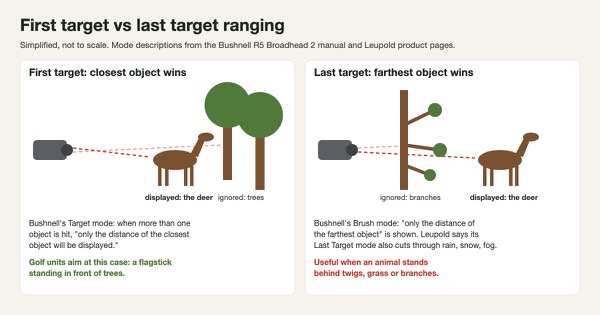
Can you use a golf range finder for bow hunting? Yes on level ground. How golf and hunting modes differ: target priority, slope vs true horizontal distance.
Updated October 7, 2026 · 5 min read
 Guides
First-Season Bowhunting Mistakes to Avoid
Deer hunting bow tips for your first season: the beginner mistakes to avoid, from skipping the tree-stand harness to untested broadheads and long shots.
Updated October 7, 2026 · 5 min read