
Iron Will Broadheads Review
Iron Will broadheads explained: S, V, Wide, SLR, Single Bevel, crossbow, turkey and small-game heads, A2 steel specs, which suits which game, and legality.

By Archery Insider Editorial Team
· 11 min read
Research-based: built from maker specs and official sources, fact-checked before publishing. How we review products
In this article
Iron Will broadheads are two-blade fixed heads with an optional cross-cutting "bleeder", made with .062 inch A2 tool steel blades hardened to 60 HRC. The range splits into standard-width S, V and Single Bevel heads, the bigger-cutting Wide Series, the long-range SLR, plus crossbow, turkey and small-game versions, in weights from 85 to 250 grains.
If you're searching "broadheads Iron Will", you'll find a premium-priced brand whose own story starts with a lost bull elk. This review explains what each series actually is, what single vs double bevel means for you, which head Iron Will itself suggests for which game, and what to check before you buy.
Who makes Iron Will broadheads?
Iron Will Outfitters was co-founded by Bill Vanderheyden, a mechanical engineer, and Eric Whiting. Its "Our Story" page says Bill moved to Colorado in 1999, lost a bull elk in 2004 after a broadhead "penetrated only a few inches", and spent seven years designing his own head, with friends and family taking "over 50 animals" during field testing. Its broadhead pages cite US Patent 10,054,409.
The company also sells field points, inserts, impact collars, arrows and knives, but this review sticks to the broadheads.
The Iron Will broadhead line-up
These are the series on Iron Will's broadheads page in October 2026, with specs from each product page.
| Series | Type | Main blade | Bleeder | Weights listed | Notes from Iron Will |
|---|---|---|---|---|---|
| S Series | Double bevel, solid blade | 1 1/16 in | 3/4 in (none on Buff) | 100 to 250 gr | "supremely quiet flight, long-range accuracy" |
| V Series | Double bevel, vented blade | 1 1/16 in | 3/4 in | 100 to 200 gr | Grade 5 titanium ferrule on lighter heads, 17-4 PH stainless on heavier |
| Single Bevel | Single bevel, right or left | 1 1/16 in | 3/4 in, optional, single bevel | 100 to 250 gr | "Choose right or left to match your fletching" |
| Wide Series | Double bevel, or Wide Single Bevel | 1 3/8 in | 3/4 in | 100 to 250 gr | 2 1/8 in total cut; 19° double, 32° single bevel edges |
| SLR | Double bevel | 1 1/32 in | 3/4 in | 85, 100, 125 gr | "reduce lift by 50% compared to standard broadheads" |
| X Series (crossbow) | XSLR, XV, XS, XWide, XSB | 1 1/16 in (1 3/8 in XWide) | 3/4 in | 100 to 150 gr in the variants listed | 11/32 in ferrule diameter to suit crossbow bolts |
| Turkey | S or Wide main blade | 1 1/16 or 1 3/8 in | Sharpened 9/10 in claw | 100, 125 gr | Second-generation design with a double-bevelled claw |
| Small Game | S or Wide main blade | 1 1/16 or 1 3/8 in | Blunt 9/10 in claw | 100, 125 gr | Iron Will's original turkey head design |
Every series shares the same core spec: ".062" Thick A2 Tool Steel Blades" that are "Cryogenically Treated and Triple Tempered to 60 HRC Hardness", on "Hardened Ferrules". Most weights also come in Deep Six (6-40 thread) versions, and some in Snyder Core sizes. Packs of three and six include a waterproof travel case.
Iron Will also sells seasonal limited editions. Its Elk 2026 and Whitetail 2026 sets, engraved Single Bevel or S Series heads, were both marked sold out when we checked.
Standard, Wide and SLR: what the width means
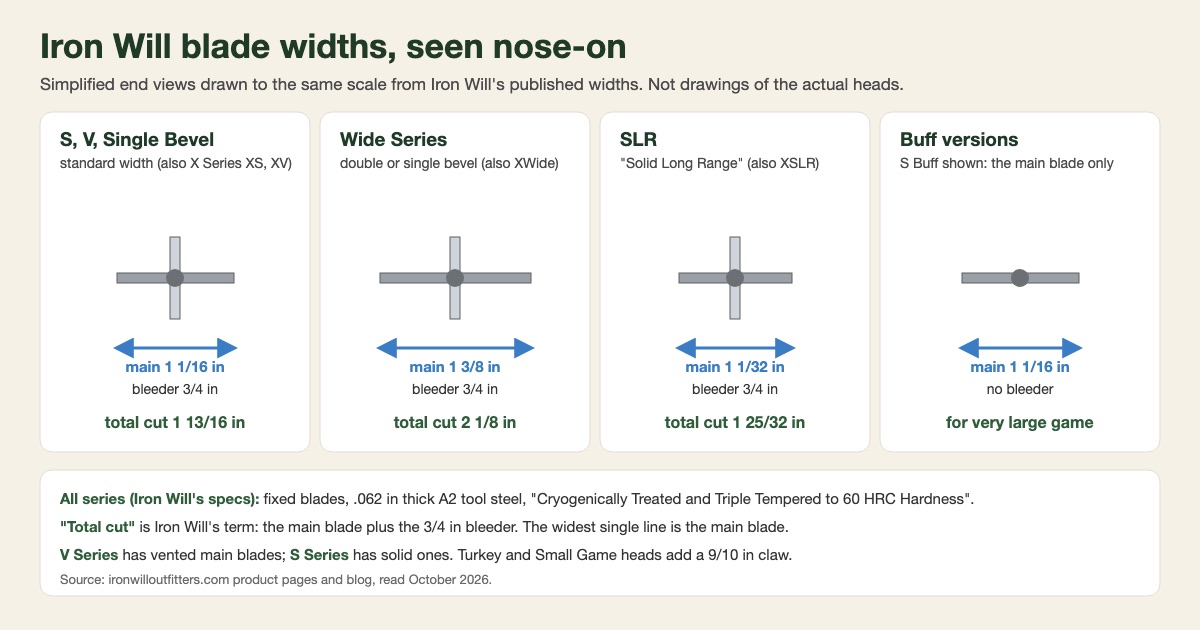
The main choice is width. Iron Will uses "total cut" to mean the main blade plus the 3/4 inch bleeder, so a standard head is 1 13/16 inches in total, a Wide is 2 1/8 inches, and the SLR is 1 25/32 inches.
Iron Will's own advice, from its blog post on choosing a broadhead: its standard heads "are a great all-around broadhead" and the writer's "first choice for caribou, mule deer, or elk", while Wide heads are "ideal to get the biggest hole, most blood on the ground, and quickest kill". Wide heads "spin true and fly well, but are not as forgiving as our standard heads. For this reason, we recommend them for shots under 50 yards." The post calls Wide the "head of choice for whitetails or bears from tree stand or blind ambushes where shots are typically less than 40 yards."
SLR stands for Solid Long Range. Iron Will says its profile will "reduce lift by 50% compared to standard broadheads, while also reducing overall drag", which makes it "exceptionally forgiving for high speed set ups, minor form inconsistencies, tuning imperfections, crosswind conditions" and hurried or gloved follow-up shots. The 50% figure is Iron Will's own claim; we haven't seen an independent test of it.
Iron Will also suggests a mixed quiver: "We often carry S Series or Single Bevel as our first head for an elk hunt, but carry a couple Wide Series also in the quiver for those close range setups."
S vs V: solid or vented
The S and V Series share the same widths and steel; the difference is the main blade. S blades are solid and V blades are vented (Iron Will's replacement blades are listed as "S125-S250 Solid" and "V100-V200 Vented").
Vents cut surface area, which can help flight. If broadheads won't group, Iron Will's FAQ suggests fitting a different main blade to the same ferrule, such as the vented Wide 125 blade in place of a solid one, because with "the reduction in the surface area, you should see slightly increased accuracy".
Single bevel vs double bevel, explained simply
A double-bevel blade is sharpened on both faces, so it cuts straight. A single-bevel blade is sharpened on one face only, with a flat back, so pressure on the bevel twists the head as it passes through. Iron Will says its Single Bevel heads "maintain the arrow's rotational spin through impact, resulting in a bone splitting effect and more tissue damage".
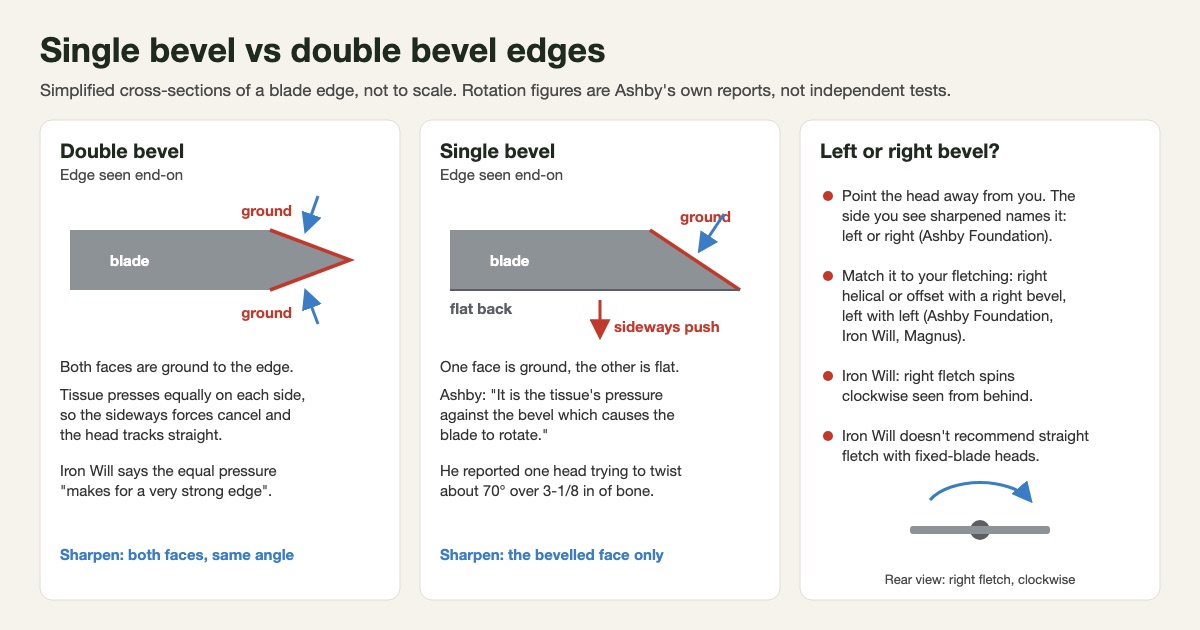
The catch is direction. Iron Will's FAQ: "Right Fletch rotates clockwise as viewed from the back and requires a Single Bevel RIGHT broadhead (SBRight). Left fletch rotates counterclockwise and requires a Single Bevel LEFT broadhead (SBLeft)." Mismatch them and the head fights the arrow's spin at impact.
Iron Will's fletching advice for its heads is "at least 2 degrees offset or helical with 2.5 to 3 degrees being ideal", with vanes "over 0.5 inches tall". It doesn't recommend straight fletching with fixed heads, but says straight-fletch shooters can use either bevel direction or a double-bevel S or Wide, since double bevels "do not rotate on impact". Our single-bevel broadheads guide goes further into what's measured and what's marketing.
Which Iron Will head for which game
Here's how Iron Will's own recommendations translate into a starting point.
| Hunt | Iron Will's suggestion | Why |
|---|---|---|
| Elk, mule deer, caribou, open country | S Series or Single Bevel; add an SLR for long follow-ups | Standard width is the "great all-around broadhead" with better long-range forgiveness |
| Whitetail or bear from a stand or blind | Wide Series | Biggest hole; Iron Will recommends it for shots under 50 yards |
| Very large game (Iron Will cites cape buffalo and hippo) | Buff versions, no bleeder | "the maximum possible penetration" |
| Crossbow | X Series (XS, XV, XWide, XSB, XSLR) | 11/32 in ferrule to suit crossbow bolts |
| Turkey | Turkey heads with the sharpened claw | Designed to stop the arrow "in or just beyond the bird" |
| Small game | Small Game heads with the blunt claw | Built to stop the arrow and transfer energy |
For bleeders, Iron Will is direct: "We highly recommend bleeder blades for all North American big game." For elk-specific advice on arrow weight and set-up, see our elk bowhunting setup guide.
Legality: fixed blades, width and barbs
Iron Will heads are fixed blades, so mechanical restrictions don't apply. The usual checks are cutting width and barbs.
Width. Washington's WAC 220-414-070 makes it unlawful to hunt big game "with fixed broadhead blades or open expandable blades with less than seven-eighths of an inch cutting diameter." Even the narrowest Iron Will main blade, the SLR's 1 1/32 inches, exceeds that on its own.
Barbs. Oregon's ODFW page says: "Broadheads must be non-barbed and at least 7/8" wide." If you're unsure whether a head meets your state's barb definition, ask the agency before the season. The turkey and small-game claws are separate parts aimed at smaller game, so check your state's rules for those species before using them.
Rules checked on 9 October 2026; this isn't legal advice and regulations change, so confirm with your state wildlife agency before you hunt. Our fixed-blade vs mechanical broadheads comparison covers the wider rule types.
Getting them to fly, and looking after them
Iron Will's FAQ on broadheads that won't hit with field points lists causes in order: fletching too small, straight fletch, an under-spined arrow, low FOC (the writer likes "the 12-16% range"), bow set-up, grip torque, poor tuning and a head that doesn't spin true. That's a sensible checklist for any fixed blade, and our field points vs broadheads guide walks through the tuning steps.
Care matters more than with stainless heads. Iron Will says A2 "contains less chromium than stainless steel" and "does require care"; blades ship coated in mineral oil, and you should re-oil them, especially in wet weather. Rust isn't covered by the warranty.
For sharpening, Iron Will suggests its double-sided stone for touch-ups and a fixed-angle system for heavier damage, starting "at 20-22° on a double bevel head and 32° on a single bevel head". Blades come off the ferrule with a T6 Torx driver, and replacement main blades, bleeders and screws are sold separately.
Iron Will broadheads
Advantages
- Thick .062 inch A2 tool steel blades at 60 HRC, per Iron Will
- Wide choice: S, V, Wide, SLR, single or double bevel, 85 to 250 grains
- Replaceable and resharpenable blades, with parts sold separately
- Crossbow, turkey and small-game versions
- Lifetime warranty on direct purchases, including animal damage
Trade-offs
- Premium pricing; Iron Will even has a blog post on why they cost so much
- A2 steel needs oiling, and rust isn't covered by the warranty
- Single Bevel heads must match your fletching direction
- Wide heads are less forgiving at long range, by Iron Will's own account
- Warranty only applies when you buy direct from Iron Will
Buying Iron Will broadheads
Iron Will sells through its own store, and that's where we'd buy. Its warranty page says the lifetime warranty is "valid for original owner and for broadheads purchased directly from Iron Will Outfitters only". It covers a component that "bends or breaks from being shot into or through an animal" (one claim per broadhead) and manufacturing defects, but not damage from targets, rust or normal wear.
We couldn't confirm an authorised Iron Will listing on Amazon or at Lancaster Archery in October 2026, so we haven't linked to one. If you see heads for sale elsewhere, remember they won't carry Iron Will's warranty.
Broadheads like Iron Will. If you're comparing, the specs that matter are the ones above: a fixed two-blade design with a bleeder, blade thickness, steel and hardness, replaceable blades, and whether single-bevel and heavy-weight options exist. Compare those numbers from each maker's own pages rather than relying on marketing words like "toughest".
Frequently asked questions
Are Iron Will broadheads still made?
Yes, as far as we can tell. When we checked on 9 October 2026, ironwilloutfitters.com was a working store listing the S, V, Wide, SLR, Single Bevel, crossbow, turkey and small-game heads, with 2026 limited editions and blog posts from September 2026. An earlier check found the address parked, so if the site looks odd, try again later.
Which is better, Iron Will S Series or Single Bevel?
Neither is better outright; they share the same widths and steel. The S Series is double bevel, cuts straight and works with any fletching. Single Bevel heads rotate as they cut, which Iron Will says splits bone and adds tissue damage, but they must match your fletching direction. Iron Will uses both as first-choice elk heads.
Do Iron Will broadheads come in 100 grain?
Yes. The S, V, Single Bevel and Wide Series all start at 100 grains, the SLR comes in 85, 100 and 125, and the crossbow X Series runs from 100 to 150 grains. Heavier S, Single Bevel and Wide heads go up to 250 grains, and most weights come with Deep Six threads too.
Can you sharpen Iron Will broadheads?
Yes. Iron Will recommends its double-sided stone for touch-ups, and a fixed-angle sharpener such as a KME, Gatco or Lansky for heavier damage, starting at 20 to 22 degrees on double-bevel heads and 32 degrees on single-bevel heads. Remove the blades with a T6 Torx driver first, and oil them afterwards.
Are Iron Will broadheads legal for deer and elk?
They're fixed-blade, two-edged heads with main blades of at least 1 1/32 inches, so they clear common 7/8 inch minimums such as Washington's and Oregon's. Check your state's barb definition and species rules, especially for the turkey and small-game heads, and confirm with your wildlife agency before you hunt.
Related articles
 Gear
Single-Bevel Broadheads Explained
Single bevel broadheads explained: what the one-sided edge does, what Ashby and makers claim about rotation, left vs right bevel, fletching and sharpening.
November 13, 2025 · 5 min read
 Comparisons
Fixed-Blade vs Mechanical Broadheads: Pros, Cons and Rules
Fixed-blade vs mechanical broadheads compared: flight, tuning, cutting diameter, energy needs, durability, hybrid designs, regulations and which suits your bow.
Updated October 9, 2026 · 6 min read
 Training
Field Points vs Broadheads: Why Impact Changes
Why broadheads hit differently from field points, and how to fix it: paper tuning, spin-testing, micro-tuning the rest at 30 yards, FOC and re-sighting.
October 14, 2026 · 9 min read