
Single-Bevel Broadheads Explained
Single bevel broadheads explained: what the one-sided edge does, what Ashby and makers claim about rotation, left vs right bevel, fletching and sharpening.
By Archery Insider Editorial Team
· 5 min read
In this article
A single-bevel broadhead has edges ground on one face only, with the other face left flat, instead of the usual double bevel ground on both sides. Makers and Dr Ed Ashby say this one-sided grind makes the head twist through tissue and split bone. Those claims come from Ashby's own reports and from companies selling the heads, so treat them as claims, not settled fact.
What single bevel means
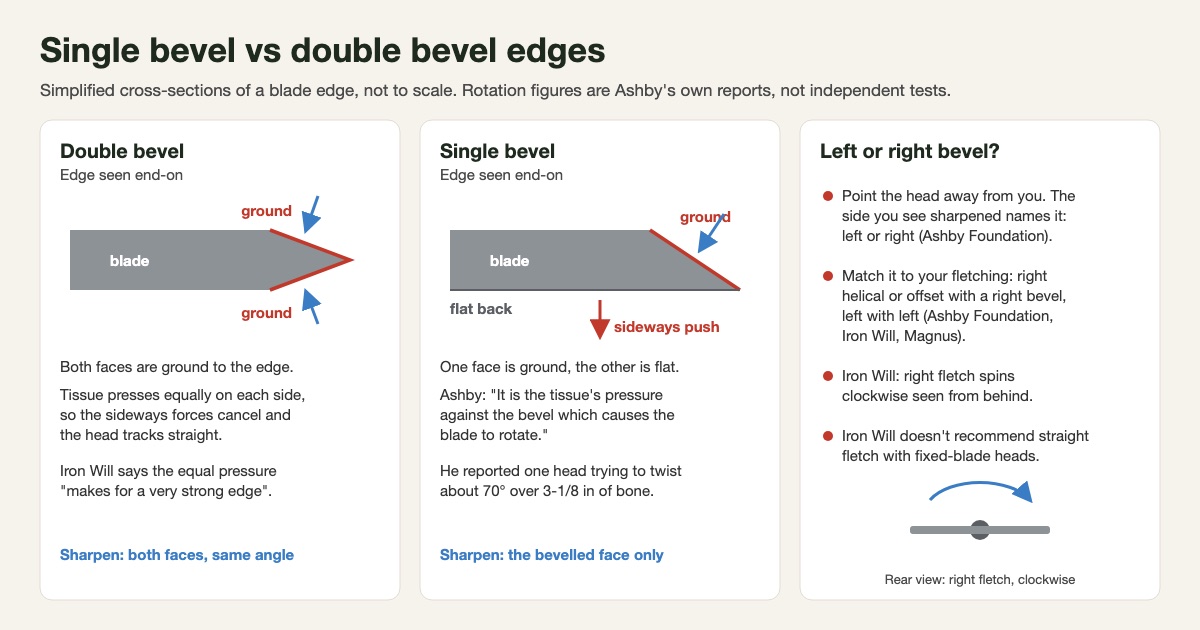
Look at a normal broadhead edge end-on and you see a V: both faces ground to meet in the middle. That is a double bevel. A single bevel is ground on one face only, so the edge looks like a chisel.
Single-bevel heads are fixed-blade designs, most often two-blade and cut-on-contact. Iron Will grinds a single bevel "on both their main blade and bleeder blade". On a two-blade head, each edge is bevelled on the opposite face, a bit like a propeller.
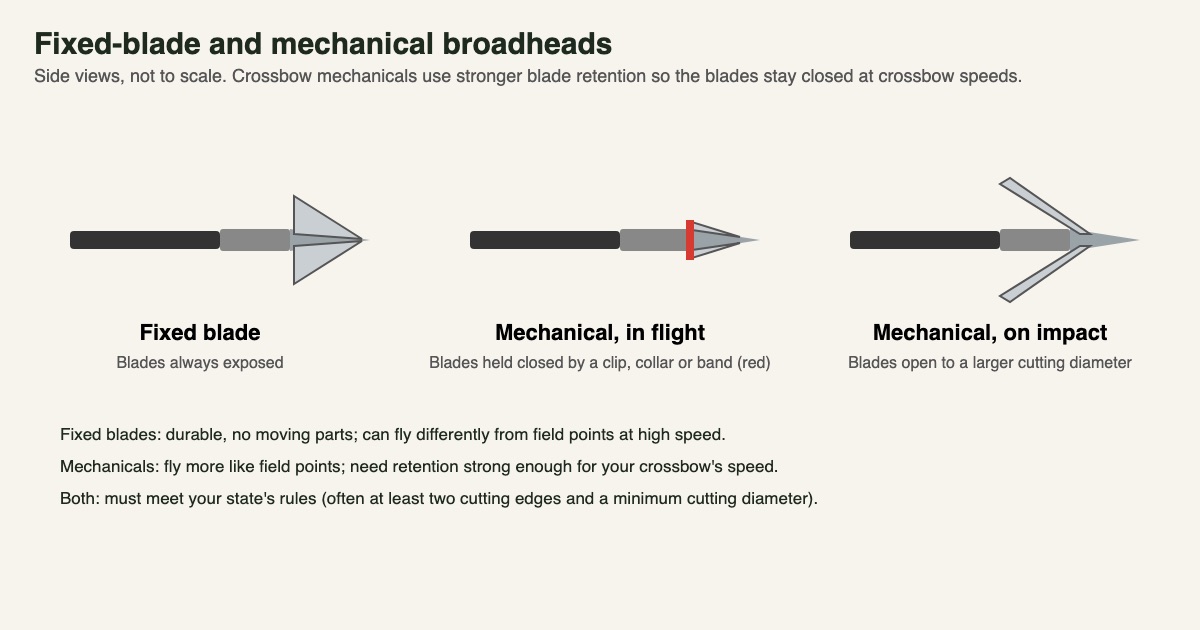
Still choosing between fixed and expanding heads? Our fixed-blade vs mechanical broadheads comparison covers that first.
The rotation claims: what's measured and what's marketing
The best-known case for single bevels comes from Ashby: "It is the tissue's pressure against the bevel which causes the blade to rotate, producing the blade's torque." He stresses this isn't the fletching: "The single-beveled broadhead's rotation is caused by the tissue(s) the blade is penetrating." In one test, he reported bone pressure trying to twist a head "about 70 degrees during its 3-1/8″ of travel through the bone."
Context matters. Ashby's reports are his own field studies, self-published rather than peer-reviewed, and widely republished by companies selling single-bevel heads. We aren't aware of independent studies repeating them at scale.
Makers go further. Magnus, via 3Rivers' listing, says the design "creates a rotational force that causes the broadhead to twist" and helps it "split bone instead of stopping against it". Iron Will says the rotation "opens up holes and causes more tissue damage." Neither page cites independent data.
Iron Will's comparison is modest: "Through our testing, we haven't found that single bevel or double bevel edges produce any noticeable differences in accuracy." It credits the double bevel with "a very strong edge" and concludes: "you can't go wrong with either choice."
Left vs right bevel and your fletching
The Ashby Bowhunting Foundation's FAQ explains how to tell: "With the broadhead pointing away from you, which side do you see sharpened? If left, it is a left bevel. If right, it is a right bevel."
The usual guidance is to match the bevel to your arrow's spin. This is maker and practitioner advice, not a measured rule:
| Your fletching | Spin seen from behind | Bevel the makers suggest |
|---|---|---|
| Right helical or right offset | Clockwise (Iron Will) | Right bevel |
| Left helical or left offset | Anticlockwise | Left bevel |
| Straight | "Minimal rotation" (Iron Will) | Either, or a double-bevel head instead |
The Ashby Foundation's reason: mismatched, fletching and bevel "will be working against each other." Iron Will doesn't recommend straight fletching with fixed heads at all. Our broadheads for traditional bows guide explains why many recurve hunters choose two-blade heads.
Sharpening a single bevel
A single bevel is honed on its bevelled face only. Keep the existing angle, then lightly remove the burr from the flat back without grinding a second bevel into it. Magnus says its main blades "can be resharpened".
Whatever the bevel, confirm your sharpened heads hit with your field points. To save blades in summer practice, our practice broadheads guide explains where matched practice heads help.
For examples to consider, you can browse single-bevel broadheads on Amazon or search for Iron Will single-bevel heads. 3Rivers lists the Magnus Single Bevel 2-Blade in 125 and 150 grains, left or right bevel. Check bevel direction, grain weight and your state's cutting-width rule.
Frequently asked questions
Single bevel vs double bevel: which is better?
We aren't aware of independent testing showing either is better. Ashby's self-published reports and makers credit single bevels with rotating in tissue and splitting bone. Iron Will, which sells both, says it found no noticeable accuracy difference. Pick a well-made head that flies straight from your bow and stays sharp.
Do single-bevel broadheads need helical fletching?
Makers recommend matching them to helical or offset fletching. Iron Will doesn't recommend straight fletching with fixed-blade heads because it gives minimal rotation and can cause poor flight. The Ashby Foundation says to pair right helical with right bevel and left with left, so the two aren't working against each other.
Can I use a left-bevel head with right-helical fletching?
It may still fly, but the makers and the Ashby Foundation advise against it, saying the fletching and bevel would work against each other. Treat that as practitioner guidance rather than proven physics. The easiest fix is to order the bevel that matches your fletching, then confirm flight by shooting your actual broadheads before you hunt.
Related articles
 Comparisons
Fixed-Blade vs Mechanical Broadheads: Pros, Cons and Rules
Fixed-blade vs mechanical broadheads compared: flight, tuning, cutting diameter, energy needs, durability, hybrid designs, regulations and which suits your bow.
Updated February 13, 2026 · 6 min read
 Gear
GearBroadheads for Traditional Bows: What Works
Traditional bow broadheads: why two-blade cut-on-contact heads suit recurves and longbows, plus head weight, FOC, sharpening, mechanicals and legal minimums.
Updated October 6, 2026 · 5 min read
 Comparisons
Feathers vs Vanes: Which Arrow Fletching Should You Use?
Feathers vs vanes compared: weight, forgiveness off the shelf, speed, drag, weather, durability, noise, rests, broadheads and which fletching suits your bow.
Updated September 30, 2026 · 5 min read