
Hamskea R7 Review: Containment, Tuning and Verdict
Hamskea R7 review: the Integrate dovetail mount, Wedge Lock lever arm, micro-tune and Quick-Swap, plus how it compares with the Everest, MX2 and Victor.

By Archery Insider Editorial Team
· 12 min read
Research-based: built from maker specs and official sources, fact-checked before publishing. How we review products
In this article
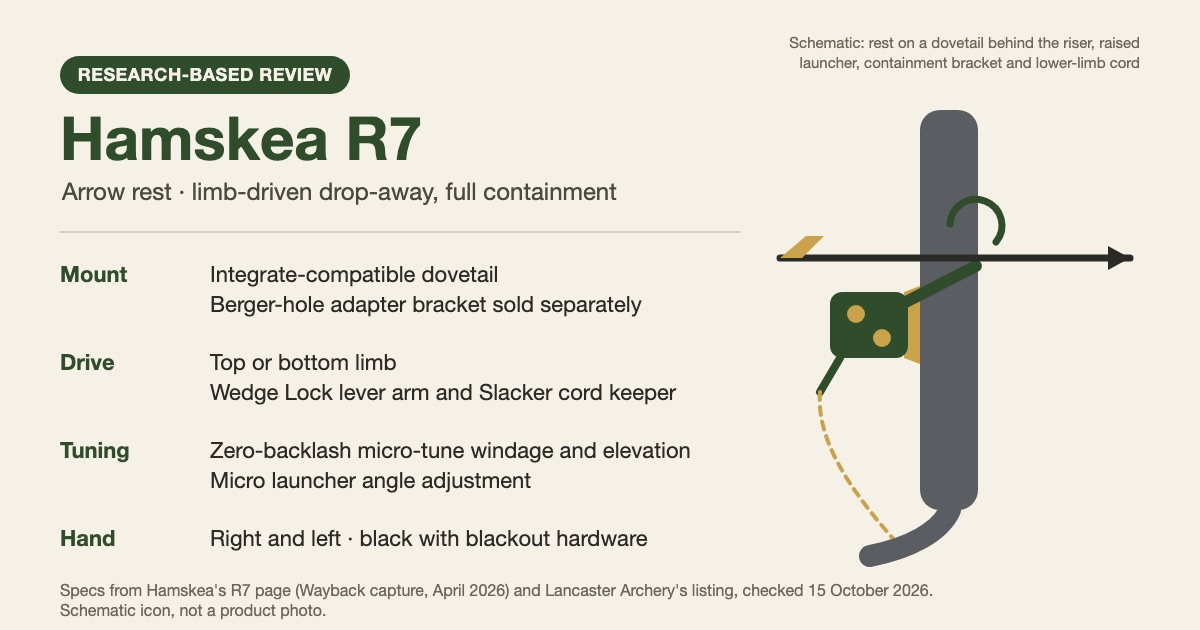
The R7 is Hamskea's seventh-generation arrow rest and its new flagship, launched in November 2025 with an Integrate dovetail mount. This Hamskea R7 review comes down to one point: it's a full-containment, limb-driven drop-away that fixes the small annoyances owners had with earlier Hamskea rests, from hard-to-reach lock screws to cord slipping in the clamp. It suits bowhunters with an Integrate-ready riser who don't mind paying flagship money. Hamskea says the R7 is sold only through its dealers, so we point you to Hamskea's dealer locator rather than to the third-party R7 listings on Amazon.
Hamskea R7
Advantages
- Integrate dovetail mount slides onto compatible risers with no bracket
- Wedge Lock lever arm sets cord tension with a single screw
- Relocated lock screws work with a standard Allen key set, according to GearJunkie
- Quick-Swap and removable containment brackets cover hunting and target use
Trade-offs
- Sold through dealers only, and Outdoor Life calls it hard to get
- Bows without a dovetail need a separate adapter bracket
- Limb-driven only: no cable-driven option in any listing we read
Hamskea R7 specs
Hamskea publishes features rather than a spec table, so this table combines the maker's R7 page with Lancaster Archery's specification list.
| Spec | Hamskea R7 | Source |
|---|---|---|
| Type | Drop-away, full containment | Lancaster |
| Activation | Limb-driven, top or bottom limb | Hamskea, Lancaster |
| Mount | Integrate-compatible dovetail | Hamskea |
| Non-dovetail risers | Berger Hole Adapter Bracket Kit, sold separately | Hamskea |
| Micro-adjust | Windage and elevation, zero-backlash detents, laser-marked knobs | Hamskea, Lancaster |
| Launcher | Micro angle adjustment, woven fabric cover | Hamskea |
| Cord system | Wedge Lock lever arm, Slacker cord management | Hamskea |
| Hand | Right and left | Lancaster |
| Colour | Black, blackout hardware | Lancaster, Hamskea |
| Weight | Not published (blank on Lancaster's listing) | Lancaster |
| Warranty | Limited lifetime | goHUNT, Hamskea |
Lancaster's listing went live on 3 November 2025. Hamskea's page calls the add-on the "Berger Hole Adapter Bracket Kit"; Lancaster's R7 listing calls it a "Universal Bracket".
Design and features
Integrate dovetail mounting
The headline change is the mount. The Epsilon and the original Everest attach through brackets (a C.O.R. riser interface, a Mathews bracket or a universal bracket); the R7 slides straight onto an Integrate-compatible dovetail. Hamskea promises "streamlined fit and repeatable alignment", and Kirchner calls it "the first INTEGRATE-compatible" rest in Hamskea's line-up, although Lancaster listed an Integrate version of the Everest on the same day as the R7.
Wedge Lock lever arm and Slacker cord management
Every limb-driven rest depends on its cord. If the cord slips, the launcher rises late or not at all. The R7's Wedge Lock lever arm combines the lever arm and cord clamp in one piece, and Lancaster's accessory listing says a single screw sets the tension. The Slacker system tidies the loose tag end of the cord.
This is where the hands-on evidence is strongest. Kirchner says cord slipping was "a common hiccup" with earlier Hamskea rests, and that after a few late-season hunts, including a backpack hunt, he hadn't had to retighten the R7's cord "once".
Micro-tune you can reach
Hamskea moved the elevation and windage lock screws so they're easier to get at. Kirchner explains why that matters: on earlier Hamskea rests he needed a stubby Allen wrench just for the rest, because standard folding sets wouldn't fit. With the R7 he says that extra key is gone. The micro-tune detents were also refined to remove backlash, and the knobs carry laser-marked directional markings. Hamskea doesn't publish a per-click distance for the R7, so we can't compare it with QAD's .0019 in figure.
Launcher, spring and rebound dampener
Carried over from earlier Hamskea rests are micro launcher angle adjustment, Zero-Tolerance Technology (Hamskea's term for removing slop), an adjustable internal torsion spring and the rebound dampener. Hamskea says the dampener "reduces cord shock and improves overall system longevity". Outdoor Life's P.J. Reilly calls it "the best system I've seen for what it does".
The launcher now wears a woven fabric cover in place of felt. Kirchner describes it as a "woven nylon type of fabric" and expects it to outlast felt. Worn felt on another of his rests once cost him a mule deer buck, spooked as he drew.
Quick-Swap, containment and target use
Hamskea's and Lancaster's copy says Quick-Swap lets you "convert between rest models quickly (target ↔ hunting)". Kirchner adds that you can swap rests "by a simple turn of a screw" without changing bows or retuning; that's his description, and you should still check your arrows hit where they did after a swap. The containment brackets are removable, and Hamskea's R7 Target Plug Kit replaces them with aluminium plugs that, says Lancaster, keep dust and debris out of the rest.
Fit, setup and compatibility
Does the R7 fit your bow?
Start with the riser. If your bow has an Integrate-compatible dovetail on the back of the riser, the R7 slides straight on. If it only has a Berger hole (the threaded hole on the side of the riser), you need Hamskea's Berger Hole Adapter Bracket. Lancaster describes it as an L-bracket for "older bows or bows that may not have the dovetail machined into their riser", with three attachment points for different riser thicknesses so you can still reach centre shot.
Then check hand: the R7 comes in right- and left-hand versions.
Installing and timing it
Follow Hamskea's printed instructions first. These steps follow general drop-away practice and the adjustments Hamskea lists.
- Mount the rest on the dovetail (or the adapter bracket) and leave the adjustments loose enough to move.
- Set centre shot and height with a bow square and an arrow. Our centre shot guide walks through it.
- Fit the arrow guide. The Pillar arrow guide sticks to the riser and has adjustable height for curved riser designs.
- Attach the cord to the top or bottom limb and set tension with the Wedge Lock lever arm, then tuck the tail into the Slacker.
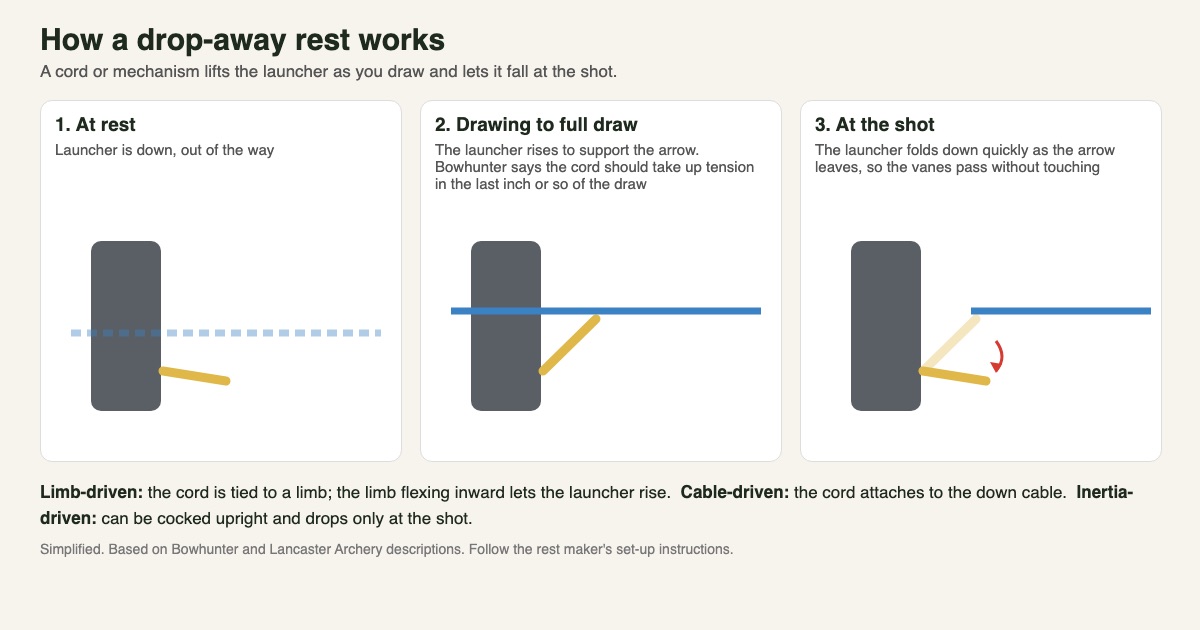
- Time the launcher. Draw slowly with an arrow on the rest. The launcher should be fully up by full draw and drop as the arrow leaves.
- Set spring tension and launcher angle, then lock everything down.
Our drop-away rest installation guide explains timing and limb- versus cable-driven set-ups in more detail.
Tuning after timing
Once the launcher times correctly, shoot through paper and use the micro-tune knobs for small moves. Our paper tuning guide explains how to read tears. Kirchner called tuning the R7 "a breeze", mainly because the lock screws are easy to reach.
Hamskea doesn't list arrow diameter limits in anything we read, so check that the containment bracket clears your shafts and vanes before your first hunt.
What other reviewers found
- GearJunkie (Josh Kirchner, 11 February 2026): hunted with it on a few late-season trips, including a backpack hunt, and took a javelina and a Coues deer. He says Hamskea "hit an absolute home run". His one con was price.
- Outdoor Life (P.J. Reilly, 13 April 2026): named it "Best Limb-Driven Rest" and called it "the most compact rest Hamskea has offered to date". Pros: slimmer than other Hamskea rests and multiple micro-adjustable controls. Cons: "Expensive" and "Hard to get due to demand". Reilly says his picks are based on his experience with a wide range of rests; he works for Lancaster Archery Supply.
Neither reported a failure, but both wrote within months of launch.
How the Hamskea R7 compares
Buyers mostly weigh the R7 against Hamskea's own Everest, QAD's Integrate MX2 and the Vaportrail Victor IMS. All four mount on Integrate risers. Figures come from each rest's Lancaster listing.
| Hamskea R7 | Hamskea Everest (Integrate) | QAD Integrate MX2 | Vaportrail Victor IMS | |
|---|---|---|---|---|
| Drive | Top or bottom limb | Limb (copy also says cable) | Cable | Top or bottom limb |
| Containment | Full | Full | Full, 80° capture | Full, over-moulded cage |
| Micro-adjust | Windage and elevation | "No" in spec list | .0019 in a click | Windage and elevation |
| Body | Not specified | Billet 6000-series aluminium | 7075 aluminium launcher | Not specified |
| Listed weight | Not published | Not published | Not published | 3.8 oz |
Hamskea R7 vs Everest
The Everest is Hamskea's all-metal rest, now also sold with an Integrate mount. Lancaster lists billet-machined 6000-series aluminium, two stainless steel bearings, the same rebound dampener and micro launcher angle adjustment, but a cord clamp tensioner rather than the Wedge Lock arm. Lancaster's listing contradicts itself on two points: its feature list says the Everest can be set up top limb, bottom limb or cable-driven, but its spec list says "limb driven", and it lists micro-adjust as "No". Ask a dealer before relying on either.
Hamskea R7 vs QAD Integrate MX2
This is the limb- versus cable-driven choice. The MX2 ties into the down cable, locks the launcher down at 0° after the shot to stop bounce-back and uses .0019 in micro-clicks. Its listing says the EZ clamp allows timing-cord changes with "No bow press or serving required". Outdoor Life split the two, naming the MX2 its best cable-driven rest and the R7 its best limb-driven rest. A limb-driven rest puts no load on your cables; a cable-driven rest has no cord to the limb.
Hamskea R7 vs Vaportrail Victor IMS
The Victor is the R7's closest match on paper: limb-driven from either limb, Integrate-mounted, fully contained, with micro-adjustable windage and elevation. Lancaster's listing gives a 3.8 oz weight, cage colours matched to popular bow finishes and multiple blade options, and says its free-floating head supports the arrow "for up to 70% of the shot cycle". The R7 counters with its cord clamp and Quick-Swap. Our Hamskea Epsilon review covers Hamskea's bracket-mounted alternative.
Who should buy it, and who shouldn't
Good fits:
- Owners of Integrate-ready bows who want limb drive without adding a bracket.
- Backcountry and spot-and-stalk hunters who carry a nocked arrow and want full containment, blackout hardware and a cord that stays put.
- Hunters who also shoot 3D or targets and will use Quick-Swap and the target plug kit.
Look elsewhere if you are:
- New to compound bows. A fixed rest like the Trophy Ridge Whisker Biscuit needs no timing at all.
- Set on cable drive. The R7 is limb-driven only.
- On a tight budget. Both reviewers flag the cost.
Where to buy
Hamskea's R7 page says the rest "is only available for purchase through our dealers". Use Hamskea's dealer locator, or ask a local pro shop to order one and time it for you. Hamskea's warranty page describes a limited lifetime warranty covering mechanical failures and manufacturing or workmanship defects, excluding normal wear items and obvious abuse. Contact Hamskea before sending anything back.
If you'd rather buy online, two alternatives are worth a look. You can check Hamskea V2 Epsilon listings on Amazon, a limb- or cable-driven rest on brackets, or look at the QAD Integrate MX2 on QAD's store if you want a cable-driven Integrate rest. Check the hand and the bow-brand version before you order.
Frequently asked questions
Is the Hamskea R7 a good hunting rest?
The evidence says yes. It's fully contained, limb-driven and blacked out, with a woven launcher cover in place of felt. GearJunkie's Josh Kirchner used it on a few late-season hunts, including a backpack hunt, without having to retighten the cord, and Outdoor Life named it the best limb-driven rest. Both reviews are early, so long-term durability is still unproven.
Hamskea R7 vs Everest: which should I choose?
Both come in Integrate versions and share the rebound dampener and micro launcher angle adjustment. The Everest is billet-machined aluminium with two stainless bearings and a cord clamp tensioner. The R7 adds the Wedge Lock lever arm, Slacker cord management, laser-marked zero-backlash micro-tune and Quick-Swap. Lancaster's spec list shows micro-adjust as "No" for the Everest.
Hamskea R7 vs MX2: what's the difference?
Drive is the difference. The R7 is limb-driven, with a cord tied to the top or bottom limb. QAD's Integrate MX2 is cable-driven, has an 80° capture position, locks its launcher down after the shot and lists .0019 in micro-clicks. Both mount on Integrate risers, both are fully contained, and Outdoor Life rated each the best of its type.
Will the Hamskea R7 fit my bow?
It fits any riser with an Integrate-compatible dovetail directly, in right- or left-hand versions. Bows with only a Berger hole need Hamskea's Berger Hole Adapter Bracket, sold separately. Lancaster says it has three attachment points to suit different riser thicknesses. If you're unsure what your riser has, check your bow maker's specs or ask a dealer.
Can I buy the Hamskea R7 on Amazon?
Amazon does show R7 listings from third-party sellers (we saw right- and left-hand versions in October 2026). Hamskea, though, says the R7 is only sold through its dealers, so we don't link them. If you buy there, check the seller against Hamskea's dealer locator first. A local pro shop can also order, fit and time it. Online, Amazon also lists alternatives such as Hamskea's V2 Epsilon.
Related articles
 Reviews
Hamskea Epsilon Review: Containment, Tuning and Verdict
Hamskea Epsilon review: original vs V2, the C.O.R. behind-riser mount, brackets, limb or cable drive, timing, tuning, and how it compares with the R7.
October 17, 2026 · 12 min read
 Training
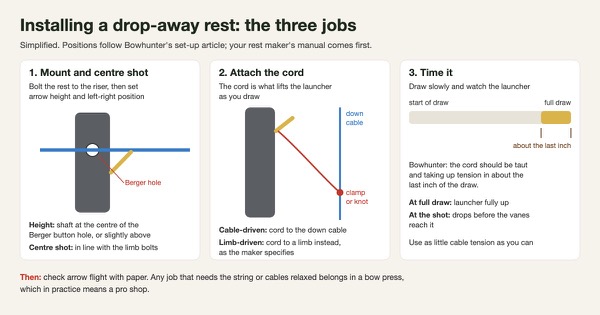
How to Install and Time a Drop-Away Rest
How to install a drop-away arrow rest on a compound bow: mounting, centre shot, cable or limb cord, timing and paper checks, plus when to use a pro shop.
Updated October 8, 2026 · 5 min read
 Training
How to Set Centre Shot on a Bow
How should an arrow sit on a rest? Set centre shot by sighting down the string: just outside it on a recurve, in line on a compound, then confirm by shooting.
Updated October 8, 2026 · 5 min read