
Hamskea Epsilon Review: Containment, Tuning and Verdict
Hamskea Epsilon review: original vs V2, the C.O.R. behind-riser mount, brackets, limb or cable drive, timing, tuning, and how it compares with the R7.

By Archery Insider Editorial Team
· 12 min read
Research-based: built from maker specs and official sources, fact-checked before publishing. How we review products
In this article
Many drop-away rests bolt to the side of the riser. The Epsilon sits behind it, and this Hamskea Epsilon review explains why that matters: Hamskea says its C.O.R. mount puts the arrow at centre shot by design and keeps the rest out of the quiver's way. It's a compact, full-containment drop-away that can run off the top limb, the bottom limb or the down cable, with micro-click adjustment. You can compare current Hamskea Epsilon rests on Amazon, where the V2 is listed in more than one bracket version.
Hamskea Epsilon
Advantages
- C.O.R. mount sits the rest behind the riser, leaving room for a quiver close to the bow
- Full containment with an over-moulded, two-piece bracket
- Top limb, bottom limb or cable-driven, so it adapts to most set-ups
- Micro-click windage and elevation at .003 in a click
Trade-offs
- Bracket choice decides fit, so check riser thickness and year first
- Limb-driven timing takes patience, and GearJunkie's cord needed re-tensioning after break-in
- Two large dealers listed versions as sold out or on clearance in October 2026
Hamskea Epsilon specs: original and V2
Hamskea's site refused our requests, so these figures come from Lancaster Archery, goHUNT and Canada Archery Online, which both reproduce Hamskea's spec text. Where they differ, we say so.
| Spec | Original Epsilon | V2 Epsilon |
|---|---|---|
| Type | Full-containment drop-away | Full-containment drop-away |
| Mounting | C.O.R. behind the riser | C.O.R. behind the riser |
| Brackets | Mathews or universal | Mathews, universal (AMO 5/16x24 thread), C.O.R. riser interface |
| Activation | Top limb, bottom limb or cable | Top limb, bottom limb or cable |
| Bearings | Three stainless steel ball bearings | Three stainless steel ball bearings |
| Micro-adjust | Detent micro-click windage and elevation, .003 in a click | Detent micro-tune, plus micro launcher adjustment |
| Cord attachment | "Set it and forget it" cord clamp tensioner | Cord clamp lever arm |
| Listed weight | 4.6 oz (Mathews bracket), 5.1 oz (universal), both goHUNT | 5.1 oz (goHUNT) |
| Hand | Right and left | Right and left |
| Warranty | Limited lifetime (goHUNT) | Limited lifetime (goHUNT) |
The original box includes the rebound dampener, the bracket, a limb pad and riser-mounted arrow guide, die-cut felt, a limb activation cord, instructions, mounting hardware and a 5/32 in Allen wrench, says Lancaster, which also lists a Delta V arrow guide among its features. The V2 listings name the cord clamp lever arm, activation cord, Delta V arrow guide and riser-mounted arrow guide as included. One conflict worth knowing: Field & Stream lists "only limb-driven options" as a con, while every dealer listing we read says the Epsilon can also be set up cable-driven.
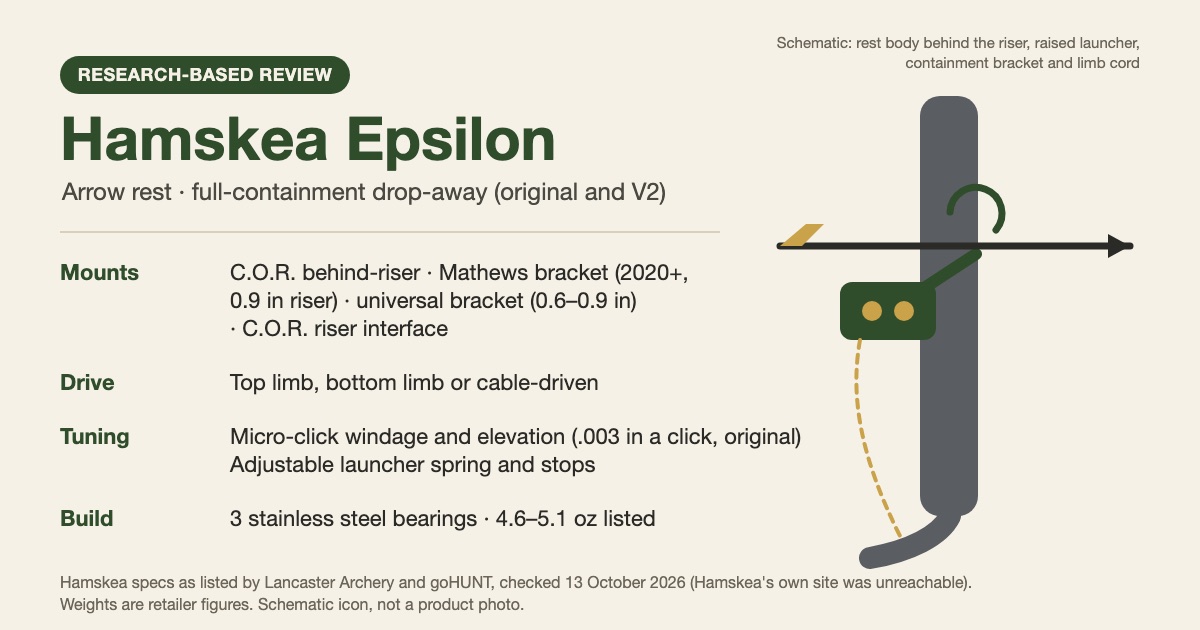
How the Epsilon works
The C.O.R. mount: centre shot by design
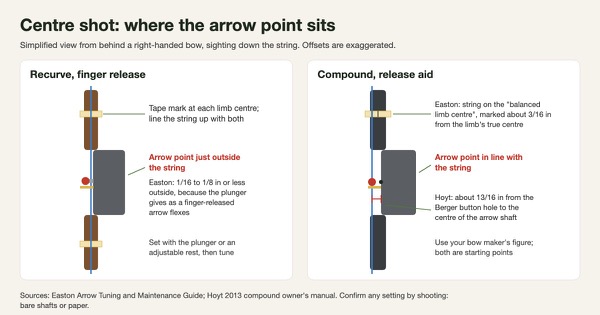
Centre shot is the left-right position of the arrow relative to the string. On a side-mounted rest you set it by sliding the launcher across. The Epsilon's C.O.R. bracket places the rest body in line behind the riser, and Hamskea says this "positions the arrow at center shot by design." GearJunkie's Josh Kirchner put a number on it: mounted correctly, the rest sits at the 13/16 in centre shot he uses as a tuning starting point.
There's a second benefit. Because nothing hangs off the side of the riser, a low-profile quiver can sit closer to the bow. Hamskea's copy says the mount eliminates "quiver interference", and Western Hunter's James Yates found the Epsilon "nearly an inch slimmer in width" than Hamskea's earlier Trinity Hunter Pro.
Containment and loading
The over-moulded containment bracket is a two-piece design that, in Hamskea's text on goHUNT, allows "easy arrow loading." Kirchner notes that arrows load through a small slot and that both the top and side containment can be removed. So you can open it up if you don't want full capture.
Launcher, bearings and the rebound dampener
The launcher has a curved steel core with a sound-dampening overmould. It pivots on three stainless steel ball bearings, which Hamskea says give "maximum platform stability". Zero Tolerance Technology (ZTT) is Hamskea's term for eliminating lateral shaft movement.
The elastomer rebound dampener manages launcher rebound. Hamskea says it mitigates "the shock that is transferred from the limb to the rest during the shot", preventing wear that "could eventually lead to failure." Lancaster's copy adds that the rest "ensures absolutely no fletching contact"; that's the maker's claim, and how cleanly vanes clear on your bow still depends on timing.
Micro-tune
Windage and elevation use detent micro-click knobs at .003 in a click, and Kirchner reports a positive lock screw on each. You also get adjustable torsion spring tension and adjustable up and down launcher stops.
What the V2 changed
Lancaster lists four V2 changes: micro launcher adjustment, easier-to-reach elevation screws, a cord clamp lever arm, and a "rock-solid foundation". Canada Archery Online adds detail: micro-adjust and locking screws for blade angle on the underside (no washer needed), and horizontal set screws mounted outside rather than inside. Hamskea says the V2 combines features of its Everest rest with the original Epsilon.
Fit, setup and compatibility
Which bracket fits your bow
- Mathews bracket. Lancaster says it fits Mathews bows from 2020 or newer with a 0.9 in riser thickness.
- Universal bracket. goHUNT lists it for risers between 0.6 and 0.9 in thick, and Lancaster gives the V2 version's mounting style as AMO 5/16x24, the standard Berger-hole thread.
- C.O.R. riser interface. Lancaster's listing for Hamskea's Everest describes a C.O.R. riser mount interface that fixes to two holes drilled into the back of the riser instead of the Berger hole. Check that your riser has them before ordering.
Limb-driven or cable-driven
A limb-driven set-up ties the cord to the top or bottom limb, so the rest puts no load on the cables. A cable-driven set-up attaches the cord to the down cable. Both work on the Epsilon. Our drop-away rest installation guide compares the two in detail.
Installing and timing it
Follow Hamskea's printed instructions first; we couldn't reach the maker's site to read them. These steps follow general drop-away practice and the adjustments Hamskea lists.
- Fit the bracket and rest with the supplied hardware, leaving the adjustment screws loose enough to move.
- Check centre shot and height. The C.O.R. mount should put you close; confirm with a bow square and arrow, and see our centre shot guide.
- Attach the cord to the limb (with the limb pad) or the down cable, using the cord clamp or V2 lever arm.
- Time the launcher. Draw slowly with an arrow on the rest. The launcher should be fully up by full draw and should drop as the arrow leaves.
- Set the stops and spring. Use the up and down stops and spring tension to suit your arrow.
- Re-check after a session. Kirchner found the cord settled: after a morning's shooting he had to readjust tension so the launcher sat flat on the shelf, a quick fix with the clamp screw.
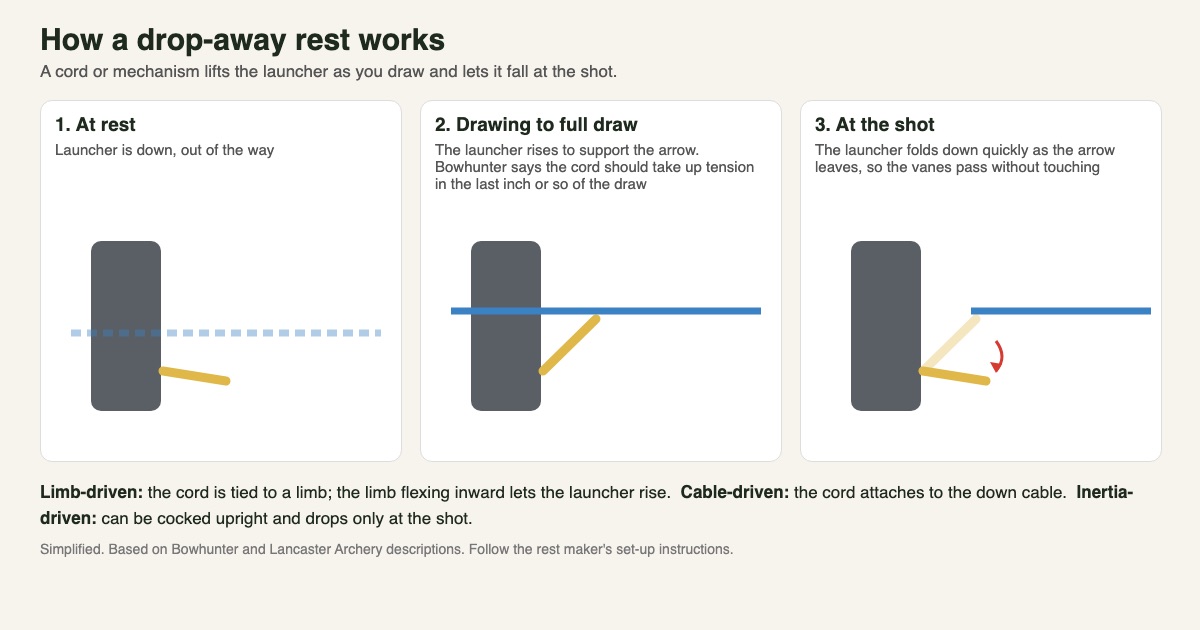
Tuning after timing
Once the launcher times correctly, shoot through paper and use the micro-click knobs for small moves. Kirchner reports shooting "a bullet hole through a paper in minutes" thanks to the centre-shot mount. Our paper tuning guide explains how to read tears.
Arrows, quivers and target use
Hamskea doesn't publish an arrow-diameter range in the listings we read, so check containment clearance with your own shafts and vanes. The quiver is where the behind-riser mount pays off: Western Hunter's Yates says it lets the quiver sit "super tight to the riser for much better bow balance", and pitched the Epsilon as a match for Hoyt's In-Line accessory system and Mathews's Bridge-Lock sight. If you shoot targets in the off-season, Hamskea's target conversion kit swaps the rest over.
What other reviewers found
- Field & Stream (Jace Bauserman, dated 23 January 2026): named it "Best Limb-Driven". Bauserman says he tested every rest on the range and in the field, citing in-line mounting, easy loading and "no bounce back".
- GearJunkie (Josh Kirchner, 22 November 2022): used it on "numerous backcountry hunts" and in "all manner of weather" without a hiccup. His complaints: cost, cord break-in, and a mount that "came loose on me after shooting for a day", possibly user error, which didn't recur in the following eight months.
Kirchner's review predates the V2, and Field & Stream doesn't say which version it shot, so treat both as evidence for the platform.
How the Epsilon compares
Buyers mostly weigh the Epsilon against Hamskea's R7 and Everest and QAD's Integrate MX2. Figures come from each rest's Lancaster listing.
| Epsilon | Hamskea R7 | Hamskea Everest | QAD Integrate MX2 | |
|---|---|---|---|---|
| Mount | C.O.R. brackets | Integrate dovetail | C.O.R. brackets | Integrate |
| Drive | Limb or cable | Limb | Limb, or cable fall-away | Cable |
| Bearings | Three stainless steel | Not listed | Two sealed stainless steel | Not listed |
| Micro-adjust | .003 in a click | Detent micro-tune | Standard windage and elevation | .0019 in a click |
| Containment | Full | Full | Full | Full, 80° capture |
Hamskea Epsilon vs R7
The R7 is Hamskea's newer rest: Lancaster's listing dates from November 2025 and calls it "the latest Hamskea Archery Solutions compound rest." It mounts directly on Integrate-compatible risers (the universal bracket is sold separately) and adds a Wedge Lock lever arm, a Cord Slacker system, a quick-swap feature for converting between target and hunting set-ups, laser-marked micro-tune knobs and micro launcher angle adjustment. Its listing says limb-driven only. Outdoor Life's P.J. Reilly picked the R7 as his best limb-driven rest in April 2026, calling it "the most compact rest Hamskea has offered to date", with "expensive" and "hard to get" as its cons.
Hamskea Epsilon vs Everest
The Everest is the all-metal, billet-machined sibling. It shares the C.O.R. mount, rebound dampener and ZTT, and Hamskea says its C.O.R. brackets put the rest at 13/16 in centre shot out of the box. The differences: two sealed bearings rather than three, a continuous micro launcher angle adjustment with independent stops, and standard (not micro-click) windage and elevation.
Epsilon vs QAD UltraRest Integrate MX2
The MX2 is cable-driven and slides onto Integrate risers, with Mathews, Hoyt and Elite versions listed at Lancaster. QAD lists .0019 in micro-clicks, an 80° capture position, a launcher that locks down at 0° to stop bounce-back, and an EZ clamp that needs "no bow press or serving" for timing changes. Field & Stream named the Integrate MX its best overall rest.
Who should buy it, and who shouldn't
Good fits:
- Mathews owners (2020 or newer, 0.9 in riser) who want a rest built around a Mathews-approved bracket.
- Western and spot-and-stalk hunters who carry a nocked arrow and value full containment and a tight quiver fit.
- Tinkerers who'll use the micro-clicks and spring settings.
Look elsewhere if you are:
- New to compounds. A fixed rest like the Trophy Ridge Whisker Biscuit needs no timing at all.
- On an Integrate riser, where the R7 or MX2 mount without a bracket.
Where to buy
Hamskea sells through archery dealers, and a pro shop can confirm the bracket and time the rest for you. When we checked on 13 October 2026, Lancaster listed both V2 versions as sold out and the original Mathews-bracket rest in left-hand only, and Canada Archery Online listed the V2 as clearance. We couldn't confirm from Hamskea whether the Epsilon is being discontinued.
Mathews bows from 2020 on with a 0.9 in riser
Hamskea V2 Epsilon, Mathews bracket (right-hand)
The V2 on its Mathews bracket. For other bows, Amazon also lists the V2 Epsilon with the C.O.R. riser interface bracket; check hand and bracket before you order.
- Type
- Full-containment drop-away, C.O.R. behind-riser mount
- Drive
- Top limb, bottom limb or cable
- Micro-adjust
- Detent micro-tune windage and elevation; micro launcher adjustment
- Bearings
- Three stainless steel ball bearings
Specifications: Hamskea specs as listed by Lancaster Archery and goHUNT, checked 13 October 2026
Frequently asked questions
Is the Hamskea Epsilon a good hunting rest?
It was designed for it. Full containment holds the arrow while you move, the behind-riser mount keeps the quiver close, and the rebound dampener is there to stop bounce-back. Field & Stream named it its best limb-driven rest, and GearJunkie's reviewer used it on backcountry hunts with only a cord re-tension after break-in.
What's the difference between the Hamskea Epsilon and the Epsilon V2?
The V2 keeps the C.O.R. mount, three bearings and full containment, and adds micro launcher adjustment, easier-to-reach elevation screws and a cord clamp lever arm, plus blade-angle locking screws underneath and outside-mounted horizontal set screws. Dealer listings for the V2 date from February 2025, and it adds a C.O.R. riser interface bracket option.
Hamskea Epsilon vs R7: which should I choose?
Start with your riser. The R7 slides onto Integrate-compatible risers and is limb-driven only, with newer touches like the Wedge Lock lever arm and a quick target-to-hunting swap. The Epsilon uses brackets, including a Mathews-approved one for 2020-or-newer bows, and can also run off the down cable. If your bow isn't Integrate-ready, the Epsilon fits more directly.
Hamskea Epsilon vs Everest: what's different?
Both use C.O.R. mounting, full containment and a rebound dampener. The Everest is all metal with two sealed bearings, continuous launcher angle adjustment and standard windage and elevation. The Epsilon is the more compact platform, with three bearings and micro-click windage and elevation (.003 in a click on the original).
Does the Hamskea Epsilon fit any bow?
No. The Mathews bracket fits 2020-or-newer Mathews bows with a 0.9 in riser, the universal bracket fits risers 0.6 to 0.9 in thick through the Berger hole, and the C.O.R. riser interface needs a riser drilled for it. Measure your riser or ask a dealer before ordering.
Related articles
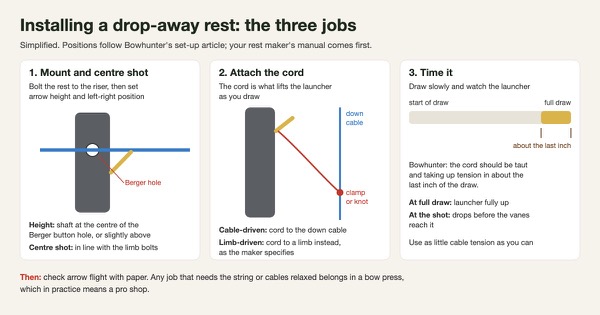 Training
How to Install and Time a Drop-Away Rest
How to install a drop-away arrow rest on a compound bow: mounting, centre shot, cable or limb cord, timing and paper checks, plus when to use a pro shop.
Updated October 8, 2026 · 5 min read
 Training
How to Set Centre Shot on a Bow
How should an arrow sit on a rest? Set centre shot by sighting down the string: just outside it on a recurve, in line on a compound, then confirm by shooting.
Updated October 8, 2026 · 5 min read
 Training
Paper Tuning a Bow: How to Read Tears and Fix Them
How to paper tune a bow: what it shows, frame setup, reading nock-high, low, left and right tears, the order of fixes, and when to see a pro shop.
October 8, 2026 · 10 min read