
Barnett XP370 vs XP400: Specs and Packages Compared
Crossbow XP 370 vs XP400: Barnett's own specs side by side, with speed, kinetic energy, draw weight, cocking, size, scope package and who each one suits.

By Archery Insider Editorial Team
· 11 min read
Research-based: built from maker specs and official sources, fact-checked before publishing. How we review products
In this article
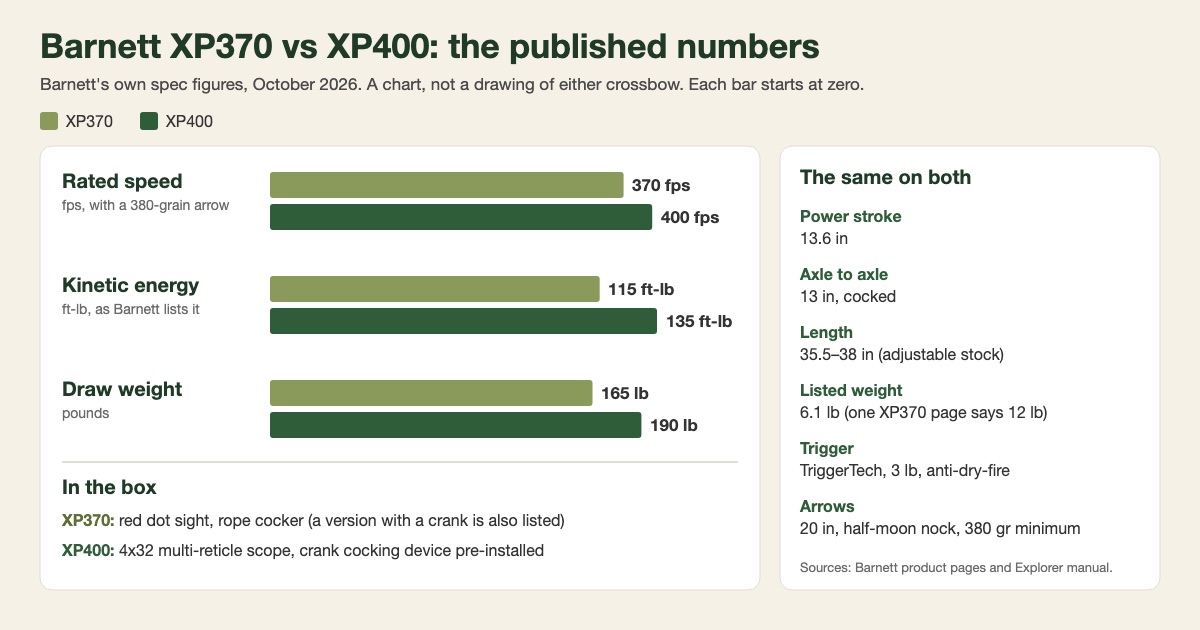
If you're weighing up the Barnett crossbow XP 370 against the XP400, the short version is that they're the same Explorer-series chassis with different power. Barnett lists both with a 13.6 inch power stroke, a 13 inch cocked axle-to-axle width and a 35.5–38 inch length, but the XP400 draws 190 lb to the XP370's 165 lb, and Barnett rates it at 400 fps and 135 ft-lb against 370 fps and 115 ft-lb.
The other big difference is the box. Barnett's XP370 package comes with a red dot sight and a rope cocker (there's also a version with a crank), while the XP400 comes with a 4x32 multi-reticle scope and a crank cocking device already fitted. This comparison lines up Barnett's own figures, checks the kinetic energy numbers with the standard formula, and explains what the extra 25 lb of draw weight means when you cock it.
XP370 vs XP400 at a glance
Here's how Barnett lists the two crossbows. The XP370 figures come from its XP370 and XP370 with CCD pages; the XP400 figures come from its XP400 w/CCD page and the Midnight Edition page.
| Spec | XP370 | XP400 |
|---|---|---|
| Rated speed | 370 fps | 400 fps |
| Kinetic energy (Barnett) | 115 ft-lb | 135 ft-lb |
| Speed test arrow | 380 grains | 380 grains |
| Draw weight | 165 lb | 190 lb |
| Power stroke | 13.6 in | 13.6 in |
| Axle to axle (cocked) | 13 in | 13 in |
| Length | 35.5–38 in | 35.5–38 in |
| Listed product weight | 6.1 lb (12 lb on one page) | 6.1 lb |
| Trigger | TriggerTech, 3 lb, anti-dry-fire | TriggerTech, 3 lb, anti-dry-fire |
| Limbs | Compression-moulded | Custom composite laminated |
| Cocking in the box | Rope cocker, or crank on the "with CCD" version | Crank cocking device pre-installed |
| Sight in the box | Red dot (red/green illuminated on the CCD version) | 4x32 multi-reticle scope |
| Arrows in the box | Two 20 in carbon arrows | Two 20 in Headhunter carbon arrows with 100 gr points and Strobe lighted nocks |
| Quiver | Lightweight side-mount | Side-mount, 3 arrows |
| Stock | Adjustable butt stock | 5-position quick-adjust butt stock |
Barnett doesn't publish an overall limb width, only the axle-to-axle figure. It doesn't publish a noise rating for either model, so any claim that one is quieter than the other isn't coming from the maker.
XP 370, 380, 400: what the names mean
Barnett's manual is titled "Explorer™ / XP™ Series", and its store describes the XP 380 as "Part of our Explorer series". So "Explorer XP370" and "XP370" are the same family, and the number is the rated speed in feet per second.
That's where the confusion starts. Barnett's store lists a whole run of XP models: XP370, XP380, XP385, XP390, XP400, XP405 and XP410, plus retailer-specific names such as Expedition 370 and Expedition 400 w/CCD. Its XP 380 W/CCD listing describes 380 fps "with 122 ft. lbs. KE". The XP400 w/CCD page says it's "Available Exclusively at Bass Pro Shops", and when we checked in October 2026 Barnett's own store showed the XP370 in stock and its XP400 listings as sold out.
There have also been older versions. Southland Archery still lists an "Explorer XP 370/380/400" set with draw weights of 165, 185 and 200 lb, a 13.75 inch power stroke and a 16.5 inch axle-to-axle figure. Those numbers don't match Barnett's current XP400 page (190 lb, 13.6 inch), so treat that listing as an earlier generation. If you're buying used, read the label on the limbs and the model number on the box rather than trusting the name.
Searches for a Barnett "X Force 350" also turn up. We couldn't find an X Force model in Barnett's current store. The 350 fps crossbow in its XP family is the Recruit XP, which Barnett lists at 150 lb draw weight and 92 ft-lb.
Speed and kinetic energy, checked with the formula
Barnett marks its speeds with the note "Speed test using 380-grain arrow." That matters, because its own manual admits there's no industry standard: "The crossbow industry does not have a universal set of standards for calculating 'advertised arrow speeds.' Instead, manufacturers rely on various arrow weights to calculate speeds. These arrow weights range from 380 grains to 400 grains."
The standard kinetic energy formula, the one Easton's calculator uses, is: arrow weight in grains × speed in fps² ÷ 450,240. Here's our arithmetic with Barnett's numbers:
| Crossbow | Arrow weight | Rated speed | Our arithmetic | Barnett's figure |
|---|---|---|---|---|
| XP370 | 380 gr | 370 fps | 380 × 370² ÷ 450,240 = 115.5 ft-lb | 115 ft-lb |
| XP400 | 380 gr | 400 fps | 380 × 400² ÷ 450,240 = 135.0 ft-lb | 135 ft-lb |
So Barnett's energy figures are simply the formula applied to its speed ratings with a 380-grain arrow. That's useful, because it tells you they aren't measured with the arrows you'll actually shoot. The manual says the recommended Headhunter 20 inch arrow weighs 400 grains "(including 100 grain field point)", and a heavier arrow leaves the rail more slowly than the rating. Barnett doesn't publish speeds for the 400-grain arrow, and we won't guess one.
On paper, the XP400 is 30 fps (about 8%) faster and carries 20 ft-lb (about 17%) more energy. Energy rises with the square of speed, which is why the energy gap is roughly twice the speed gap. If you put your own arrows through a chronograph, enter the numbers here:
Calculator
Arrow kinetic energy and momentum calculator
Weigh the finished arrow with its point.
Measured through a chronograph, not the IBO rating.
Method: KE (ft-lb) = arrow weight (grains) × speed² (fps²) ÷ 450,240, the formula Easton's kinetic energy calculator uses
An estimate to start from, not a fitting. A pro shop can confirm it on your bow.
Our arrow kinetic energy and momentum guide explains where the 450,240 comes from and what energy numbers can and can't tell you about penetration.
Draw weight and cocking: the difference you'll feel
The 25 lb gap in draw weight is the part of this comparison you notice every time you load. Deer & Deer Hunting says "a rope cocker will reduce the force needed to pull the bowstring by 50%" and that a crank's gear system "reduces the draw weight of the bowstring by 90%". Using that rule of thumb, here's roughly what you'd pull. It's arithmetic from a general guideline, not a Barnett measurement:
| Method | XP370 (165 lb) | XP400 (190 lb) |
|---|---|---|
| Rope cocker (about 50% less) | about 83 lb | about 95 lb |
| Crank (about 90% less) | about 17 lb | about 19 lb |
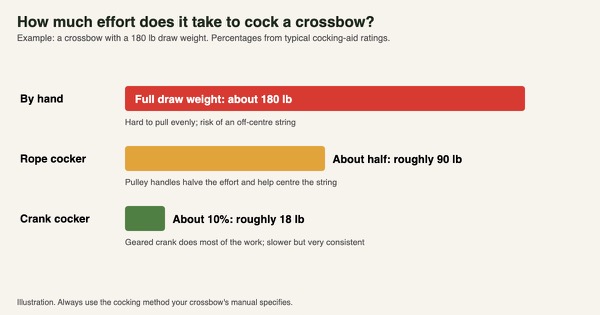
Barnett's XP370 pages mention its "Rope-Hold™ Rope Cocking Device Groove Mechanism" and say the XP370 is "Crank Cocking Device Compatible". The XP400 ships with the crank already fitted. Barnett also sells an Explorer crank as an accessory, but check with Barnett that it suits your exact model before ordering.
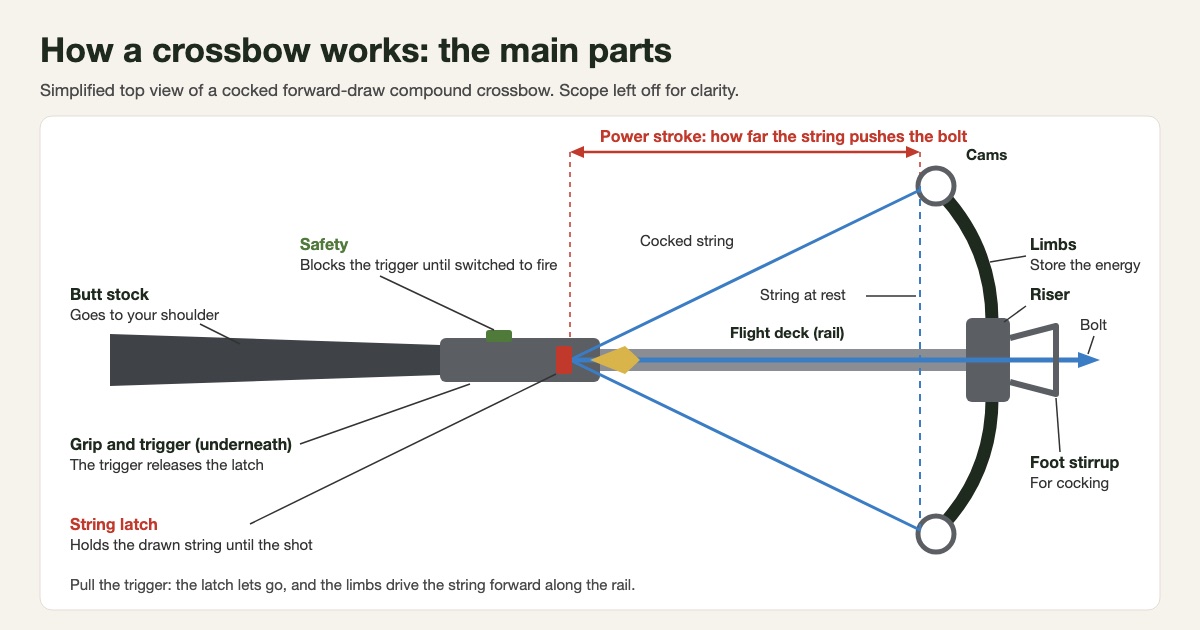
Our guide to cocking a crossbow safely walks through rope and crank technique step by step, including how to keep the string centred.
Size, weight and handling
On Barnett's figures, there's nothing to choose between them for size. Both measure 13 inches axle to axle when cocked and 35.5–38 inches long, the range coming from the adjustable butt stock. Both have pass-through foregrips, a Soft-Lok floating bristle arrow retainer and an anti-dry-fire trigger.
Weight is less clear. Barnett's XP370 with CCD and XP400 pages list a product weight of 6.1 lb, but the plain XP370 page says 12 lb. Barnett doesn't explain the difference, and 12 lb looks more like a packaged weight than a bare crossbow. Either way, the scope, quiver and arrows add to whatever the bare figure is, so plan to shoot from a rest or shooting sticks if you hunt from a ground blind.
The XP400's page also mentions three Picatinny rails and an ambidextrous safety. The XP370's mentions an anti-vibration foot stirrup. Neither page gives a noise figure, so if quietness matters, a dealer's demo or string suppressors are the only honest way to judge it.
Scope, sight and what's in the box
The red dot that comes with the XP370 is a single illuminated aiming point. The XP400's 4x32 multi-reticle scope has several aiming points for different distances. The manual warns that "the included crossbow scope models vary across the XP / Explorer™ Series packages", so read the sheet that comes with yours. It recommends zeroing at 10 yards first, then setting the top reticle at 20 yards.
Our crossbow scope sight-in guide covers that process in detail, including how to check the lower aiming points at 30 and 40 yards.
Arrows are the other thing to get right. Barnett says Explorer crossbows "specifically use half moon nocks", recommends its Headhunter 20 inch arrows, and warns never to use arrows "weighing less than 380 grains". The wrong nock or a light arrow can cause a dry fire and void the warranty. Our guide to crossbow bolts explains nock types, lengths and weights.
Legality: check before you buy
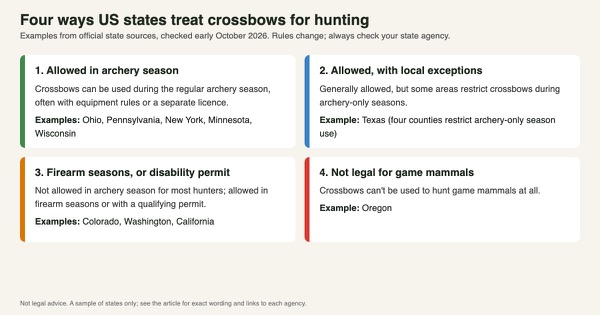
Whether either crossbow is legal where you hunt depends on your state, the species and sometimes your age or a disability permit. Some states allow crossbows in archery season, others only in firearm seasons, and a few not for big game at all.
Oregon is the clearest example. ODFW's rules say: "Only recurve, long, or compound bows are legal for hunting game mammals," and that "game birds, crows, and western gray squirrels may not be hunted with crossbows". Rules checked on 9 October 2026; this isn't legal advice and regulations change, so confirm with your state wildlife agency before you hunt.
Our guide to whether crossbows are legal for hunting explains how state rules differ and what to look for in your regulations.
Which one suits you
Choose the XP370 if: you want the lighter draw weight, you're happy with a red dot or plan to fit your own scope, and you'd rather start with a rope cocker. The 165 lb draw is the easier of the two to cock by rope, and Barnett sells a version with the crank included if you'd like it from day one.
Choose the XP400 if: you want a scope and a crank in the box and the extra rated speed and energy. Remember that the crank is doing most of the work; without it, 190 lb is a lot to pull by rope.
Either way, buy the arrows Barnett specifies, keep spares at 380 grains or more, and sight in with the points you'll hunt with.
XP370 vs XP400
Advantages
- Same 13.6 in power stroke and 13 in cocked width on both
- XP400 rated 30 fps and 20 ft-lb higher on Barnett's 380-grain test
- XP400 comes with a 4x32 scope and a crank already fitted
- XP370 has the lighter 165 lb draw and a crank option
- TriggerTech 3 lb trigger with anti-dry-fire on both
Trade-offs
- Speed and energy are rated with a 380-grain arrow, lighter than the 400-grain Headhunter Barnett recommends
- XP370 weight listed as both 6.1 lb and 12 lb on Barnett's pages
- XP400 shown as sold out and Bass Pro-exclusive when we checked
- Older Explorer XP versions have different specs, which confuses used sales
- No noise figures from Barnett for either model
You can browse Barnett XP370 listings on Amazon or look for the XP400. Check the model number, whether a crank is included and what sight comes in the box, because sellers mix up the XP generations.
Frequently asked questions
How fast is the Barnett XP 370 crossbow?
Barnett rates the XP370 at 370 fps with 115 ft-lb of kinetic energy, measured with a 380-grain arrow. Its manual recommends 400-grain Headhunter arrows, which will be a little slower. If you want your real number, shoot your hunting arrows through a chronograph and use the kinetic energy formula.
What's the difference between the XP380 and XP400?
Barnett's store describes the XP 380 as part of the Explorer series, rated at 380 fps with 122 ft-lb. The XP400 is rated at 400 fps and 135 ft-lb from a 190 lb draw. Model packages and draw weights have changed over the years, so check the label on the limbs before buying second-hand.
Can you cock a crossbow XP400 with a rope cocker?
Barnett ships the XP400 with a crank cocking device already installed, and its Explorer manual covers both rope and crank versions. Using Deer & Deer Hunting's 50% rule of thumb, a rope would still leave you pulling roughly 95 lb on a 190 lb crossbow, so the crank is the easier option.
What arrows does the Barnett XP370 use?
Barnett says Explorer crossbows use half-moon nocks and recommends its Headhunter 20 inch arrows, which weigh 400 grains including a 100 grain point. Never use arrows lighter than 380 grains. The wrong nock or a light arrow can cause a dry fire, damage the crossbow and void the warranty.
Related articles
 Training
How to Cock a Crossbow Safely
How to cock a crossbow safely: by hand, with a rope cocker or a crank, centring the string, loading a bolt correctly, and safe ways to unload or decock.
October 13, 2026 · 9 min read
 Training
How to Sight In a Crossbow Scope, Step by Step
How to sight in a crossbow scope: safety, mounting, a 20-yard zero, multi-reticle and speed-dial scopes, broadhead checks and fixes for wandering groups.
October 6, 2026 · 9 min read
 Guides
Are Crossbows Legal for Hunting? How State Rules Differ
Are crossbows legal for hunting? How US states differ on crossbows in archery season, examples from official sources, why some restrict them, and how to check.
November 1, 2026 · 12 min read