
Who Invented the Compound Bow? A Short History
Who invented the compound bow, and why? Holless W. Allen's 1966 patent filing, the 1969 grant, and how his pulleys led to today's cams and let-off.

By Archery Insider Editorial Team
· 5 min read
In this article
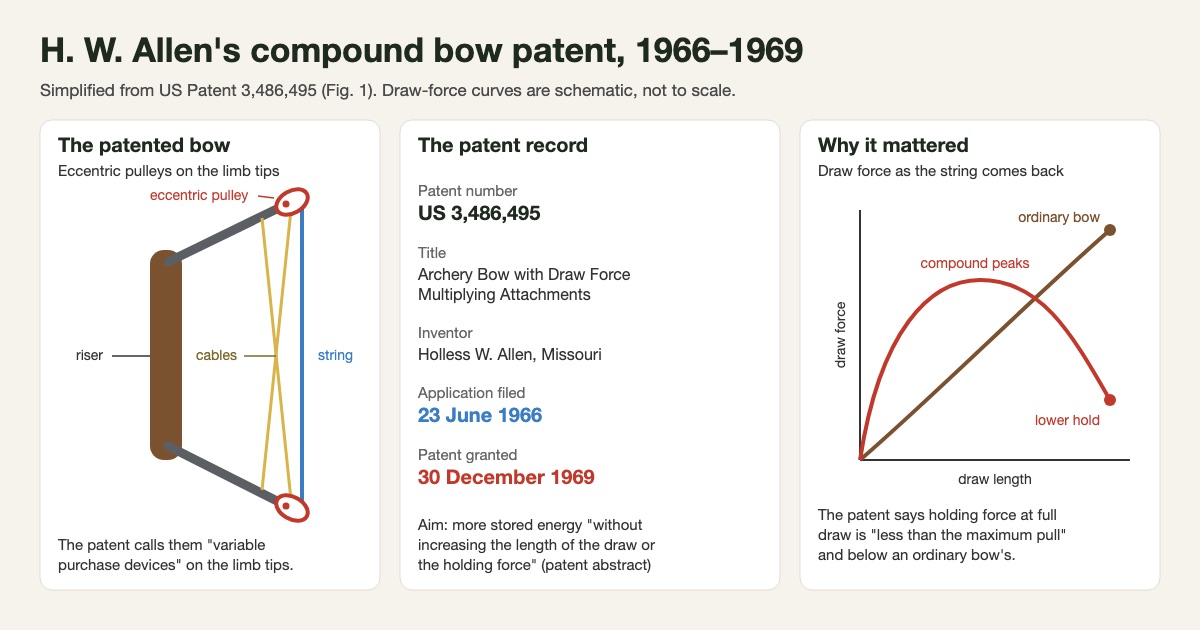
The compound bow was invented by Holless Wilbur Allen, a Missouri bowhunter, who filed a patent for it on 23 June 1966. US Patent 3,486,495 was granted on 30 December 1969. Allen's idea was to put off-centre pulleys on the limb tips so the bow could store more energy while being easier to hold at full draw.
H. W. Allen and the 1966 patent
Allen's patent is titled "Archery Bow with Draw Force Multiplying Attachments" and lists him in Missouri as an individual inventor. It was filed on 23 June 1966 and granted on 30 December 1969, which is why both years get quoted as the date the compound bow was "invented".
The abstract sums up the whole idea in one sentence. It describes a bow with "variable purchase devices mounted on the limb tips" that are worked by the bowstring "to increase the energy of the bow when drawn without increasing the length of the draw or the holding force required in the drawn position."
In practice, those devices were eccentric pulleys. The patent describes "an eccentric pulley member" on a cross pin at each limb tip, "of generally oval-shaped configuration", with cables running towards the opposite limb.
Why Allen built it
The patent explains the problem with an ordinary bow: "the maximum pull is required when the archer sets for the shot, thereby limiting the strength of the bow which may be handled by a particular individual." In other words, a stick bow is hardest to hold at exactly the moment you need to be steady.
Allen's pulleys change the leverage as the string comes back. The patent says "greater energy will be imparted to the limbs although a lesser force is required to hold the string", and that "the holding force at full draw is both less than the maximum pull ... and appreciably less than the pull weight of a conventional bow". That drop at the end of the draw is what archers now call let-off.
Archery 360's history adds the personal motive: Allen "was a bowhunter who was tired of game ducking away from arrows he shot from his traditional bow."
Early adoption: from four wheels to two
According to Archery 360, Allen "introduced the Allen Compound Bow to the market in 1967", before the patent was granted. That early four-wheel compound "didn't fare well commercially", the article says, but Allen let Tom Jennings work with the design.
Jennings released the Model T in 1974, and Archery 360 describes it as "wildly popular" with "only two wheels", lighter and easier to shoot. From there, makers kept refining the wheels into cams.

| Date | Milestone | Source |
|---|---|---|
| 23 June 1966 | Allen files his patent application | US Patent 3,486,495 |
| 1967 | Allen Compound Bow goes on sale | Archery 360 |
| 30 December 1969 | Patent granted | US Patent 3,486,495 |
| 1974 | Jennings Model T, a two-wheel compound | Archery 360 |
| Late 1970s | Martin Archery's Dynabo, the first single-cam bow | Archery 360 |
| 1990s | Mathews Solocam single-cam bows | Archery 360 |
Today's cams
Modern compounds look nothing like Allen's drawing, but the principle is the same: an off-centre wheel or cam changes the leverage through the draw. Archery 360 says Mathews' Solocam bows of the 1990s "matched the speeds achieved by dual-cam bows, but with less hand shock."
Today, Archery 360 notes, there are bows with "huge cams that deliver 90% let-off and arrow speeds over 340 feet per second".

Our compound vs recurve comparison explains how let-off changes the way each bow shoots. Even accessories now assume cables: many drop-away rests are tied to the bow's down cable.
If you're thinking of buying a first compound, our Bear Cruzer G3 review explains one adjustable example to consider, or you can browse adjustable compound bows on Amazon.
Frequently asked questions
Why were compound bows invented?
Allen's patent says an ordinary bow needs its maximum pull just as the archer settles for the shot, which limits how strong a bow a person can handle. His eccentric pulleys let the bow store more energy while needing less force to hold at full draw. Archery 360 adds that he was a bowhunter frustrated by game dodging his arrows.
When was the compound bow invented?
Holless W. Allen filed his patent application on 23 June 1966, and US Patent 3,486,495 was granted on 30 December 1969. Archery 360 says his Allen Compound Bow went on sale in 1967. Dates given for his first prototype vary between sources, so the patent dates are the most reliable markers.
Who was the compound bow inventor?
Holless Wilbur Allen, usually written H. W. Allen, invented the compound bow. The patent lists him as the only inventor, an individual based in Missouri. Tom Jennings later built on the design with his two-wheel Model T, but the patent belongs to Allen.
Related articles
 Comparisons
Compound vs Recurve Bow: Key Differences Explained
Compound vs recurve bow compared: how each works, let-off and holding weight, aiming systems, competition formats, maintenance, hunting, and which suits you.
February 6, 2025 · 8 min read
 Reviews
Bear Cruzer G3 Review: The Grow-With-You Compound Bow Explained
Research-based Bear Cruzer G3 review: 14–30 in draw, up to 70 lb, 75% let-off. Published specs, who it suits, and how it compares with the Diamond Infinite 305.
Updated July 10, 2025 · 4 min read
 Training
Nock Tuning: Rotating Nocks for Tighter Groups
How to nock tune arrows: number and shoot each shaft, rotate a flyer's nock one vane position, re-test, and avoid the vane clearance trap.
Updated October 8, 2026 · 5 min read