
A Short History of the Recurve Bow
Recurve bow history from Bronze Age composite bows to Fred Bear's fiberglass bows and the Olympic recurve, and why no one can name an inventor or a date.
By Archery Insider Editorial Team
· · 5 min read

In this article
Nobody invented the recurve bow on a particular day, so any honest recurve bow history starts without a single date or inventor. The shape, with limb tips that curve away from the archer, grew up alongside composite bows of horn, wood and sinew, which a 2025 academic review places in the Late Bronze Age. Even that dating is still argued over.
Ancient composite bows: an approximate, disputed start
A recurve's tips bend away from the archer when the bow is strung. A composite bow is built from layers of different materials, classically horn, wood and sinew. A bow can be one without the other.
In a 2025 paper in the Journal of Archaeological Method and Theory, Gabriel Šaffa notes that "prevailing theories" put its origin in the fourth millennium BCE. He reads the supposed early examples as simple self bows and concludes that the full composite bow "was a Late Bronze Age innovation, likely emerging in the first half of the second millennium BCE". In his reading it appeared once, "probably in the Near East", and spread quickly across Eurasia. That is one scholar's reassessment, not settled fact, so every early date here is approximate.
The Metropolitan Museum of Art holds two sections of an Egyptian composite bow, catalogued as European white birch and horn and dated to about 1550–1295 BCE.
Šaffa credits Indo-Iranian peoples with developing the technology further, "culminating in the emergence of the distinctive Scythian design by the fourth century BCE". Popular claims of a Scythian, Assyrian or Central Asian "invention" date conflict with one another.
Turkish bows: the form refined
Later Turkish bows show how far the form was taken. The Met's "Composite Bow with Forty Arrows" is dated AH 1132 (1719–20 CE) and listed as horn, wood, sinew, lacquer and decorative materials, with a recorded length of 64.8 cm (25½ in) and a weight of 365 g. Photographed unstrung, its limbs curl forward into a deep C.
The Met also holds a 17th–18th-century Ottoman bow of wood, sinew, horn and gold, which it catalogues as a "reflex bow". Museums do not always use the word recurve.
Fred Bear and laminated limbs
In the modern story, Bear Archery says Fred Bear founded the company in 1933 and credits him with "the first fiberglass take-down bow", which is the company's own account.
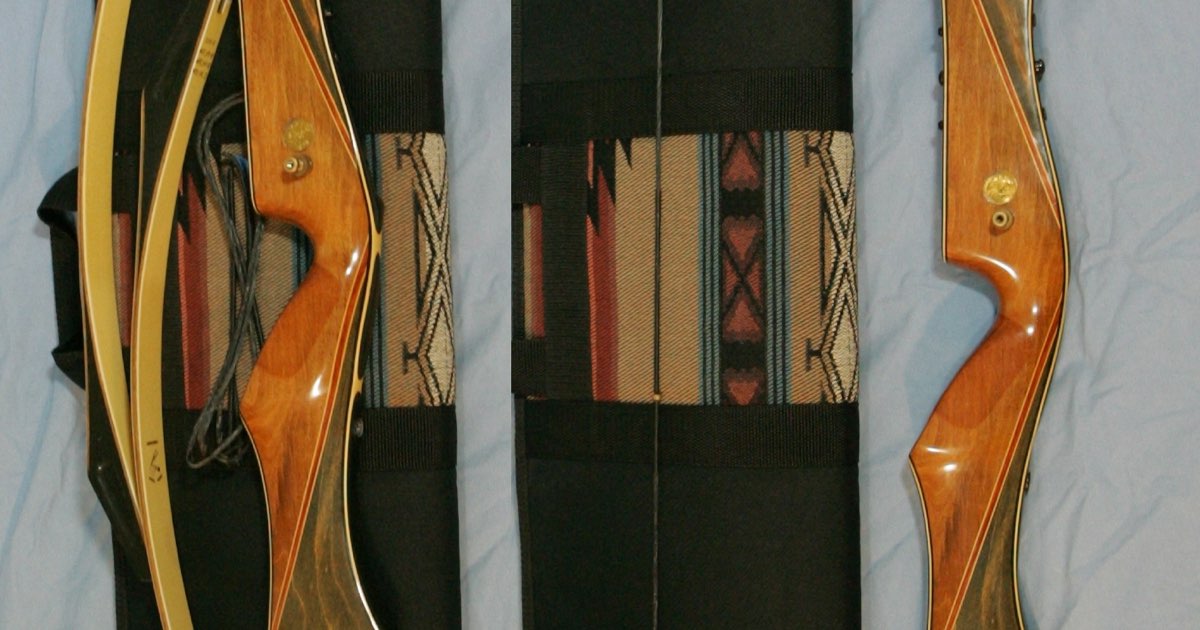
The company's Grizzly recurve shows the construction that replaced horn and sinew. Bear says the Grizzly has been "proving itself since 1950" and that "Mr. Bear made the last design change to the Grizzly in 1964." Today's version has a hard-rock maple riser and limbs of "clear maple backed and faced with high strength black fiberglass".
The Olympic recurve
World Archery states: "Recurve has been the bowstyle used at the Olympic Games since archery's reintroduction to the programme in 1972."
It describes "laminated carbon fibre and carbon foam in the limbs", notes that some makers still use bamboo, and says the riser "is often made of aluminium or carbon fibre". An Olympic recurve also carries a sight, stabilisers that "help to balance the bow and reduce vibration", and a clicker, "a device that checks the draw length". Our longbow vs recurve comparison explains how today's recurves differ from straight-limbed bows.
Recurve bow timeline
| Approximate date | Milestone (source) |
|---|---|
| 4th millennium BCE (disputed) | Earliest suggested composite bows (older theories, per Šaffa) |
| First half of 2nd millennium BCE | Full composite bow (Šaffa) |
| About 1550–1295 BCE | Egyptian composite bow sections (the Met) |
| By the 4th century BCE | Distinctive Scythian design (Šaffa) |
| 1719–20 CE | Turkish composite bow (the Met) |
| 1933 | Bear Archery founded (Bear) |
| 1950 | Grizzly recurve introduced (Bear) |
| 1972 | Recurve becomes the Olympic bowstyle (World Archery) |
If you want to read further, you can browse archery history books on Amazon. Look for titles that cite museum collections and archaeological finds. Want to shoot one? Start with our guide to choosing your first recurve bow.
Frequently asked questions
When was the recurve bow invented?
No one knows exactly. Gabriel Šaffa's 2025 review dates the full horn, wood and sinew composite bow to roughly the first half of the second millennium BCE; older theories reach back to the fourth millennium BCE. Any single year quoted online is a guess.
Who invented the recurve bow?
No individual. Šaffa argues the full composite bow arose once, probably in the Near East, and spread across Eurasia. Fred Bear is the best-known modern name, but Bear Archery credits him with the first fiberglass take-down bow, not with inventing the recurve shape.
Is a recurve bow the same as a composite bow?
No. Composite refers to construction from layers such as horn, wood and sinew; recurve refers to tips that curve away from the archer. The Met's Turkish bow is both. A modern Olympic recurve, with the carbon and foam limbs World Archery describes, is a recurve but not a horn composite.
Related articles
 Comparisons
Longbow vs Recurve Bow: Differences for Traditional Archers
Longbow vs recurve compared: limb shape, draw feel, hand shock, speed, length, accessories, competition rules, hunting and which traditional bow suits you.
Updated September 30, 2026 · 6 min read
 Guides
How to Choose Your First Recurve Bow: A Beginner's Guide
How to choose a first recurve bow: takedown vs one-piece, draw weight, bow length for your draw length, riser types, eye dominance, and essential accessories.
Updated February 6, 2025 · 11 min read
 Guides
Who Invented the Compound Bow? A Short History
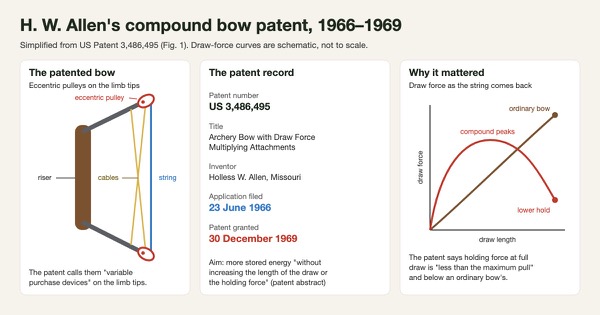
Who invented the compound bow, and why? Holless W. Allen's 1966 patent filing, the 1969 grant, and how his pulleys led to today's cams and let-off.
April 7, 2025 · 5 min read