
String Silencers and Limb Dampeners Explained
Bow string silencers, string stops and limb dampeners: what each does, where it fits, which need a bow press, and what maker claims do and don't prove.
By Archery Insider Editorial Team
· 5 min read
In this article
Bow string silencers and limb dampeners are rubber add-ons that absorb some of the vibration left in a bow after the shot, the source of much of its noise. Silencers fit on the string, string stops catch the string as it returns, and limb dampeners attach to the limbs. Hoyt's owner's manual says some of its bows come with dampers and silencers as standard "to decrease vibration and noise."
Why bow noise matters
Not all of a bow's stored energy goes into the arrow. The rest shakes through the string, limbs and riser, and that is the buzz and slap you hear. For bowhunters, the concern is a deer reacting to the sound and moving before the arrow arrives, often called "jumping the string."
Makers sell to that worry. LimbSaver says its string decelerator can help "prevent animals from jumping the string." That's a sales claim, not a measured result.
String silencers and string stops
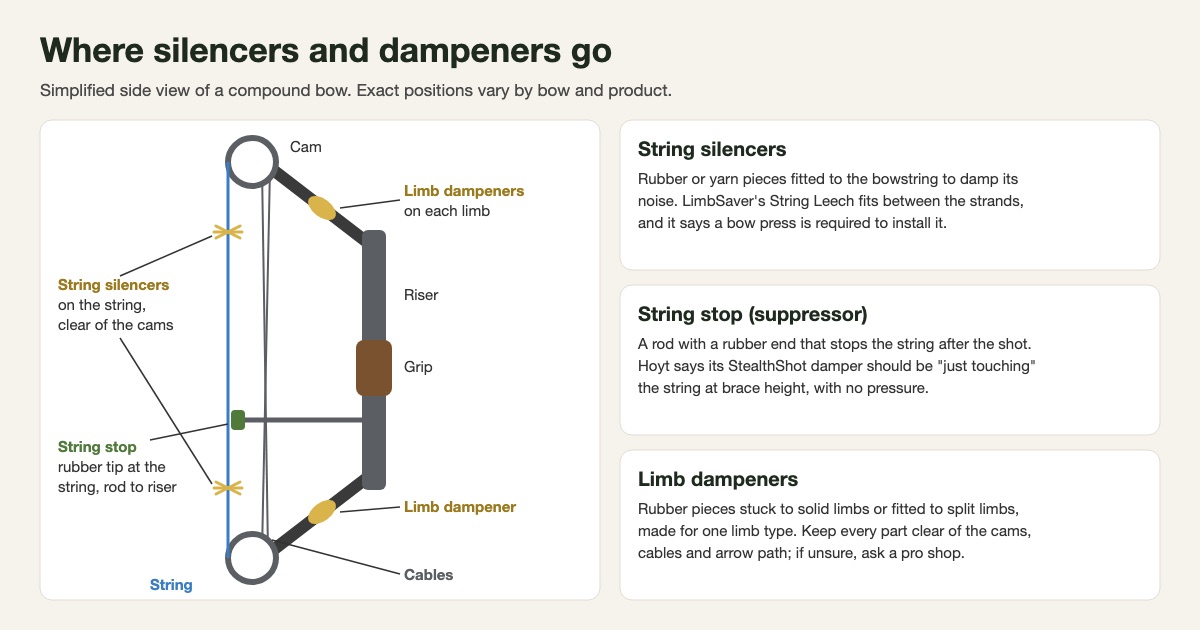
String silencers are small rubber or yarn pieces fitted to the bowstring. LimbSaver's Super String Leech is one example: the maker says it "installs between the strands of bow strings (bow press is required for installation)" and can be placed at various points along the string. It also claims the string comes to a stop "in nearly half the time after the shot." Fitting one is a similar job to tying in a peep sight.
String stops (also called suppressors or decelerators) work differently. A short rod mounts on the riser with a rubber tip just in front of the string at rest, so the string hits it on the way back. LimbSaver describes its Universal String Decelerator as a "progressive resistance pillar" that "slows bow string to a stop to minimize slapping noise," mounting to a stabilizer accessory hole. Hoyt says its own StealthShot damper should be "just touching the string at brace height (no pressure)."
| Part | Where it fits | Install note |
|---|---|---|
| String silencer | On the string, between the cams and grip | Between-strand types need a press |
| String stop | Riser, with a rubber tip at the string | Set to touch the string with no pressure |
| Limb dampener | On solid limbs or between split limbs | Buy the version made for your limb type |
Placement is where things go wrong. Hoyt's owner's manual says anything attached to the string or cables must be installed so it "cannot move or come off," that attached accessories must be "clear of string and arrow flight path," and that only its retailers should install string components. Its safety page says never to draw or shoot a bow without all string accessories, silencers included, "properly installed and secured to the string." If you change strings, they need moving to the new one, as our article on changing a bowstring explains.
Limb dampeners
Limb dampeners are rubber pieces that attach to the limbs to soak up limb vibration. LimbSaver makes separate versions for solid and split limbs. Its solid-limb Broadband dampener uses "industrial strength 3M adhesive," and both versions are listed as "not for use with crossbows."

LimbSaver says the Broadband dampener is "engineered to reduce up to 70% of vibration at wide frequency levels." The product pages we read don't explain how that figure was measured, so treat it as the maker's claim, not an independent test.
Dampeners wear out. Hoyt's manual says to "inspect them periodically and replace when wear is evident," notes that its dampers and silencers are "not covered under warranty," and says to always remove its LimbShox dampers before putting the bow in a press.
Is there a speed cost?
We couldn't confirm a figure for speed loss: none of the LimbSaver or Hoyt pages we read put a number on it, so we won't either. A shop with a chronograph can measure your own bow before and after.
Another route to a quieter shot is a dampened hunting stabilizer; our Bee Stinger Sport Hunter Xtreme review covers one. You can also browse bow string silencers or compound bow limb dampeners on Amazon. Treat any listing as an example to consider, and check it suits your limb type.
Frequently asked questions
How do you install bow string silencers?
It depends on the type. Silencers that fit between the string's strands, such as LimbSaver's String Leech, need the bow in a press, so a pro shop is the usual place. Wherever they go, they must stay clear of the cams, cables and arrow path and be fixed so they can't slide.
Do limb dampeners really work?
Makers say so: LimbSaver claims its Broadband dampener reduces up to 70% of vibration, and Hoyt's manual says some of its bows come with dampers "to decrease vibration and noise." We found no independent test, so expect a quieter feel rather than a guaranteed figure. Inspect them and replace any that show wear.
Related articles
 Training
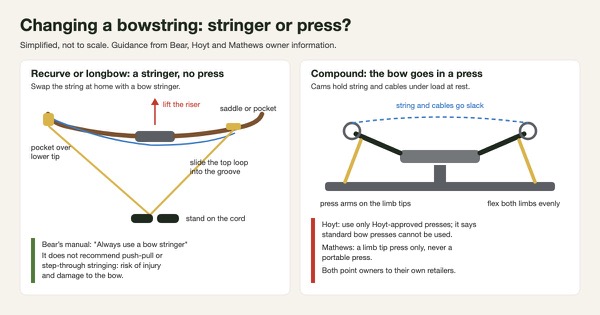
Changing a Bowstring: When You Need a Press
Changing a bow string without a press works on recurves and longbows with a stringer. Most compounds need a maker-approved press. Here's how to tell.
June 23, 2025 · 5 min read
 Gear
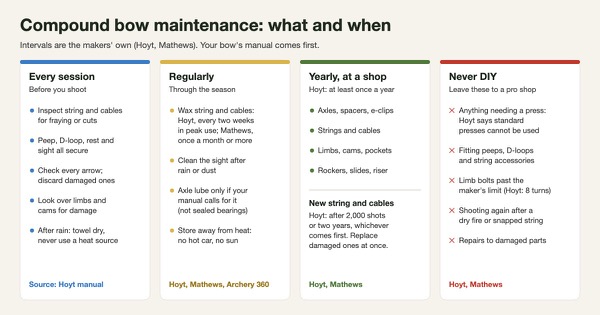
GearCompound Bow Maintenance Checklist
Compound bow maintenance by interval: what to check every session, how often makers say to wax, the yearly shop list, storage and the jobs never to DIY.
September 7, 2026 · 5 min read
 Gear
GearDoes Bowstring Colour Matter?
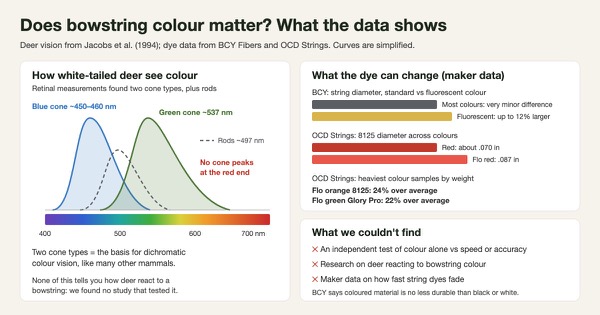
Does bow string color matter for hunting or accuracy? What deer vision research shows, what string makers measured about dyes, and how to choose a colour.
September 12, 2026 · 4 min read