
Spin Vanes Explained: Curled Vanes for Target Arrows
Spin vanes explained: what curled spin wing vanes do, why recurve target archers use them, rest clearance, and why they're taped on rather than glued in a jig.
By Archery Insider Editorial Team
· · 5 min read
In this article
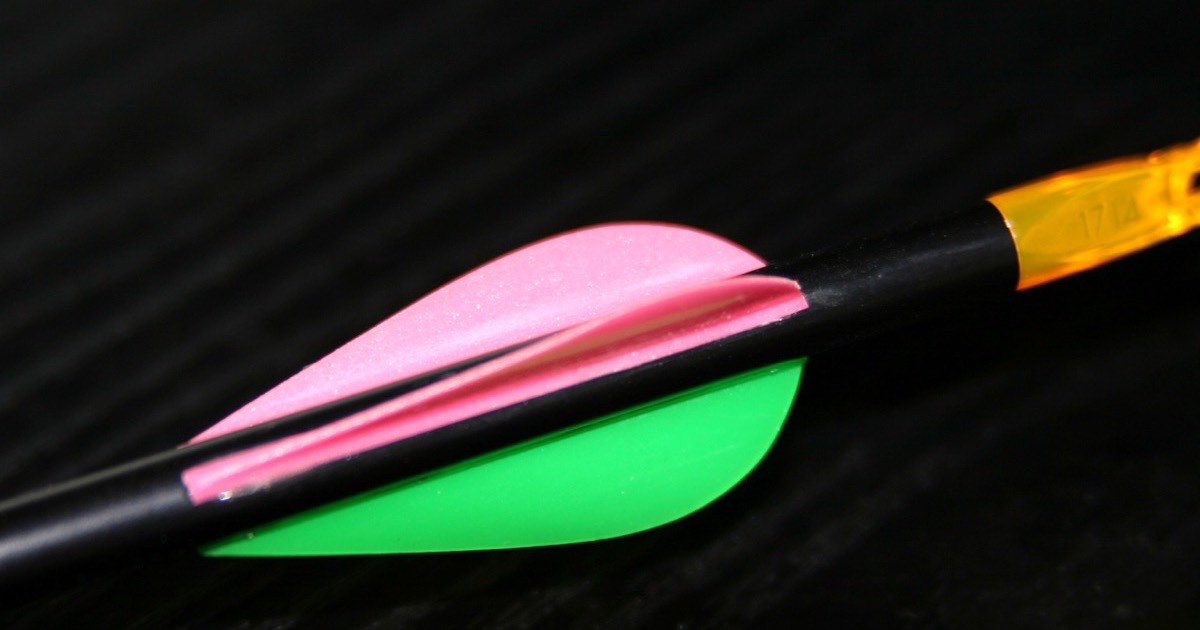
Spin vanes, often sold as spin wings, are thin plastic vanes with a strong built-in curl that makes a target arrow rotate quickly in flight. They are made for Olympic-style recurve archery, and unlike most vanes they are usually stuck on with double-sided tape rather than glued in a fletching jig.
What spin vanes are
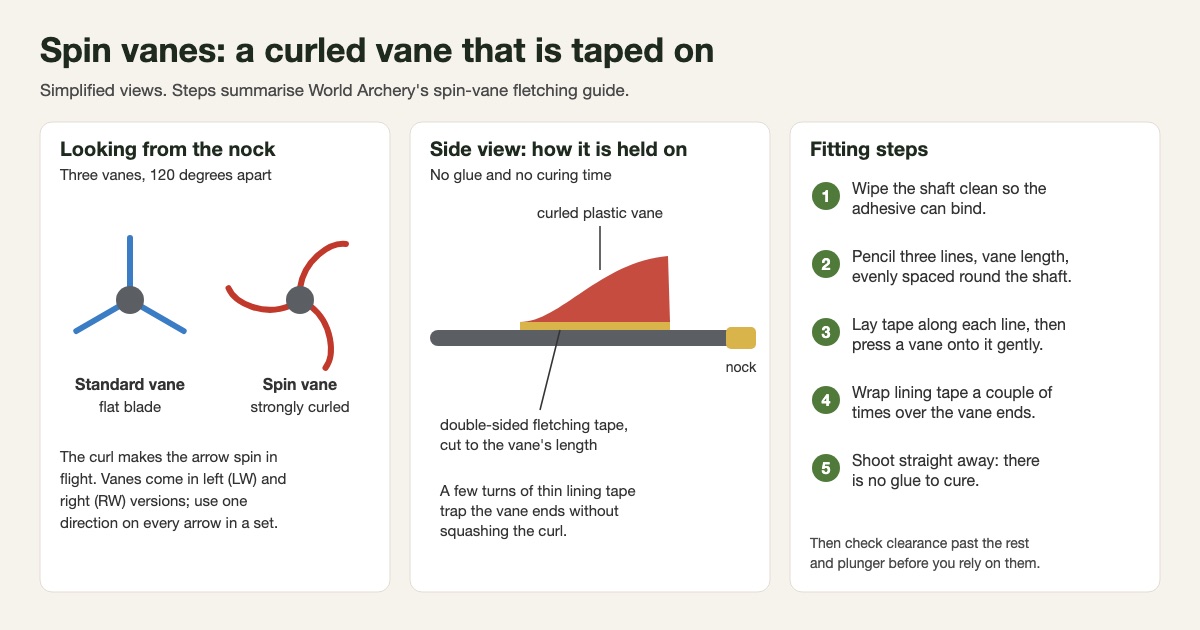
A standard vane is a flat plastic blade, sometimes glued at an angle to add spin. A spin vane builds the spin into the vane itself: seen from the nock, each one curls over like a small sail.
World Archery's explanation is simple: "These vanes work by making the arrow spin in flight... the rotating effect stabilises the arrow, making it potentially more accurate." Note the word "potentially": spin won't fix a badly matched arrow.
Spin vanes come in left and right versions because the curl has a direction. Easton's Spin Wing vanes are listed as RW, and Lancaster Archery lists Gas Pro spin vanes in LH and RH. Pick one direction and use it on every arrow in your set.
Why recurve target archers use them
Recurve target arrows are usually thin carbon shafts, and spin vanes are designed for them:
- Easton says its Spin Wing RW vanes are "designed specifically for recurve archery."
- Lancaster's listing says Gas Pro spin vanes were "developed for Olympic recurve shooters" and are "designed for small diameter shafts."
Archery 360 adds that compound arrows travel too fast for these vanes to work at their best, while recurve arrows benefit from the quicker rotation.
Some retailers add bolder claims about spin rates or 70-metre performance. We haven't found maker data behind them, so treat them as sales copy. On a first set of aluminium target arrows, such as those in our Easton XX75 Jazz review, ordinary small vanes or feathers work fine.
Clearance and rest choice
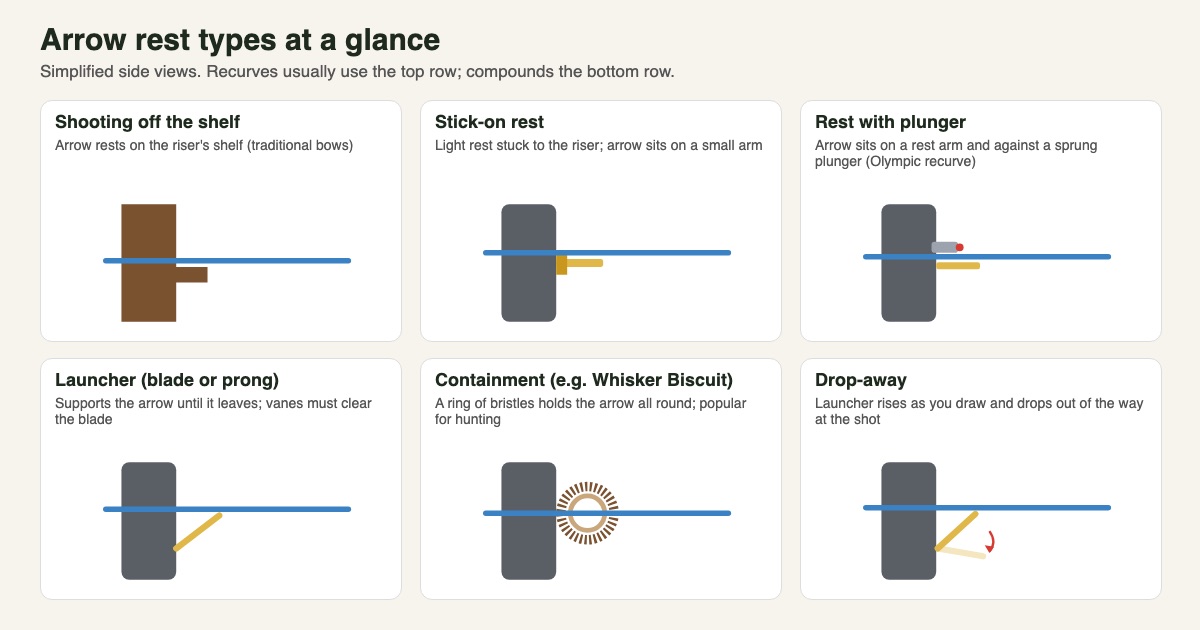
A curled vane is still stiff plastic, and if it strikes the rest or plunger the arrow is knocked off line. Our feathers vs vanes comparison explains why feathers forgive that contact and vanes don't.
Easton's tuning guide gives a simple clearance test: spray dry powder foot spray or similar on the back quarter of the arrow, the fletching, the rest and the sight window, shoot into a firm target, and look for where the powder is scraped off. If the fletching is hitting the rest, Easton suggests turning the nock in 1/32-turn steps until it clears, choosing a lower-profile fletching, or moving the plunger out slightly. Our guides to nock tuning and the plunger cover both adjustments.
Attaching spin vanes: tape vs glue
Most vanes are glued to the shaft in a fletching jig. Archery 360 notes that spin wings are different: they "are taped, making them easy to replace during competitions." Gas Pro packs include "double-side adhesive and wrapping tape," according to Lancaster's listing. Easton's page doesn't say how its Spin Wings attach, so follow your pack's instructions.
World Archery's method, in brief:
| Step | What to do |
|---|---|
| 1. Clean | Wipe the bare shafts free of dust and grime so the tape binds |
| 2. Mark | Pencil three lines the length of the vane, evenly spaced round the shaft |
| 3. Tape | Cut fletching tape to the vane's length and lay it along each line |
| 4. Fit | Clamp the vane, line its straight edge up with the tape, press it on gently |
| 5. Wrap | Wrap lining tape "a couple of times, but no more" to trap the vane ends without squashing their shape |
No glue means no curing time, and a damaged vane is quick to swap.
You can browse spin wing vanes on Amazon or search Easton Spin Wing vanes, one example to consider. Check the hand (LW or RW).
Frequently asked questions
Do you need a fletching jig for spin vanes?
Not to glue them, because they are taped on. World Archery's guide still lists a fletching jig, used to hold each vane straight while you press it onto the tape. The jig's clamp helps you place every vane in the same spot on every arrow, which matters more than the method.
Can you use spin wing vanes on a compound bow?
They are designed for recurves. Archery 360 says compound shooters avoid them because compound arrows fly too fast for these vanes to work at their best. Compound archers usually choose conventional vanes glued in a jig, sized and shaped to clear their rest.
Are spin vanes better than feathers for recurve?
It depends on the set-up. Spin vanes suit tuned Olympic recurves with a rest and plunger. Feathers forgive contact with the bow, which suits shooting off the shelf, so they remain the safer choice on traditional bows and less carefully tuned set-ups.
Related articles
 Comparisons
Feathers vs Vanes: Which Arrow Fletching Should You Use?
Feathers vs vanes compared: weight, forgiveness off the shelf, speed, drag, weather, durability, noise, rests, broadheads and which fletching suits your bow.
Updated September 30, 2026 · 5 min read
 Reviews
Easton XX75 Jazz Arrows Review: The Beginner Aluminium Standard
Research-based Easton XX75 Jazz review: 7075 alloy, ±.005 in straightness, sizes 1214 to 2016, how to pick a size for your recurve, and when to move to carbon.
Updated August 6, 2025 · 4 min read
 Training
How to Straighten Crushed Feather Fletching
How to straighten arrow fletchings: the steam-and-finger method a feather maker recommends, how to avoid scalds, when to re-fletch, and how to store arrows.
Updated October 6, 2026 · 5 min read