
Compound Bow Maintenance Checklist
Compound bow maintenance by interval: what to check every session, how often makers say to wax, the yearly shop list, storage and the jobs never to DIY.
By Archery Insider Editorial Team
· 5 min read
In this article
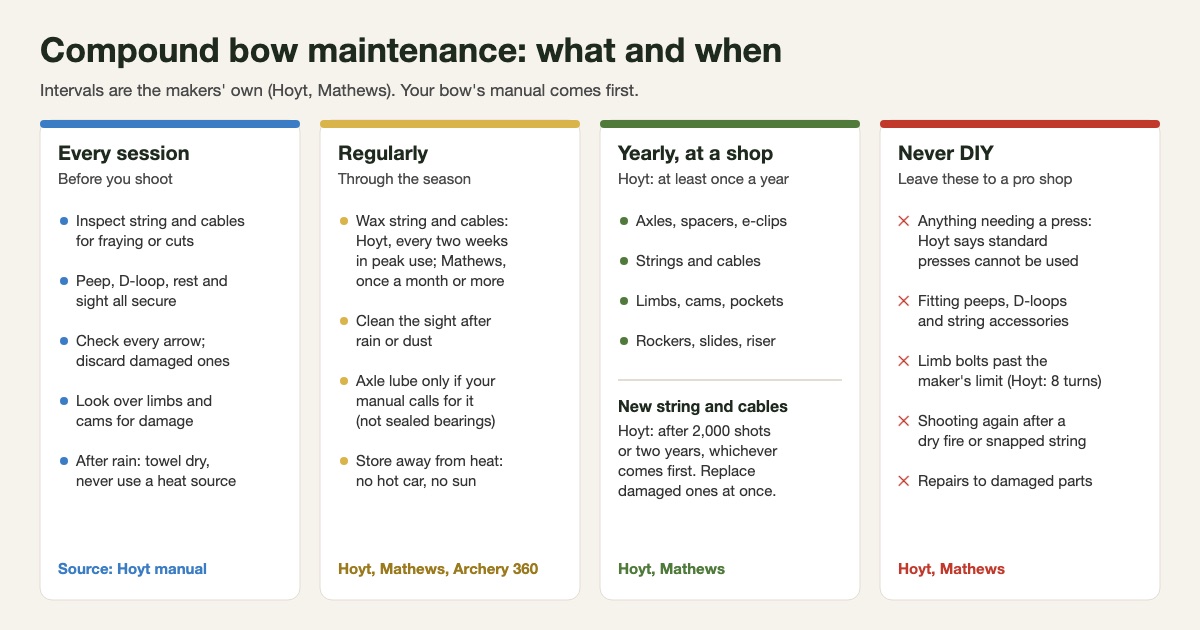
Compound bow maintenance comes down to three habits: inspect the bow before you shoot, wax and clean it through the season, and take it to a pro shop once a year. The intervals below come from the makers, mainly Hoyt and Mathews; your own bow's manual comes first. Anything that needs a bow press is not a home job.
Before every session
Hoyt's safety page asks you to "carefully inspect the condition of your bow, accessories, arrows, and your release aid" before each use. In practice: look along the string and cables for fraying, and check the peep, D-loop, rest and sight haven't moved. Mathews puts it plainly: "Replace damaged strings and cables immediately."
Hoyt's compound owner's manual also says to inspect your arrows for damage before each shot and to "discard all damaged arrows." Unsure whether a fuzzy patch matters? Our guide to whether you can repair a frayed bowstring explains how to tell wear from damage.
| When | What to do | Whose guidance |
|---|---|---|
| Every session | Inspect string, cables, accessories, arrows and release | Hoyt |
| After rain or dust | Towel dry; clean the sight | Hoyt, Archery 360 |
| Every two weeks to monthly | Wax string and cables | Hoyt, Mathews |
| Once a year | Pro shop inspection and service | Hoyt |
| 2,000 shots or two years | New string and cables | Hoyt |
Through the season: wax, clean and lube
Wax keeps strings and cables in good condition. Hoyt's manual says to apply "a light coat of bowstring wax" regularly and suggests "once every two weeks during peak use." Mathews' FAQ says to "wax your strings and cables once a month or more depending on the condition." Each figure applies to that maker's bows.
Cleaning matters most after bad weather. Archery 360 says to clean your bow "after shooting in adverse conditions, such as in rain or dust," and suggests canned compressed air for clearing a sight. Hoyt's manual says to towel-dry a wet bow and not to use a heat source to dry it.
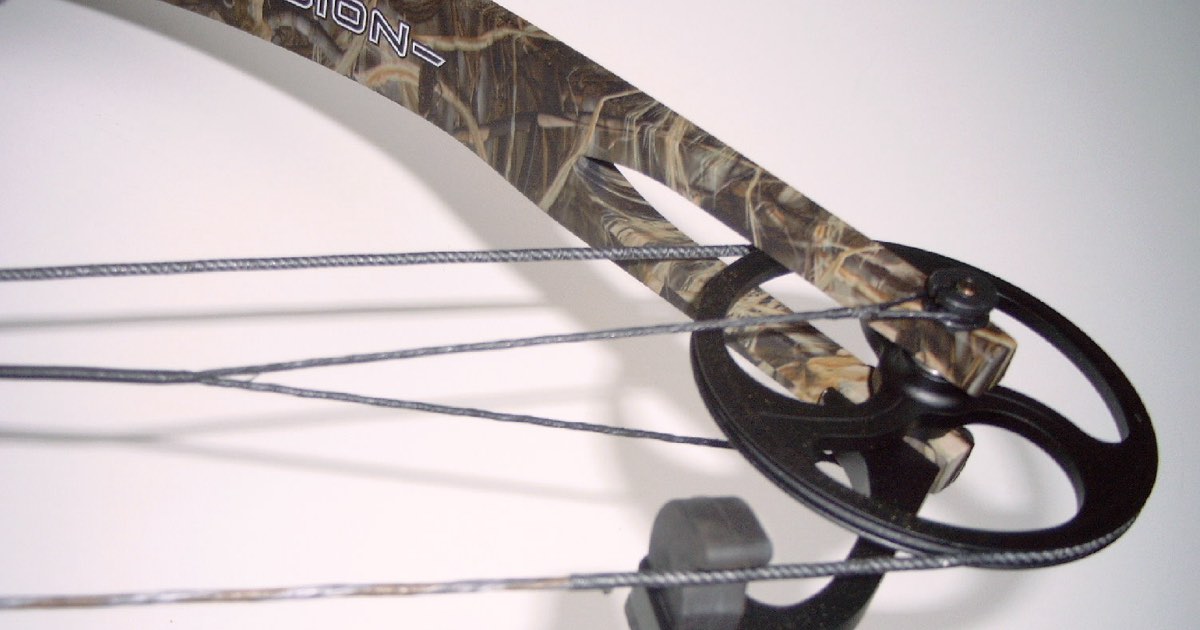
Lubrication depends on the bow. Hoyt's manual says its sealed ball bearings "do not require lubrication," while conventional bearings or bushings need a light spot of lube on the axles every 1,500 to 2,000 shots. It warns against penetrating oils such as WD-40. If your manual is silent, ask your shop.
The yearly pro-shop list
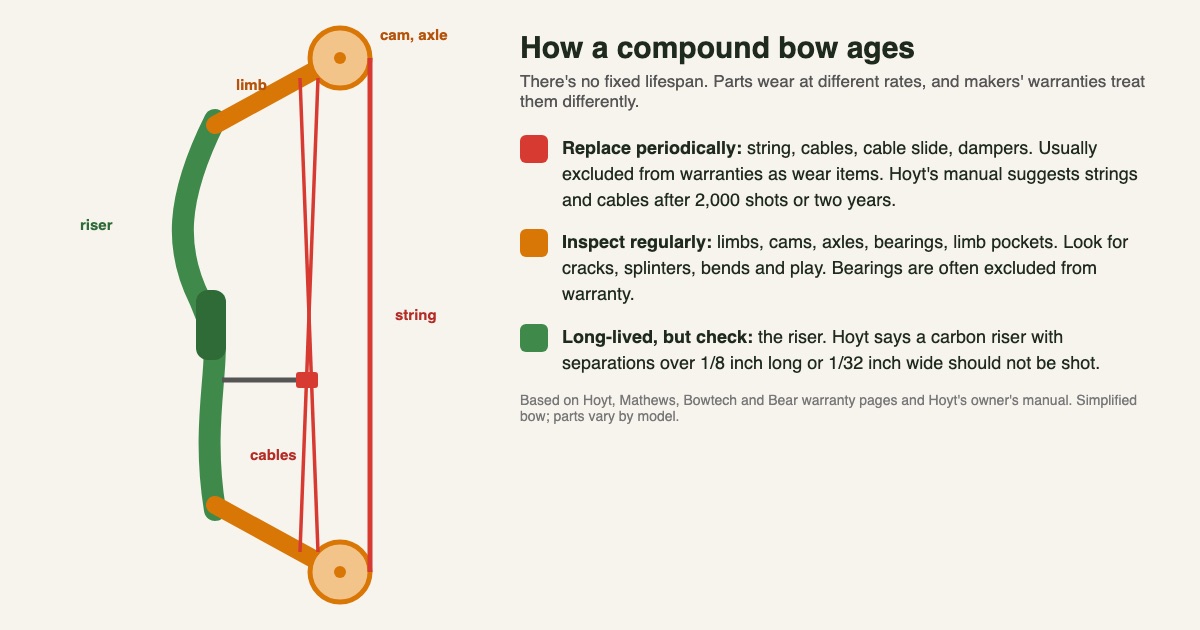
Hoyt recommends taking your bow to a Hoyt retailer "at least once a year for a professional maintenance, cleaning and inspection." Its checklist: axles, spacers, e-clips, strings, cables, limbs, cams, limb pockets, pocket rockers, cable slides and the riser.
Strings and cables are the main wear items. Hoyt recommends replacing them "after 2,000 shots or after two years, whichever comes first." Archery 360 shows how much usage changes that: an archer who shoots once a week might need a new string "every eight to 12 months," while someone practising six days a week and competing often "could be replacing their string every month."
Storage and what never to DIY
Heat is the main storage risk. Archery 360 warns against leaving a bow "in hot direct sunlight for extended periods of time, or in a hot car," and Hoyt says to "never expose your bow to extreme heat or prolonged moisture."
Some jobs need a shop:
- Anything that needs a press. Hoyt says "STANDARD BOW PRESSES CANNOT BE USED" on its bows, and Mathews says "only a limb tip press should be used." Our article on changing a bowstring explains why.
- String accessories. Hoyt recommends that only its retailers install peeps, D-loops and other string parts. See our peep sight installation guide for what that job involves.
- Limb bolts. Hoyt warns never to loosen them more than 8 turns, as the bow could "violently disassemble." Other makers set their own limits.
- After a dry fire. Hoyt says the bow should go back to Hoyt or a retailer "for inspection before any further use."
For the home jobs, you can browse bowstring wax on Amazon or bow maintenance kits. Treat any listing as an example to consider, and check your maker recommends the wax type.
Frequently asked questions
How often should you wax a compound bow string?
Follow your maker. Hoyt's owner's manual suggests a light coat once every two weeks during peak use, and Mathews' FAQ says once a month or more, depending on the condition of the strings. Check for fraying each time you apply it.
How often should a compound bow be serviced?
Hoyt recommends a professional maintenance, cleaning and inspection at least once a year, covering axles, cams, limbs, pockets, strings, cables and the riser. Get it checked sooner if you see damage, the bow has been dry fired, or it no longer holds its draw weight or timing.
Can I adjust compound bow limb bolts myself?
Small draw-weight changes within the maker's range are usually an owner adjustment. Mathews says both limb bolts must be turned equally, and Hoyt warns never to back them out more than 8 turns. If you're unsure of your bow's limit, ask a pro shop first.
Related articles
 Gear
GearString Silencers and Limb Dampeners Explained
Bow string silencers, string stops and limb dampeners: what each does, where it fits, which need a bow press, and what maker claims do and don't prove.
September 28, 2026 · 5 min read
 Gear
GearBows for Women: Fit Matters More Than Colour
Choosing a compound bow for women or a recurve? Draw length, draw weight, grip and mass weight matter more than a women's label. How to check each one.
August 24, 2026 · 5 min read
 Gear
GearBow Grip Wraps and Tape: Do They Help?
Does compound bow grip tape or a grip wrap help? What a wrap changes for comfort, wet hands and cold risers, and why it can't fix torque.
Updated October 6, 2026 · 4 min read