
Filming Your Hunt: Stabilizer and Tree Cameras
Bow stabilizer camera, tree arm or head cam? How each films a bowhunt, why bow-mounted footage shakes, phone mounts, state rules and filming ethics.
By Archery Insider Editorial Team
· · 5 min read
In this article
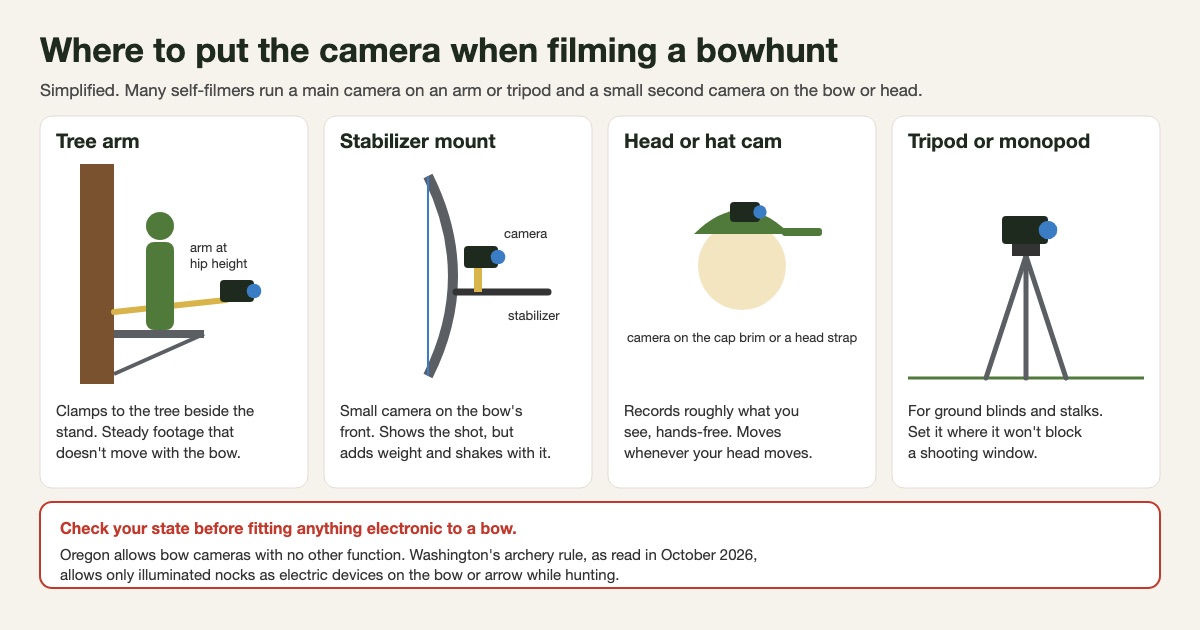
A bow stabilizer camera films the shot from your own bow, but it moves and shakes with the bow, so self-filming guides treat it as a second angle. The steady main footage usually comes from a camera on a tree arm beside the stand, or a tripod on the ground. Check your state's rules before fitting anything to the bow.
Bow-mounted vs tree arm vs head cam
| Camera position | What it films | Weight on the bow | Main drawback |
|---|---|---|---|
| Stabilizer or bow mount | The shot from behind the arrow | Yes | Moves and shakes with the bow |
| Tree arm | You and the animal, steadily | None | Extra kit to carry and set |
| Tripod or monopod | Ground-level scenes | None | Takes space in a blind |
| Head or hat cam | Roughly what you see | None | Moves whenever your head moves |
For the main camera, Josh Honeycutt's Archery Business guide to self-filming says "a camcorder style camera is best", and it suggests GoPro action cameras for alternate angles.
Fourth Arrow's self-filming guide explains where to put the tree arm. At full draw, a right-handed shooter covers angles to the left easily, but shooting to the right "quickly gets very awkward". That awkward zone is the place for the camera: "A right handed shooter should have the camera at hip height on his/her right." Left-handers reverse it. Hip height, it says, is "low enough that you can still shoot over it".
One example: Fourth Arrow lists its Stiff Arm at 1 lb 13 oz for the arm alone, 32 inches long with 38 inches of reach, rated for 10 lb. Those are maker figures.
Stabilizer-mount cameras and balance
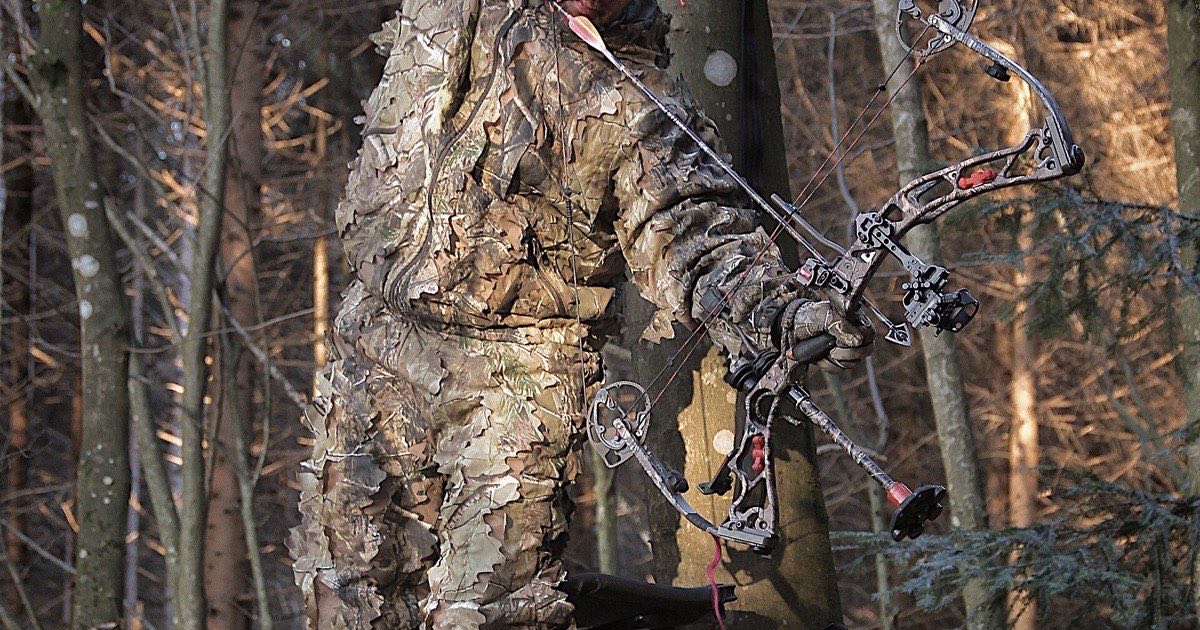
A bow camera films the shot from the archer's side. The trade-offs come from where it sits. As the name says, a stabilizer camera mounts on or at the stabilizer, which sits in a threaded bushing below the grip on most modern bows, as our Bee Stinger Sport Hunter Xtreme review explains. That puts extra weight out front.
Weight away from the riser changes how a bow holds and moves after the shot, and footage jumps when the bow recoils. After fitting a mount, shoot again at known distances to confirm your sight marks, and check nothing rattles.
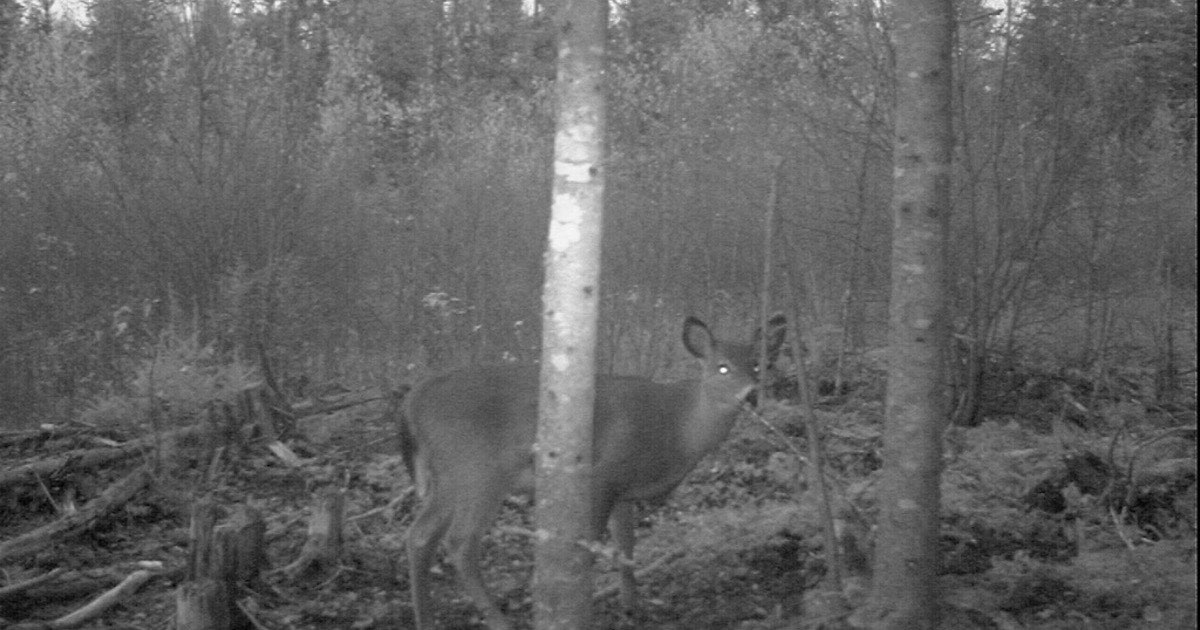
A 2016 article on Fourth Arrow's blog reported Grant Woods's conclusion that point-of-view cameras are good for "getting footage of the hunter taking the shot", with Woods adding: "You can see very little of what is going on at twenty or thirty yards". Cameras have improved since; treat it as one view.
For a bow hunting phone mount, one option is to put the phone on the arm, not the bow. Fourth Arrow says its phone mount's grip extends to 3.75 inches, fits a phone "with a case on" and attaches to the quick-release plate of its video heads.
Legal note: cameras on bows
Rules on electronic devices attached to bows vary. Oregon's wildlife department says hunters shall not use electronic devices attached to a bow or arrow, except lighted nocks and "cameras that have no other function (such as range-finding)". Washington's archery rule, WAC 220-414-070, as we read it in October 2026, says: "It is unlawful to have any electrical equipment or electric device(s), except for illuminated nocks, attached to the bow or arrow while hunting."
We haven't checked every state, so read your agency's current regulations before fitting a camera to a bow.
Ethics of filming
The animal comes first: never take a longer or worse shot to suit the camera. Fourth Arrow's advice to "zoom out" helps, leaving a margin so a deer can't step out of frame while you draw.
Footage can also help recovery. Woods said that with a proper camera he can "see where an arrow hit exactly" and decide whether to follow up or wait. Compare what you see with our deer shot placement guide.
For examples to consider, you can browse tree camera arms on Amazon or look at bow camera mounts. For a ground set-up, our tree stand vs ground blind comparison explains the difference in shooting angles.
Frequently asked questions
Does a bow stabilizer camera affect accuracy?
It can change how your bow balances, because it adds weight at the front, and it moves with the bow at the shot. After fitting one, confirm your sight marks at known distances, and check your state allows cameras on bows.
Can I use my phone to film a bowhunt?
Yes, many hunters start that way. Mount the phone on a tree arm or tripod rather than the bow, using a phone clamp on a video head; Fourth Arrow's, for example, fits phones in cases. Practise in low light and carry spare power.
Related articles
 Comparisons
Tree Stand vs Ground Blind for Bowhunting
Tree stand vs ground blind for bowhunting deer: view, hiding your draw, scent, shot angle, safety and setup compared, with when to choose each.
Updated October 6, 2026 · 5 min read
 Reviews
Bee Stinger Sport Hunter Xtreme Review: A Hunting Stabilizer
Bee Stinger Sport Hunter Xtreme review: 6, 8 and 10-inch carbon rods, Sims dampener, removable 1 oz weights, how to choose length and weight, and who it suits.
June 10, 2026 · 6 min read
 Gear
GearBow Hangers for Tree Stands and Ground Blinds
Deer hunting bow hangers explained: screw-in vs strap-on for tree stands, public-land rules on tree damage, ground blind hangers and haul line safety.
September 5, 2026 · 5 min read