
Archery Target Repair: Bags, Blocks and Foam
Archery target repair for bag, block and layered-foam targets: rotation, compacting, replacement covers and when a worn target should be retired.

By Archery Insider Editorial Team
· · 5 min read

In this article
Archery target repair for bags, blocks and layered foam is mostly about spreading wear before a hole forms: rotate the target, move your aiming spot, and compact or tighten the material as it loosens. Once a bag's cover splits, a replacement cover from the maker can save the target. Once arrows start passing deep or through, retire it.
Bag targets: rotate, compact and re-cover
A bag target is a woven cover stuffed with fill. Arrows push the fill aside, and after enough shots in one place the fill thins out and arrows go deeper.
Morrell's target care page gives a clear rule: rotate bag targets every 75–100 shots and change the bullseye you aim at often.
When a well-used side goes soft, Morrell suggests you "lay your target face down on the side with the most shots into it" and "stomp heavily on the back side of the target." That pushes the fill back towards the worn face. Morrell also notes that hanging a bag by its eyelets lets it swing, and that swing soaks up some of the arrow's energy.
When the cover itself splits or the faces are shot out, check whether the maker sells a replacement cover. Morrell, for example, sells one for its Outdoor Range Target. A cover only makes sense if the inside is still sound. Follow the maker's fitting instructions.
Layered foam: rotate and compress
Layered foam targets stack sheets of foam, held together by straps, bands or a frame. On open-layer designs, the unglued layers grip the arrow shaft by friction, which is why arrows usually pull out easily. As layers wear, they loosen and lose that grip.
Two habits keep them working:
- Rotate the target so you shoot across fresh layers rather than wearing one band.
- Re-tighten the straps or compression hardware if your target has them and the maker allows it. Tighter layers stop arrows sooner.
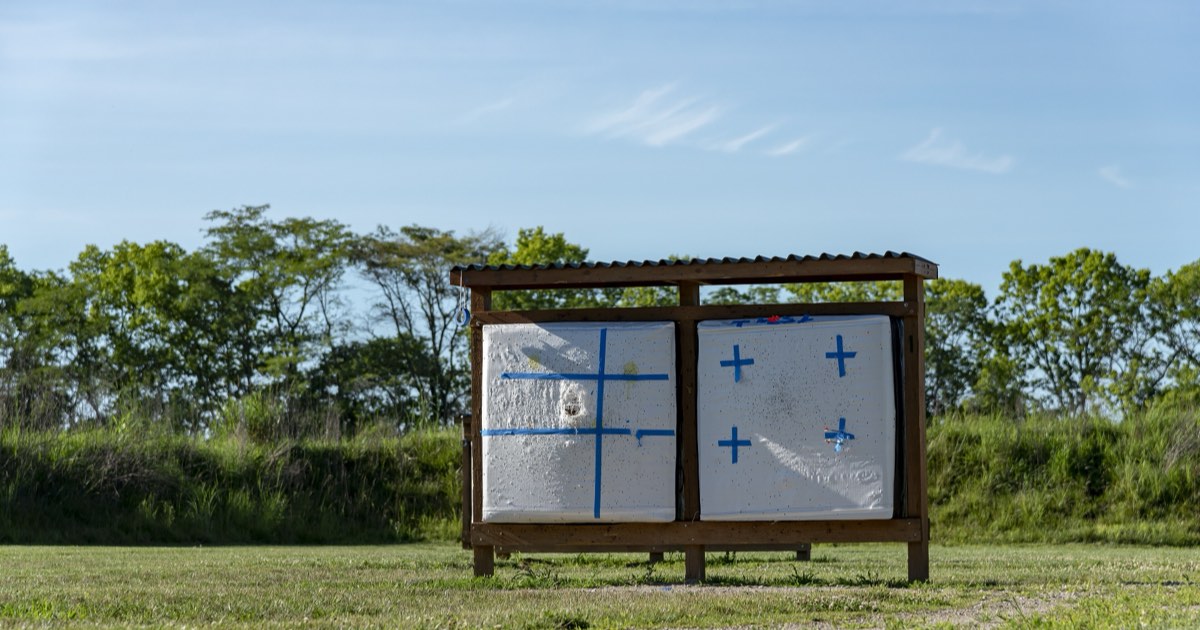
Block targets: work every face
Solid foam block targets have no fill to compact and no layers to tighten, so rotation does nearly all the work. Shoot every printed face, use every spot on each face, and turn the block between sessions.
Here is how the three types compare:
| Target type | Main wear | Routine care | Retire or re-cover when |
|---|---|---|---|
| Bag | Fill thins at the shot spot | Rotate every 75–100 shots (Morrell); compact fill | Cover splits or arrows go deep |
| Layered foam | Layers loosen and shred | Rotate; re-tighten straps or frame | Arrows pass deep even after tightening |
| Solid block | One spot shot out | Shoot every face and spot | Arrows pass deep on most faces |
For a side-by-side look at a fused-layer target and an open-layer block, see our Morrell Yellow Jacket vs Block Classic comparison.
Arrow removal and storage
Hard pulls wear targets as well as arms. Morrell says "making sure that practice tips match the arrow shaft diameter will increase the ease of arrow removal." Our arrow selection guide covers matching points to shafts.
Pull straight back along the arrow's line, and steady the target with your other hand. Some archers use arrow lubricant on the front of the shaft for dense foam; check your target maker's advice before trying it.
Morrell describes its targets as "weather-resistant, but not weatherproof" and recommends storing them under shelter or indoors when not in use. It is sensible advice for any bag or foam target.
When the shooting surface is worn but the rest is sound, you can browse replacement target covers on Amazon or search Morrell replacement covers. Check that a cover is listed for your exact target model.
A worn target that lets arrows through is a safety risk. Keep a proper backstop behind it, as our backyard range guide explains.
Frequently asked questions
How often should I rotate my archery target?
Morrell recommends rotating bag targets every 75–100 shots and changing the bullseye you shoot at frequently. The same principle helps foam blocks and layered targets: spread your shots over every face and spot so no single area wears through. Tight groups in one spot wear any target faster.
Can you buy a replacement bag for an archery target?
Some makers sell replacement covers for specific bag targets. Morrell, for example, offers one for its Outdoor Range Target. A cover only makes sense if the rest of the target is sound, and it must match your exact model. Check the maker's site for the part and its fitting instructions.
Is there an archery target repair kit for bags and foam?
Pour-in repair kits are mainly made for 3D targets. For bag and layered foam targets, repairs are simpler: compact the fill, tighten straps or the frame, rotate the target, and fit a replacement cover if the maker sells one. Once arrows pass deep or through, replacing the target is safer.
Related articles
 Reviews
Morrell Yellow Jacket YJ-350 vs Block Classic 18: Which Backyard Target?
Morrell Yellow Jacket YJ-350 vs Block Classic 18: published specs, fused versus open-layer foam, sides, speed rating, arrow removal, and which target suits you.
April 24, 2025 · 4 min read
 Guides
How to Set Up a Safe Backyard Archery Range
How to set up a safe backyard archery range: legal checks, safe buffer distances, backstops and netting, choosing a target, layout and house rules.
April 8, 2026 · 8 min read
 Gear
GearHow to Repair a 3D Archery Target
How to repair 3D archery targets: when a replacement core does the job, how pour-in repair foam works, and when it is time to buy a new target.
Updated October 6, 2026 · 5 min read