
How to String a Longbow Safely
How to string a longbow or other traditional bow with a stringer: fitting the pocket and saddle, seating both loops, checking brace height and unstringing.
By Archery Insider Editorial Team
· 4 min read
In this article
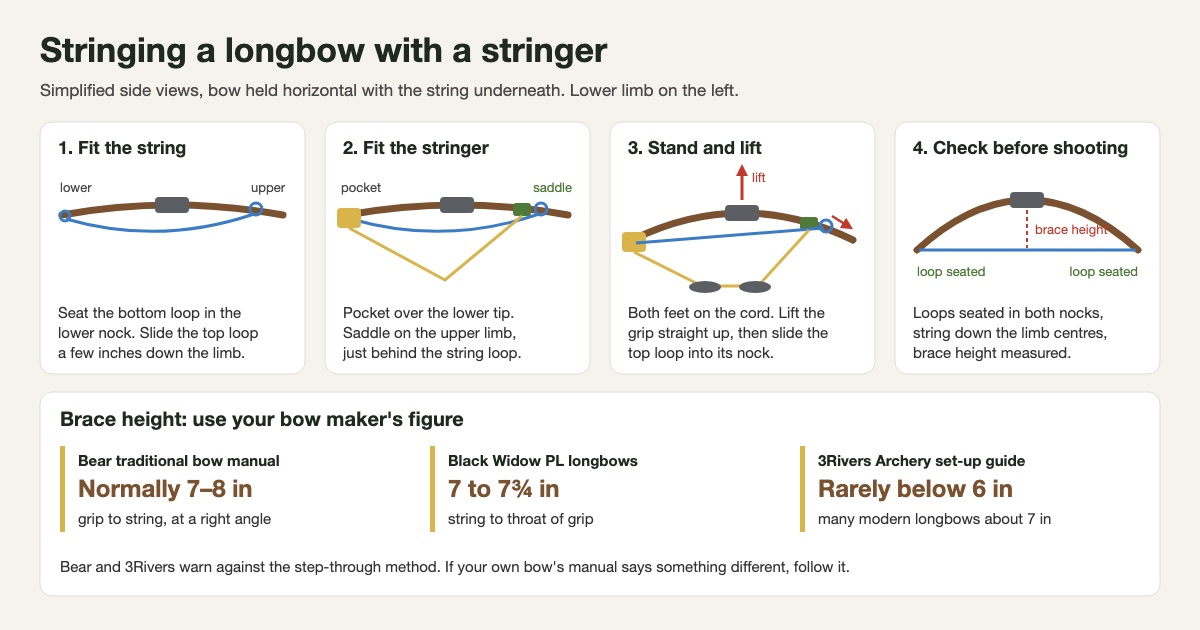
To string a longbow, fit a bow stringer with its pocket on the lower tip and its saddle on the upper limb, stand on the cord and lift the grip, then slide the top loop into its nock. Afterwards, check both loops are seated and measure brace height against your bow maker's figure. Bear's traditional bow manual is direct: "Always use a bow stringer."
Why a stringer, not step-through
A stringer bends both limbs evenly while your face stays clear of the tips. Bear's manual says it "does not recommend the 'push-pull' or 'step-through' methods, as these could result in injury to the archer or damage to the bow," and its warranty excludes "improper stringing." 3Rivers Archery says step-through "is totally unsafe for you and the bow, and should NOT be done, even in a pinch." Black Widow's warranty excludes damage "during the stringing or unstringing process."
If your own bow's manual says something different, follow it.
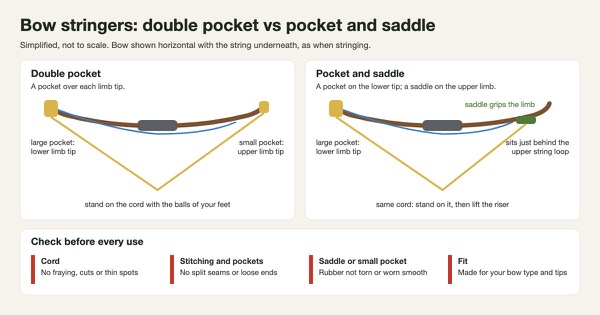
A pocket-and-saddle stringer suits most longbows, because the saddle grips the limb rather than the slim tip. Our bow stringers guide compares designs.
How to string a longbow, step by step
- Check the string. Bear says it should be about 3 in shorter than the bow; our longbow length guide explains bow length.
- Fit the loops. Seat the bottom loop fully in the lower nock. Slide the top loop a few inches down the upper limb.
- Fit the stringer. Archery 360 says to place the saddle "over the limb just behind the string loop," with the pouch on the lower tip.
- Stand on the cord. With the bow horizontal and the string underneath, Archery 360 says to "step onto the bow-stringer with both feet about shoulder-width apart."
- Lift and slide. "Hold the bow by its grip and pull straight up to flex its limbs," it says, then slide the top loop into its nock with your free hand.
- Ease down slowly, watching the top nock, and remove the stringer.
The method matches our recurve stringing guide, which also covers takedown assembly.
Checks after stringing
| Check | How | If it's wrong |
|---|---|---|
| Both loops seated | Archery 360: "Check to ensure the string is secured in both string grooves" | Unstring and restring |
| String alignment | Sight down the string; it should run down the centre of both limbs | Unstring and ask the bowyer before shooting |
| Brace height | Measure from the deepest part of the grip to the string with a bow square | Add or remove twists (below) |
Brace height for longbows
Bear defines brace height, or "fistmelle," as the distance from the string to "the deepest cut in the handle/grip area measured at a right angle to the string," and says it "normally measures between 7"-8"." Black Widow lists 7 to 7¾ in "from string to throat of grip" for its PL longbows. 3Rivers says longbows "generally are never braced lower than six inches," and many modern longbows "like to be braced at or around seven inches."
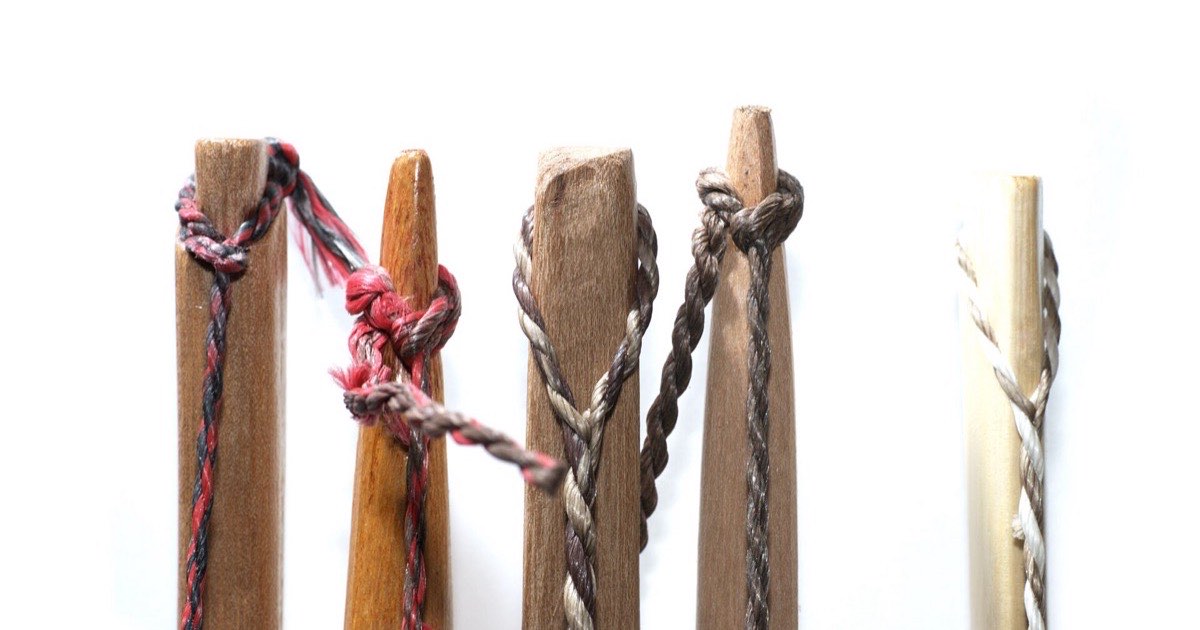
To raise brace height, add twists in the direction that tightens the centre serving, Bear says. 3Rivers warns that Flemish strings "rely on opposing twists to stay together," so take care removing twists. Bear notes a new string "will stretch slightly after being shot a few times," so recheck if you notice more "noise, vibration, or wrist slap."
Unstringing and storage
Unstring with the stringer: fit it, stand on the cord, lift, and slide the top loop out of its nock before lowering. Bear says to hang an unstrung bow "vertically with the lower tip off the floor" or across two pegs, and not to leave it in a vehicle in the sun, because "extremely high temperatures can cause the limbs to twist."
If your bow didn't come with one, you can browse longbow stringers on Amazon. One example to consider is the Bear Archery A100LBS Long Bow Stringer. Check that it suits your bow's length and tips.
Frequently asked questions
How do you string a traditional bow without a stringer?
Bear and 3Rivers both advise against it. Bear says push-pull and step-through methods "could result in injury to the archer or damage to the bow," and its warranty excludes improper stringing. Unless your bowyer's manual describes another method, buy a stringer first.
Should you unstring a longbow after shooting?
Bear says a bow may be left strung "for a week or so, but not for longer periods." Unstrung, it should hang vertically with the lower tip off the floor or rest across two pegs, away from heat. Check your own bow's manual too, because bowyers' advice can differ.
Related articles
 Training
How to String and Unstring a Recurve Bow Safely
How to string and unstring a recurve bow with a stringer, why step-through stringing twists limbs, post-stringing checks, brace height and string care.
Updated February 1, 2025 · 8 min read
 Gear
GearBow Stringers: Types and Why You Need One
What a recurve bow stringer does, double-pocket vs pocket-and-saddle types, longbow fit, why makers warn against step-through stringing, and what to inspect.
July 19, 2025 · 4 min read
 Comparisons
Longbow vs Recurve Bow: Differences for Traditional Archers
Longbow vs recurve compared: limb shape, draw feel, hand shock, speed, length, accessories, competition rules, hunting and which traditional bow suits you.
Updated September 30, 2026 · 6 min read