
How to Straighten Crushed Feather Fletching
How to straighten arrow fletchings: the steam-and-finger method a feather maker recommends, how to avoid scalds, when to re-fletch, and how to store arrows.
By Archery Insider Editorial Team
· · 5 min read
In this article
To straighten arrow fletchings made of feather, hold the crushed feathers briefly in steam, then smooth them back into shape with your fingers and let them dry. Gateway Feathers, a fletching maker, puts it simply: "Use steam and finger pressure to repair wrinkled feathers." If a feather has come loose at the base or the quill is split, re-fletch the arrow instead.
Why feathers flatten
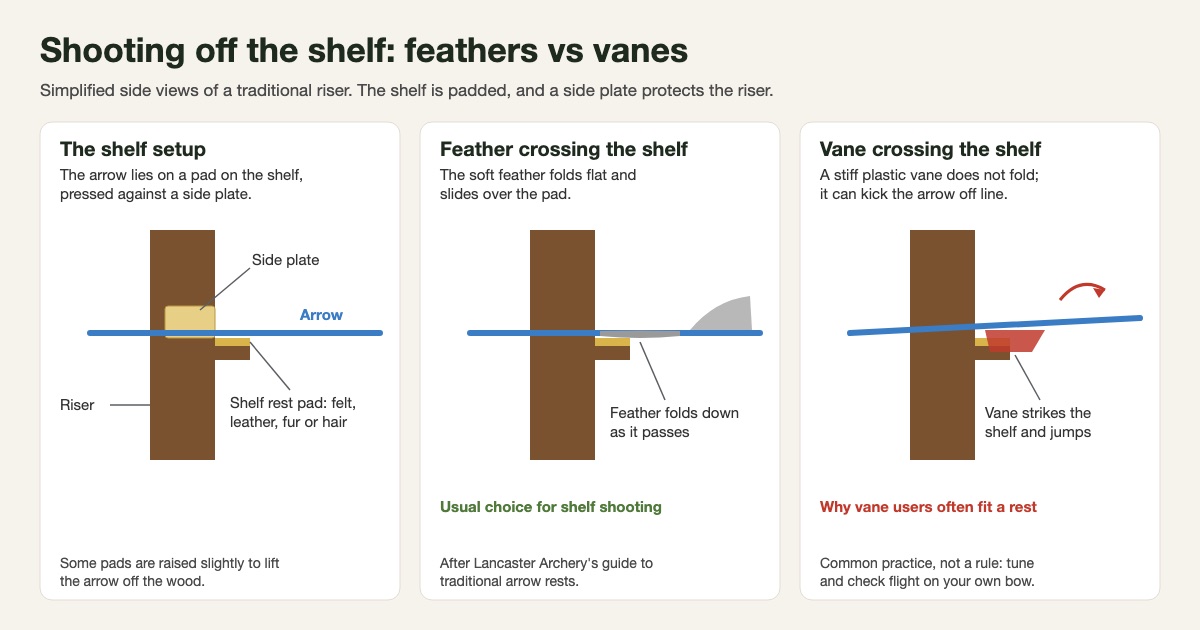
Feathers give way. When one brushes the shelf or rest, it folds flat and springs back, which is why traditional archers shooting off the shelf use them. Our feathers vs vanes comparison covers that trade-off.
The same softness means feathers get bent out of shape by:
- Other arrows. Archery 360 notes that "fletching can tear if the arrows hit against each other on the target."
- Rest contact. Archery 360 blames "improper nock rotation, an improperly tuned bow and bad drop away rest timing."
- Tight cases and quivers, which press feathers flat.
- Rain. Wet feathers mat down. Trueflight, another feather maker, suggests waterproofing powder or a plastic bag over the fletching.
The steam method, step by step
Gateway's instruction is the core: steam plus finger pressure. Most archers use a kettle at home:
- Boil a kettle on a stable surface so steam comes from the spout.
- Hold the arrow by the shaft and pass the crushed feathers through the steam, a little above the spout, a few seconds at a time.
- Turn the arrow so each feather gets some steam, and watch for it to lift.
- Smooth with your fingers once it has cooled, stroking from base to tip.
- Let it dry fully before it goes back in the quiver, then check that each feather is still firmly glued along its base.
Plastic vanes are a different story. As Gateway puts it, "feathers are not like vanes," and Easton warns that "if the rear of any hard vane is bent, it will produce a rudder effect, causing large deviation in impact." Replace bent vanes.
When to re-fletch instead
Feathers tolerate more damage than you might think. Easton says "fletching that is slightly damaged will not usually affect arrow grouping unless you shoot a hard or rigid vane." Trueflight says edge wear "seems to have no effect on their performance."
| What you see | What to do |
|---|---|
| Wrinkled or flattened feather, base firmly glued | Steam and smooth it |
| Small nicks or ragged edges | Keep shooting; Gateway says small gaps don't hurt flight |
| Feather lifting from the shaft at either end | Re-glue or re-fletch before shooting it again |
| Split quill or a feather torn away | Re-fletch |
The lifting row matters most. Easton warns that with a loose fletch the arrow "may not even hit the target past 30 yards (meters)." Archery 360 adds that with feathers, "loose sections will cause poor arrow flight."

To re-fletch, Easton says to pull the old feathers off "by hand or with pliers," wipe the area with lacquer thinner, then 91% isopropyl alcohol. A jig keeps the new feather in line; our Bohning Tower Jig review covers one. Use the same feather size and shape as the rest of the set: Gateway suggests building arrows within 3 grains of each other, and our arrow selection guide explains why matching matters.
Storing feathered arrows
- Give the fletching room so feathers don't press against each other or the case.
- Bag spare feathers. Gateway says zip lock bags keep them "fresh, dry and ready to use."
- Waterproof before wet days. Gateway says its powder treatment should last a tournament or a hunting season.
If you need to re-fletch, you can browse arrow fletching glue or replacement feather fletching on Amazon. Match the wing and size of your existing feathers.
Frequently asked questions
How do you fix arrow fletchings?
It depends on the damage. Crushed feathers that are still glued can be steamed and smoothed by hand, as Gateway Feathers recommends. Feathers or vanes lifting at the base need re-gluing or re-fletching, and bent plastic vanes should be replaced rather than reshaped.
Can you straighten plastic vanes with steam?
The steam method is for feathers. Gateway Feathers recommends it for wrinkled feathers and notes that "feathers are not like vanes." Easton warns that a hard vane bent at the rear creates "a rudder effect" and large misses, so replace a bent vane.
Do damaged feathers affect accuracy?
Small nicks and worn edges usually don't. Easton says slightly damaged fletching "will not usually affect arrow grouping" unless the vanes are hard, and Gateway agrees small missing portions don't hurt flight. A feather loose at the base is different: Easton warns the arrow won't group.
Related articles
 Comparisons
Feathers vs Vanes: Which Arrow Fletching Should You Use?
Feathers vs vanes compared: weight, forgiveness off the shelf, speed, drag, weather, durability, noise, rests, broadheads and which fletching suits your bow.
Updated September 30, 2026 · 5 min read
 Guides
How to Choose Arrows: Spine, Length, Weight and Spine Charts
How to choose arrows: what spine means, reading a spine chart, measuring arrow length, arrow weight and FOC, fletching, and bare-shaft tuning to confirm it.
Updated June 26, 2026 · 9 min read
 Reviews
Bohning Tower Jig Review: Fletch Three Vanes at Once
Bohning Tower Jig review: fletching three vanes at 120 degrees, straight, offset and helical arms, clamps and centring pins, shaft sizes, and how to use it.
June 4, 2025 · 6 min read