
How to Aim When Bowfishing: Refraction Explained
Bowfishing how to aim: why refraction makes fish look higher, published aim-low rules of thumb, how depth and angle change the hold, and polarised glasses.
By Archery Insider Editorial Team
· · 4 min read
In this article
When bowfishing, aim below the fish you see. Light bends as it leaves the water, so a fish is always deeper than it looks, and how far low you hold depends on the fish's depth and your shot angle. Published rules of thumb give a starting point, but practice sets your real hold.
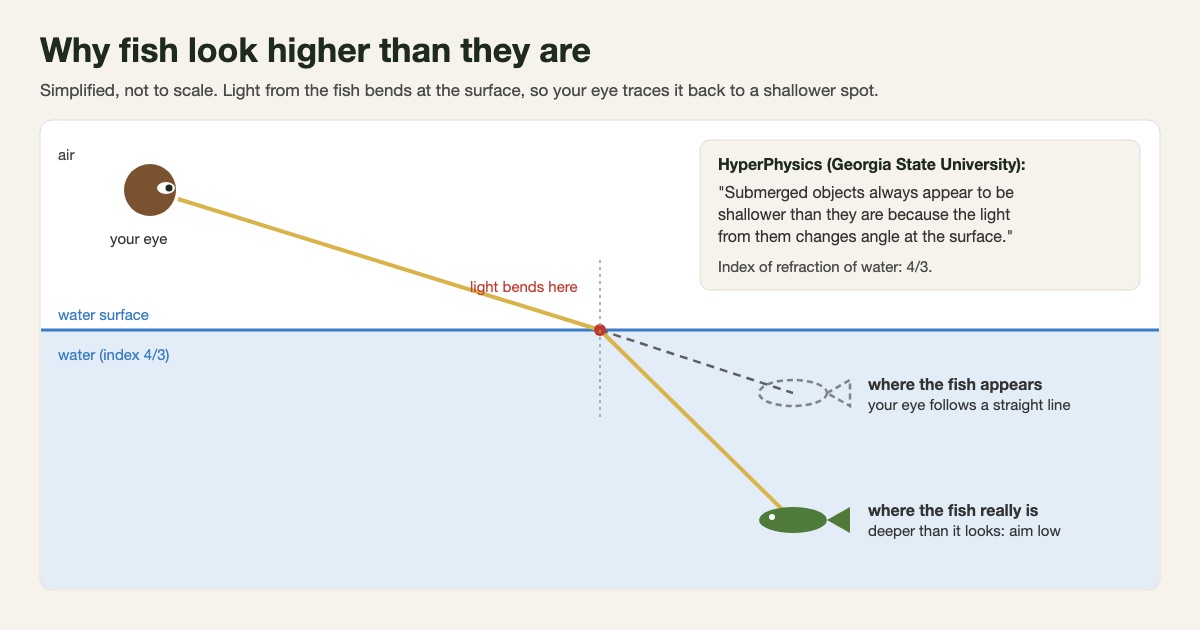
Why fish look higher than they are
Water slows light. HyperPhysics gives water an index of refraction of 4/3, meaning light "travels 3/4 as fast in water as it does in vacuum." When light from a fish crosses the surface, it changes direction. Your eye assumes the light came in a straight line, so it places the fish higher than its true position.
HyperPhysics author Rod Nave learned this as a boy, missing gar in an Arkansas pond until he and his brother "found a reliable aiming point a certain distance below them."
Most beginners make the same miss. Rinella, writing for MeatEater, estimates that "about 98% of all bowfishing misses are fired over the fish's back."
Rules of thumb, and who states them
None of these comes from a physics or university source, so treat them as starting points:
| Rule | Who states it | What it says |
|---|---|---|
| 10-4 (distance and depth) | Steven Rinella, MeatEater | Fish 10 ft away and 1 ft deep: aim 4 in low. Double the distance or the depth, double the hold |
| 10-4 (distance) | Realtree | "For every 10 feet between you and the fish, aim 4 inches below" |
| 1-3 (depth) | Realtree | "For every foot the fish is beneath the surface, aim 3 inches below the fish" |
| General hold | Steven Rinella, MeatEater | "About ten inches lower than where you want to hit the fish" |
Rinella works his rule through: a fish 20 feet away and 1 foot down needs 8 inches low, and at 20 feet and 2 feet down, "aim sixteen inches low." The rules don't agree exactly, so test them on the water.
Depth and angle
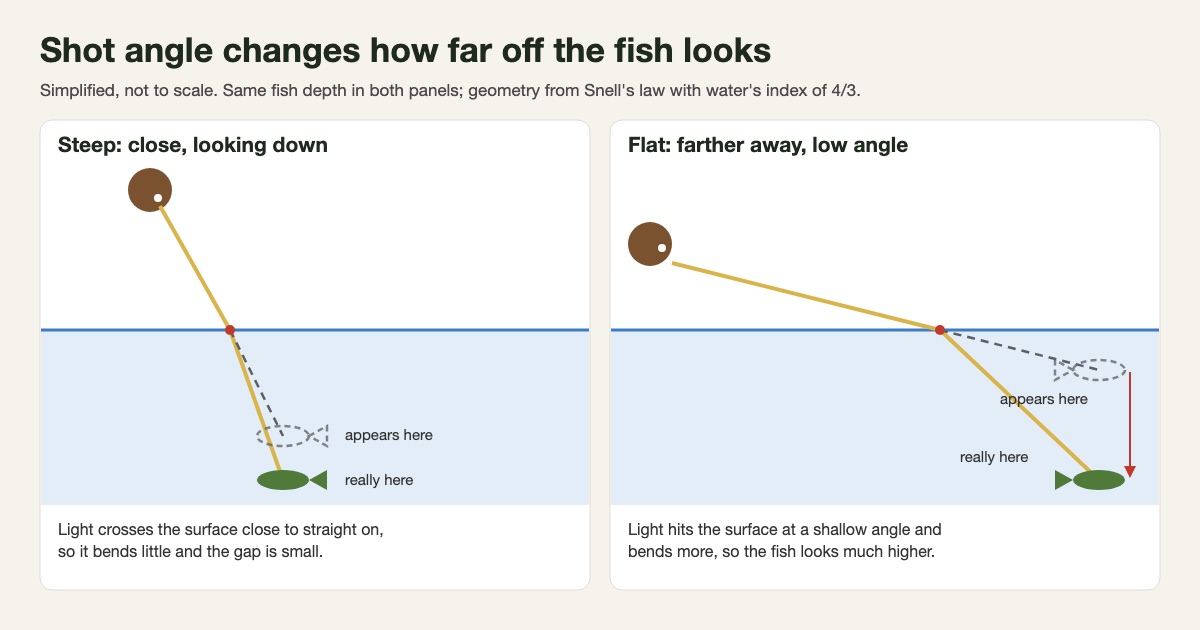
Two things change the gap:
- Depth. The deeper the fish, the more water the light travels through and the bigger the gap. Realtree puts it simply: "The deeper the fish is, the deeper you aim."
- Angle. Light that hits the surface nearly straight on bends very little. Light that meets it at a shallow angle bends more. That follows from Snell's law, which HyperPhysics uses to describe refraction.
So a fish close to a high boat deck needs less correction than one far away seen from low down.
Practise instinctive shooting
Instinctive shooting means the hold has to become a habit. Realtree says "consistent form and practice are the keys to instinctive shooting," and that with enough practice "you will just know where to aim."
A simple routine:
- Use the same anchor and draw every shot, as you would on land. Our guide to aiming a bow explains instinctive and gap aiming.
- Start with close, steep shots, where the correction is smallest.
- Shoot at a fixed object in shallow water you can wade to, and note where each arrow lands compared with your aim.
- Add distance and depth gradually, and notice how far low you had to hold.
Polarised glasses
AMS Bowfishing's instructions say polarised sunglasses for day shooting "reduce glare dramatically on the water and make fish easier to see," and recommend safety glasses at night.
You can browse bowfishing sights on Amazon or look at bowfishing gloves. If you're still choosing a set-up, our Cajun Sucker Punch review explains a complete kit.
Frequently asked questions
Why do you aim low when bowfishing?
Because refraction makes fish look shallower than they are. HyperPhysics explains that light from a submerged object changes angle at the surface, so your eye places the fish too high. Aim straight at what you see and the arrow passes over its back.
How low do you aim when bowfishing?
There's no exact figure. Rinella's 10-4 rule says aim 4 inches low for a fish 10 feet away and 1 foot down, doubling with distance or depth. Realtree adds a 1-3 rule: 3 inches low per foot of depth. Use one as a starting point and adjust in practice.
Does refraction matter more at long range?
Generally, yes. At distance you see the fish at a flatter angle, and light bends more when it meets the surface at a shallow angle. Steep shots close to the boat need less correction, which fits published rules that add hold as distance grows.
Related articles
 Training
How to Aim a Bow: Sights, Gap and Instinctive
How to aim a bow: eye dominance, anchor points, sights, gap shooting, string walking, face walking and instinctive aiming, with practice drills for each.
October 7, 2026 · 11 min read
 Reviews
Cajun Sucker Punch Review: A Complete Bowfishing Package Explained
Cajun Sucker Punch bowfishing package review: 17–31 in draw, 50 lb peak, Hybrid reel, fish rest and fibreglass arrows, aiming low, safety and the law.
May 7, 2025 · 6 min read
 Gear
GearBowfishing Reels: Spincast vs Bottle vs Drum
Bowfishing reel vs bottle vs drum: how each reel type stores and releases line, line strength, retrieval, and the safety slide rule every reel needs.
June 5, 2025 · 5 min read