
Cajun Sucker Punch Review: A Complete Bowfishing Package Explained
Cajun Sucker Punch bowfishing package review: 17–31 in draw, 50 lb peak, Hybrid reel, fish rest and fibreglass arrows, aiming low, safety and the law.
By Archery Insider Editorial Team
· 6 min read

In this article
Bowfishing is archery's most action-packed discipline: short, fast shots at fish in shallow water, often dozens in an evening. It uses different equipment from target archery or bowhunting: a reel instead of a quiver, heavy solid arrows with barbed points, and a bow built to shoot quickly and survive water and mud. Cajun Bowfishing's Sucker Punch is one of the best-known complete packages for getting started. This review explains what is in the box, what the specifications mean, and what you need to know before your first trip.
The short version
The Sucker Punch is a compound bowfishing bow sold as a ready-to-fish package. Retailers list a 50 lb peak draw weight, a 17 to 31 inch draw length range, 60 percent let-off with the draw-specific modules, a 32.25 inch axle-to-axle, a 7.25 inch brace height and a 3.2 lb mass weight. The package includes a Cajun Hybrid reel, a fish biscuit arrow rest, Blister Buster finger pads and two white fibreglass Piranha arrows. Cajun also sells an updated Sucker Punch Pro.
First bowfishing rig for carp, gar and other rough fish
Cajun Bowfishing Sucker Punch package
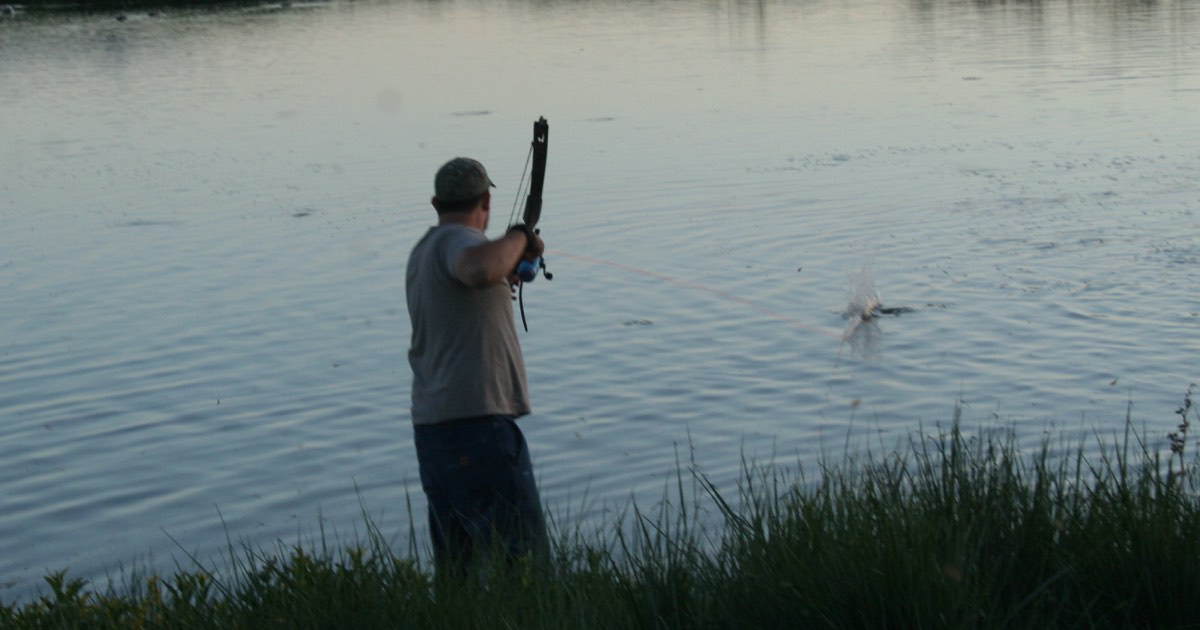
A complete bowfishing set-up in one box: bow, reel, rest and arrows. The wide draw-length range means one bow fits most adults and many teenagers.
- Peak draw weight
- 50 lb
- Draw length
- 17–31 in
- Let-off
- 60% (draw-specific modules)
- Axle-to-axle
- 32.25 in
- Brace height
- 7.25 in
- Mass weight
- 3.2 lb
- Reel
- Cajun Hybrid reel
- Included
- Fish biscuit rest, Blister Buster finger pads, 2 Piranha fibreglass arrows
Specifications: retailer listings of Cajun Bowfishing product information (see Sources)
How bowfishing differs from other archery
| Bowfishing | Target or hunting archery | |
|---|---|---|
| Arrows | Heavy solid fibreglass, attached to a line | Light carbon or aluminium |
| Points | Barbed fish points that hold the fish | Field points or broadheads |
| Arrow storage | Reel and line, no quiver | Quiver |
| Shot distance | Usually very short, often under 15 yards | 10 to 70 metres or more |
| Aiming | Instinctive, aiming low to allow for refraction | Sight or point of aim |
| Release | Often fingers, for speed | Release aid common on compounds |
Aiming low: refraction
Water bends light, so a fish appears higher and further away than it really is. Bowfishers aim below the fish they see. The deeper the fish and the steeper your angle, the lower you aim. Most bowfishers learn the correction by practice and feedback.
What the specifications mean
17 to 31 inch draw length
A very wide range, so the bow can be set for most adults and many teenagers. Set it to your draw length; our draw length guide explains how to measure.
50 lb peak and 60 percent let-off
Bowfishing arrows are heavy and the water slows them quickly, so moderate draw weights are common. Low let-off is typical of bowfishing bows: many bowfishers draw and shoot in one motion with fingers rather than holding at full draw. Cajun lists the 60 percent let-off with draw-specific modules; some retailer descriptions also mention constant-draw modules, which shoot with no fixed draw length. Check the package listing for the modules supplied.
Deep cam grooves
Cajun highlights deep cam grooves to prevent derailed strings, a common problem when line or debris catches the string around water and mud.
The reel and line
The Hybrid reel holds line attached to the arrow. After the shot, you reel in the arrow (and the fish). Two safety points apply to every bowfishing reel:
- Never shoot with line wrapped around anything, including the bow, your hand or the rest. A snagged line can snap the arrow back toward the archer.
- Check that the line is free and the reel set to shoot before every shot.
Safety and the law
- Wear eye protection and closed shoes, especially on boats at night.
- Never shoot toward people, boats or the shore where people may be.
- Keep fish points covered when not shooting.
Setting up your first rig
- Set the draw length to your measurement and the draw weight to something you can draw quickly and repeatedly.
- Fit the reel to the bow's stabilizer bushing or reel mount and spool line as the reel instructions describe.
- Attach the line to the arrow using the slide or safety slide system supplied, so the line runs freely when you shoot.
- Set the fish rest so the arrow sits level and the line runs clear of the bow.
- Practise at a target on land with the line attached before your first fishing trip, checking that the line pays out cleanly every time.
Bowfishing extras worth adding
| Item | Why |
|---|---|
| Spare arrows and points | Arrows bend and points are lost on rocks and logs |
| Polarised glasses | Cut glare so you can see fish below the surface |
| Finger tab or glove | For repeated finger releases |
| Bright lights for night bowfishing | Where legal, lights are how you see fish after dark |
| Pliers and a cooler | For removing points and handling the catch legally |
Care after every trip
- Rinse the bow, reel and arrows with fresh water, especially after brackish or muddy water.
- Dry the string and wax it; water and grit wear strings quickly.
- Check the line for nicks and replace damaged sections.
- Inspect fibreglass arrows for splits and points for loose fittings.
Common mistakes
- Shooting with line wrapped around the bow or hand.
- Aiming straight at the fish instead of below it.
- Forgetting to check species and licence rules before the trip.
- Taking too few arrows and losing the evening to one snag.
Who the Sucker Punch suits
- Newcomers to bowfishing who want everything in one box.
- Families and friends sharing a rig, thanks to the wide draw-length range.
- Bowhunters who want a dedicated, water-ready bow rather than adapting their hunting bow.
Who should look elsewhere
- Experienced bowfishers who want a specific reel type or a high-end boat set-up.
- Archers who want to adapt an existing compound by adding a reel and rest.
Cajun Sucker Punch package
Advantages
- Complete package: bow, reel, rest, arrows and finger pads
- 17–31 in draw range fits most adults and many teens
- Deep cam grooves resist string derailment
- Light 3.2 lb bow for repeated quick shots
Trade-offs
- Only two arrows included; spares are wise
- Module details vary between retailer listings
- Package reel is entry level
- Low let-off suits quick shots rather than holding
You can see the Cajun Sucker Punch on Amazon. Check the hand and package contents, and compare with the newer Sucker Punch Pro.
Frequently asked questions
What fish can you shoot with a bow?
It depends on local regulations. Many areas restrict bowfishing to certain species, often invasive carp and other rough fish. Check your local fishing rules.
Do I need a fishing licence for bowfishing?
In most places, yes. Bowfishing is usually regulated as fishing rather than hunting.
Can I use my hunting bow for bowfishing?
You can fit a bowfishing reel and rest to many compounds, but water, mud and heavy arrows are hard on equipment. Many bowfishers prefer a dedicated bow like the Sucker Punch.
Sources
- Cajun Bowfishing Sucker Punch Bowfishing Package – Lancaster Archery Supply
- Cajun Sucker Punch Bowfishing Bow Kit (product listing) – Amazon
- Cajun Bowfishing (official site) – Cajun Bowfishing
- Night bowfishers in bowfishing boat (photo context) – Wikimedia Commons
Related articles
 Reviews
Bear Cruzer G3 Review: The Grow-With-You Compound Bow Explained
Research-based Bear Cruzer G3 review: 14–30 in draw, up to 70 lb, 75% let-off. Published specs, who it suits, and how it compares with the Diamond Infinite 305.
Updated July 10, 2025 · 4 min read
 Comparisons
Compound vs Recurve Bow: Key Differences Explained
Compound vs recurve bow compared: how each works, let-off and holding weight, aiming systems, competition formats, maintenance, hunting, and which suits you.
February 6, 2025 · 8 min read
 Guides
How to Choose Arrows: Spine, Length, Weight and Spine Charts
How to choose arrows: what spine means, reading a spine chart, measuring arrow length, arrow weight and FOC, fletching, and bare-shaft tuning to confirm it.
Updated June 26, 2026 · 9 min read