
Bowfishing Reels: Spincast vs Bottle vs Drum
Bowfishing reel vs bottle vs drum: how each reel type stores and releases line, line strength, retrieval, and the safety slide rule every reel needs.
By Archery Insider Editorial Team
· 5 min read
In this article
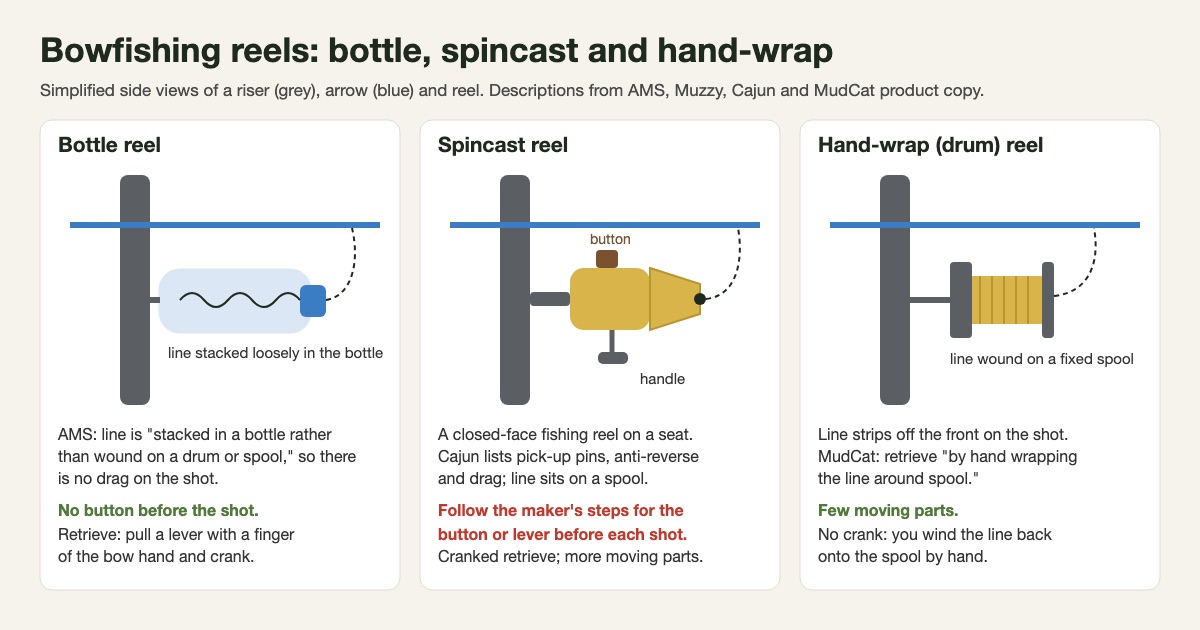
A bowfishing reel holds the line that ties your arrow to the fish, and the three common types differ in how they store it. A bottle reel stacks line loosely in a cup, a spincast reel winds it on a spool under a hood, and a hand-wrap drum reel holds it on a fixed spool you reload by hand. Each trades simplicity, drag and retrieve differently.
Three reel types compared
| Reel type | How line is stored | Before the shot | Retrieve | Main trade-off |
|---|---|---|---|---|
| Bottle | Stacked loosely in a bottle | Nothing to press (AMS, Muzzy) | Pull a lever, then crank | No drag on the shot; no adjustable fighting drag |
| Spincast | Wound on a spool under a hood | Free the line as the maker directs | Crank | Drag and anti-reverse; more to manage |
| Hand-wrap drum | Wound on a fixed spool | Line strips off the front | Wrap line back by hand | Very simple; no crank |
AMS explains its bottle design: "The line is stacked in a bottle rather than wound on a drum or spool so there is no drag on the line when it's shot." AMS lists a 3:1 gear ratio for the Retriever Pro, retrieving 17 inches of line per crank. Muzzy sells its bottle reel on the same idea, saying it "eliminates the need to push buttons or release levers before the shot."
The catch: AMS says the Retriever "does not have an adjustable fighting drag." You control line with the trigger or pull the fish in by hand.
Spincast reels look like closed-face fishing reels on a reel seat. Cajun describes its Spin Master with "dual pick up pins" to grab slack line and a "one way anti-reverse bearing" that provides "proper drag engagement."
MudCat's wrap-style reel comes with 50 feet of 80-pound line on a spool that attaches to the bow, and you "retrieve arrow by hand wrapping the line around spool."
Line strength
Makers ship reels pre-loaded, and the ratings vary:
- AMS Retriever Pro: 25 yards of 200-pound braided Dacron.
- Muzzy bottle reel: 25 yards of 150-pound line.
- Cajun Spin Master: 150 feet of Fast Flight line.
- MudCat wrap-style reel: 50 feet of 80-pound line.
AMS advises replacing line "that is badly frayed" and warns that "twisted line causes knots."
Safety: the line must run free
AMS's safety slide sheet explains that when line is tied to the tail of an arrow, "a trailing loop of line forms and has the potential to knot itself to the bowstring, cable or the arrow rest. This could cause the arrow to suddenly stop mid-flight and comeback toward the archer." Its product page adds: "Never tie your line to the tail of an arrow (regardless of reel used)!"
The AMS operation instructions give the set-up:
- Nock the arrow with the shock pad up.
- "Always keep the EverGlide Safety Slide in front of arrow rest."
- Tighten the line to the reel and push it into the line retainer.
- Check the slide moves freely on the shaft.
Never shoot with line wrapped around your hand, the bow or the rest. On a spincast reel, follow its maker's instructions for the button or lever every time.
Which reel for beginners?
Match the reel to how you fish:
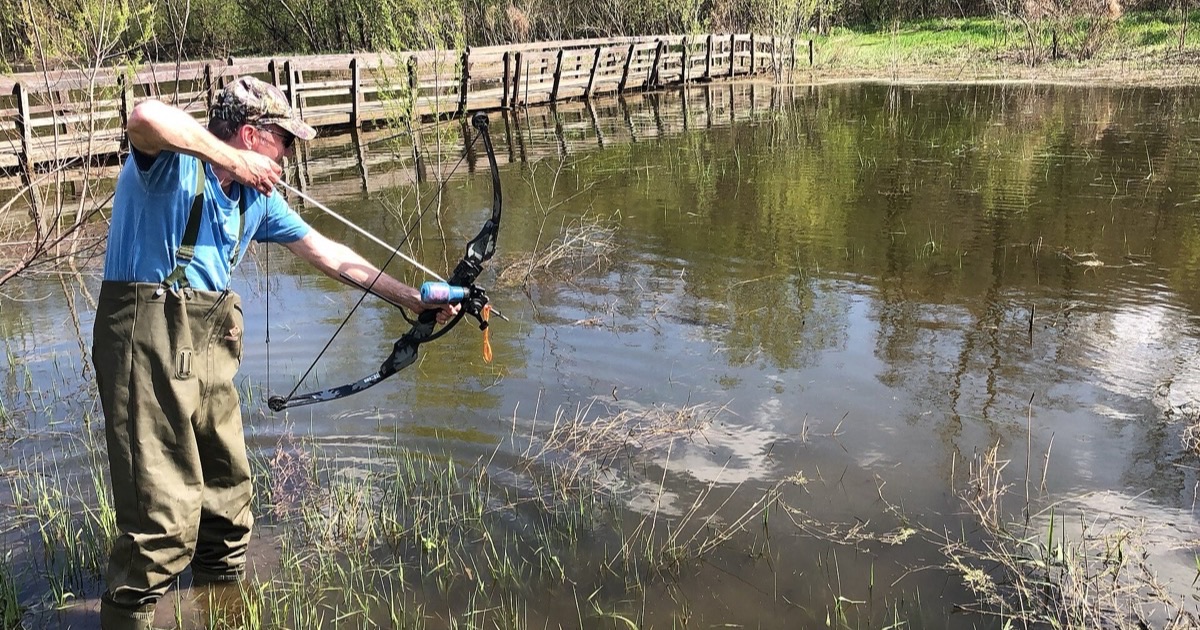
- Many quick, close shots: a bottle reel's no-button routine is short.
- Big fish that pull hard: a reel with drag, such as a spincast, gives more control.
- Few parts: a hand-wrap reel, if you don't mind winding by hand.
Use purpose-made bowfishing arrows with a slide, not target shafts; our arrow selection guide explains spine and weight. Kits often include a reel, as our Cajun Sucker Punch review shows.
You can browse bowfishing bottle reels on Amazon or compare bowfishing spincast reels. The AMS Retriever Pro and Muzzy's bottle reel are examples to consider; check the hand and line rating before you buy.
Frequently asked questions
Is a bottle reel better than a spincast for bowfishing?
Neither suits everyone. AMS says its bottle reel releases line with no drag and needs no button before the shot, but it lacks an adjustable fighting drag. Cajun's spincast reels add pick-up pins, anti-reverse and drag. Choose by how often you shoot and how hard the fish pull.
What pound line do you need for bowfishing?
It depends on the reel and the fish. AMS fits 200-pound Dacron to the Retriever Pro, Muzzy lists 150-pound line for its bottle reel and MudCat ships 80-pound line. Stay within your reel's capacity and replace frayed line.
Can you tie bowfishing line straight to the arrow?
No. AMS warns that line tied to the tail of an arrow can loop, knot on the string, cable or rest, and snap the arrow back toward the archer. Fit a safety slide to every arrow and keep it in front of the rest.
Related articles
 Reviews
Cajun Sucker Punch Review: A Complete Bowfishing Package Explained
Cajun Sucker Punch bowfishing package review: 17–31 in draw, 50 lb peak, Hybrid reel, fish rest and fibreglass arrows, aiming low, safety and the law.
May 7, 2025 · 6 min read
 Guides
How to Choose Arrows: Spine, Length, Weight and Spine Charts
How to choose arrows: what spine means, reading a spine chart, measuring arrow length, arrow weight and FOC, fletching, and bare-shaft tuning to confirm it.
Updated June 26, 2026 · 9 min read
 Training
How to Aim When Bowfishing: Refraction Explained
Bowfishing how to aim: why refraction makes fish look higher, published aim-low rules of thumb, how depth and angle change the hold, and polarised glasses.
Updated October 7, 2026 · 4 min read