
Why Hunt With a Bow? 9 Reasons Hunters Choose Archery
What is the main reason hunters choose to hunt with a bow? More days in the woods. Nine reasons, each backed by agency data, plus the honest trade-offs.

By Archery Insider Editorial Team
· 9 min read
In this article
What is the main reason hunters choose to hunt with a bow? For most, it's time: archery seasons usually open weeks before the guns and close later, so a bowhunter gets far more days in the woods. Close encounters, the challenge and hunting the rut with little pressure come right behind.
Below are nine reasons hunters pick up a bow, each tied to something an agency or organisation has published, followed by the trade-offs nobody should skip. If you're still deciding whether to start, our guide on whether you can hunt deer with a bow covers the practical first steps.
The main reason hunters choose to hunt with a bow
There's no single official answer, and we couldn't find a trustworthy national survey that ranks hunters' reasons. (A "58% say difficulty" figure circulates online, but we couldn't trace it to any primary source, so we've left it out.) What the agencies do publish points clearly to opportunity: more days, better timing and less competition. The rest are reasons hunters give once they've tried it.
| Reason | What the evidence says | Source |
|---|---|---|
| More days to hunt | Missouri archery: 112 days; main firearms portion: 11 | Missouri Dept. of Conservation |
| Hunt the rut | Archery seasons often include it; elk rut overlap in the West | Pennsylvania Game Commission, onX |
| Less pressure | Archery season lets you hunt "when pressure is low" | Minnesota DNR |
| Close encounters | Most game taken at 10 to 50 yards | onX |
| Access near towns | Archers manage deer where guns aren't feasible | Pennsylvania Game Commission |
| Easy practice | Little space needed; arrows are reusable | onX |
| One tool, many species | Turkey, bear and grouse with the same bow | onX |
| Meat without lead | "No risk of damaged or lead-exposed meat" | onX |
| Conservation funding | Excise tax on archery gear since 1972 | Archery Trade Association |
9 reasons hunters choose archery
1. Longer seasons and more days afield
This is the reason most hunters give, and the dates back it up. The Missouri Department of Conservation lists archery deer season for 2026–27 as 15 September to 13 November, then 25 November to 15 January 2027. That's 112 days. The November firearms portion runs 14 to 24 November, 11 days, with a handful of shorter youth, antlerless and alternative-methods portions spread around it.
Minnesota's archery season runs from 19 September to 31 December 2026, and the state's natural resources department says it "opens more than a month before the statewide firearms season and continues long after the firearms season has closed." In Pennsylvania, the Game Commission's 2026 release gives a statewide archery season of 3 October to 20 November, reopening 26 December to 24 January 2027.
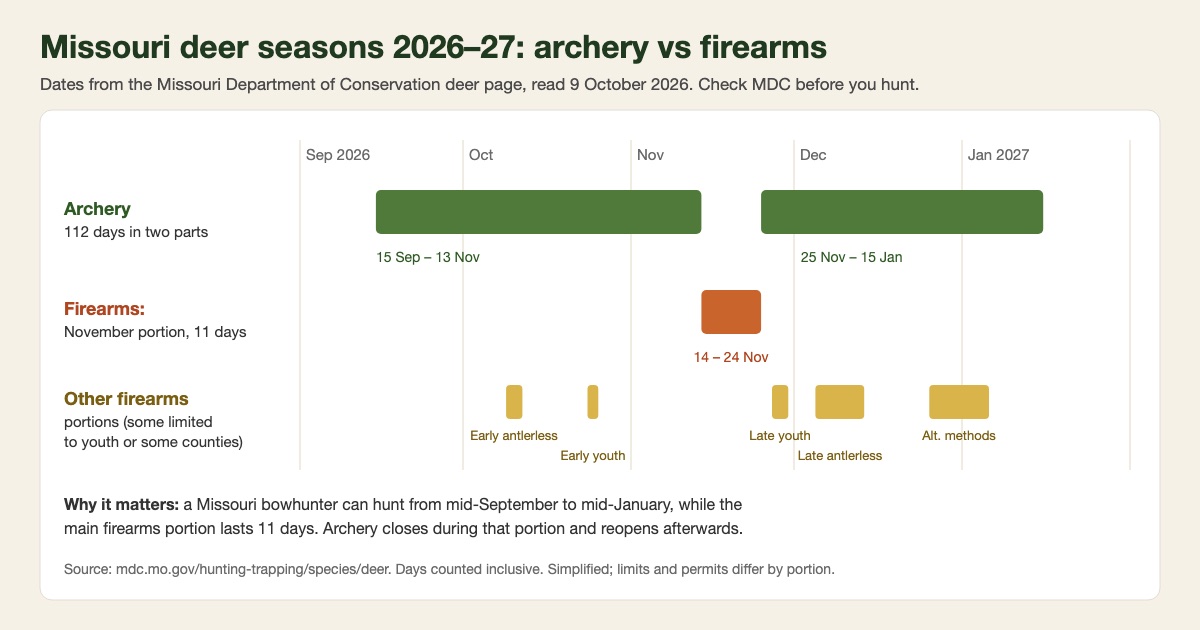
More days matter because deer behaviour changes through autumn. The Pennsylvania Game Commission notes that "typically, every week of the archery season contributes at least 10% of the overall bow harvest," and its executive director, Steve Smith, put it simply: "Hunting even one more day can mean the difference between harvesting a deer and not."
2. You can hunt the rut
In many states the archery season spans the whitetail rut, when bucks move in daylight. Pennsylvania's Steve Smith lists "the excitement of the whitetail rut" among the "huge draws" for the state's archers. Out west, onX points out that "archery seasons overlap peak elk rut", the time bulls bugle and respond to calls. Our guide to bowhunting the rut explains the phases and how to hunt each one.
3. Less hunting pressure
Early archery weeks often come before most hunters arrive. Minnesota's DNR frames the long archery season as "giving you plenty of time to hunt when pressure is low", and onX lists "potentially less competition from other hunters" among the reasons to start with a bow.
4. Close encounters and a real challenge
A bow asks you to get close. onX says "most game will be taken between 10-50 yards", and that's where many bowhunters find the appeal: drawing undetected on a deer a few yards away. onX sums up the bowhunter's motivation as being "in it for the challenge" and appreciating "the traditional method of hunting". If you want to know where your own limit should sit, read how far you can shoot a deer with a bow.
5. Access near towns and suburbs
Because a bow's range is short, some areas open to archery stay closed to firearms. onX mentions "special access to hunting units in some states (including inside city limits, along river bottoms, or near developed areas)". The Pennsylvania Game Commission says archers "play an especially important role in managing deer in areas that are more heavily urban and suburban, where firearms hunting is not always feasible."
6. Year-round practice that's easy to fit in
onX notes that you "do not need a lot of room to practice" and "do not need to keep buying boxes of shells", because arrows are reusable. A backyard target, a local range or a 3D shoot keeps you sharp all year.
7. One bow, many species
The bow you use for deer can, where legal, also take other game. onX lists "turkey, bear, and grouse" as quarry for the same bow, and adds that in many states antlerless deer "can be taken with over-the-counter tags."
8. Meat without lead
onX makes the point that bowhunting gives "no risk of damaged or lead-exposed meat", and claims "cleaner kills when we make them". The qualifier matters: a broadhead kills by cutting, so shot placement is everything, and a poor shot is a real welfare problem. That debate gets its own article on whether bowhunting is ethical.
9. Your gear funds conservation
The Pittman-Robertson Act of 1937 created the federal Wildlife Restoration Program. The U.S. Fish and Wildlife Service says it is funded by "manufacturer taxes on ammunition, firearms, and archery equipment" and pays for habitat, research, hunter education and ranges. The Archery Trade Association (ATA) explains that "Congress added archery equipment to the FET in 1972", and the tax is "a 10% to 11% tax manufacturers pay on the first sale". The ATA puts the archery industry's contribution at "an average of $57 million annually" over the past ten years.
The honest trade-offs
Every reason above has a cost. onX's own list of downsides is a good checklist.
| Trade-off | What it means in practice |
|---|---|
| Getting close is hard | onX: "Odds of success might be lower for newer hunters." |
| Gear wears out | "Strings need replacement every few years and parts break." |
| Heat in early season | In the South, early archery seasons can be hot, so meat needs fast cooling |
| Early seasons can miss the rut | onX: "Most rutting activity for deer takes place well after early archery seasons." |
| Physical demand | "Requires a certain amount of physical ability to draw a bow." |
| Practice commitment | You need regular shooting to stay accurate at your chosen range |
Draw weight is less of a barrier than people expect. Missouri sets no minimum, and its conservation department recommends 40 pounds or more, adding that the force needed "is less than most people think." See our guide to draw weight for deer hunting for how to choose.
Is bowhunting growing?
The National Deer Association's 2026 Deer Report surveyed state agencies on harvest by weapon. Nationally, "archery hunters (bow and crossbow combined) took 25%" of the 2024–25 deer harvest. That share was 23% in 2014 and 15% in 2002, so most of the growth came between 2002 and 2014. In the Northeast, archers averaged 33%, and New Jersey, Connecticut and Massachusetts were the only states at 50% or more.
Pennsylvania shows the scale: the Game Commission says its "350,000-plus bowhunters harvested an estimated 178,140 deer" in 2024–25, about a third of the state's deer.
The ATA describes the recruitment, retention and reactivation (R3) effort as dating from 2012, and, citing the U.S. Fish and Wildlife Service, says Pittman-Robertson grants have "funded more than 150 R3 projects" since 2017, including mentored hunts, classes and new ranges.
Bow or rifle: which should you start with?
It depends on your time, your land and your goals. onX's advice is that a rifle gives "a better chance at filling your freezer within the first few years", while a bow suits hunters who want the challenge, the exercise and "more days to hunt". Many hunters do both, using the bow in the long archery season and the rifle in the short firearms window. Our bowhunting vs rifle hunting comparison covers range, cost, practice and safety side by side.
Whichever you pick, check your state agency for hunter education and any separate bowhunter course it requires before you buy a licence.
Frequently asked questions
What is the main reason hunters choose to hunt with a bow?
Opportunity. Archery seasons are usually much longer than firearms seasons. Missouri's 2026–27 archery deer season runs 112 days against an 11-day November firearms portion, and Minnesota's opens more than a month before its firearms season. More days mean more chances to hunt the rut and low-pressure deer.
Why bow hunting instead of rifle hunting?
Hunters choose a bow for longer seasons, close encounters, the challenge and access to areas closed to guns. The cost is difficulty: shots are usually 10 to 50 yards, and onX warns that new bowhunters may see lower success. Many hunters use both, each in its own season.
Is bowhunting harder than gun hunting?
Generally, yes. You need to get much closer, draw without being seen and shoot accurately under pressure, which takes regular practice. The National Deer Association says archers still took 25% of the US deer harvest in 2024–25, so it's very achievable with preparation and sensible shot limits.
Does bowhunting help conservation?
Yes, through funding. Since 1972, manufacturers have paid a federal excise tax on archery equipment, which the U.S. Fish and Wildlife Service distributes to state wildlife agencies through the Pittman-Robertson program. The Archery Trade Association puts the archery industry's share at about $57 million a year on average.
Related articles
 Comparisons
Bowhunting vs Rifle Hunting: Which Should You Choose?
Bowhunting vs rifle hunting compared: how each kills, effective range, seasons, skill and practice, scouting, safety, cost of entry and which suits you.
October 15, 2026 · 9 min read
 Guides
Can You Hunt Deer With a Bow? A Beginner's Guide
Yes, you can hunt deer with a bow. Learn the legal basics, which bows work, how hard it is, effective range, gear, shot placement and a first-season plan.
October 6, 2026 · 13 min read
 Guides
Bowhunting From a Ground Blind
Bowhunting from a ground blind: choosing and placing a blind, brushing it in, shooting seated, shooting through mesh, broadhead choice and common mistakes.
October 13, 2026 · 9 min read