
Turkey Shot Placement With a Bow
Turkey anatomy for bow hunting: where the vitals sit, aim points for broadside, strutting-away and head-on birds, and the legal checks for head and neck shots.
By Archery Insider Editorial Team
· · 5 min read

In this article
Turkey anatomy for bow hunting comes down to one fact: a gobbler's vitals are small and sit high in the body, tucked under the spine, while much of what you see is feathers. The National Wild Turkey Federation (NWTF) advises arrowing a broadside bird "slightly behind the wing joint and just beneath the spine." Other angles have their own aim points, and head or neck shots come with legal checks.
A small target inside a big bird
When a strutting tom puffs up and fans out, the outline you see is much larger than the body underneath, and the vital organs are only a small part of that body.
NWTF's bowhunting guide, written by Darron McDougal, puts the key point simply: "The lungs are tucked underneath the spine." He adds that an arrow an inch or two lower than the spine takes out all of the vitals. He advises aiming in the upper third of the body on a side-on bird and warns that hits low in the chest may only wound.
Aim points by angle
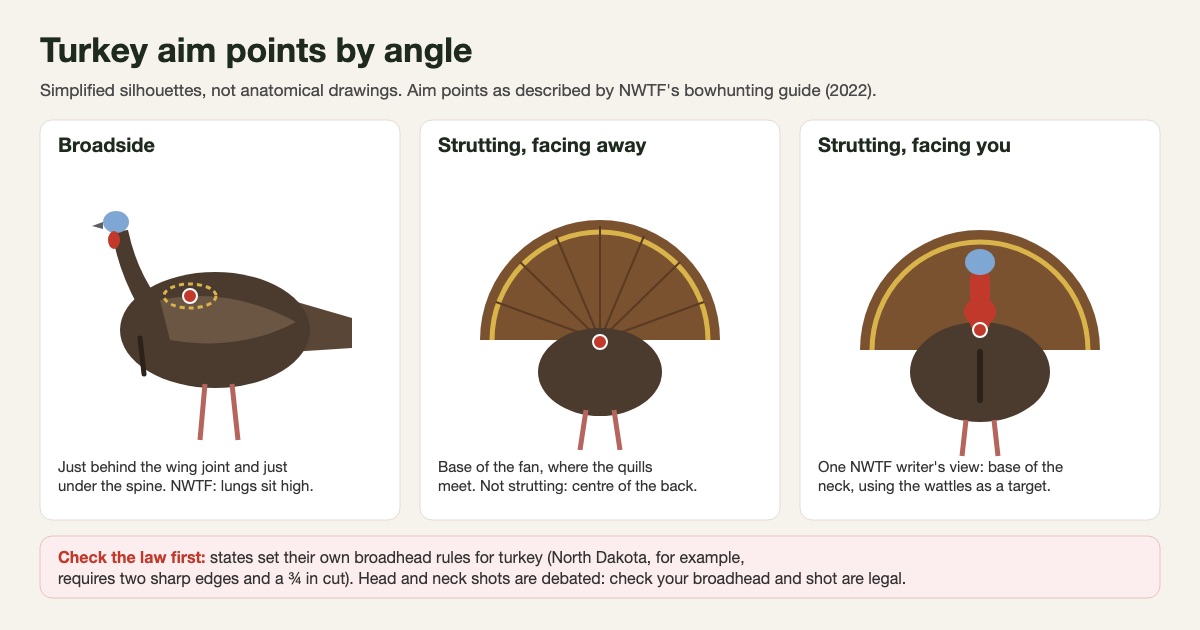
| Bird's position | Aim point (NWTF guide) | Notes |
|---|---|---|
| Broadside | "Slightly behind the wing joint and just beneath the spine" | Upper third of the body |
| Strutting, facing away | "At the base of his fan where all of the quills meet" | Where the tail feathers join the body |
| Not strutting, facing away | "Dead center on its back, both up and down and right to left" | Centre of the back from behind |
| Strutting, facing you | Base of the neck | The writer's view, not a universal rule |
Broadside is the angle most hunters wait for. The wing joint gives you a visible reference, and the vitals sit just behind and below the line of the back.
Strutting away is the other classic shot. The point where the quills meet is easy to pick out, even when the fan fills your view.
Facing you is the hardest call. McDougal writes that one shot he has "seen work well with beginners shooting minimal weight is right at the base of the neck on a head-on strutter," using the wattles as a target. That's one experienced writer's view, not a consensus, and the target is small.
Head and neck shots: check the law first
Head and neck shots are debated among bowhunters. The target is tiny and moves constantly, and specialist head-shot broadheads exist for it. Before you try either, read your state's current turkey regulations, because the rules differ.
North Dakota's 2026 spring turkey proclamation is a good example of how specific they get. Arrows must be "tipped with a metal broadhead, with at least two sharp cutting edges, and have a cutting diameter of at least 3/4 inches (i.e., not able to pass through a 3/4 inch ring)." It adds that "it is illegal to hunt turkeys with barbed arrows," and bans arrows "capable of causing damage or injury to the animal in excess of that inflicted by the cutting edges of the broadhead." Other states set their own minimums and limits. Check that any head-shot broadhead meets your state's definition of a legal turkey arrow before you buy it.
Broadhead choice and practice
McDougal favours mechanical broadheads for turkey because of their "larger cutting diameters," and for fixed blades he advises "don't go smaller than 1 inch on cutting diameter." Some states restrict expandable designs, as our fixed-blade vs mechanical broadheads comparison explains, so check the rules there too.
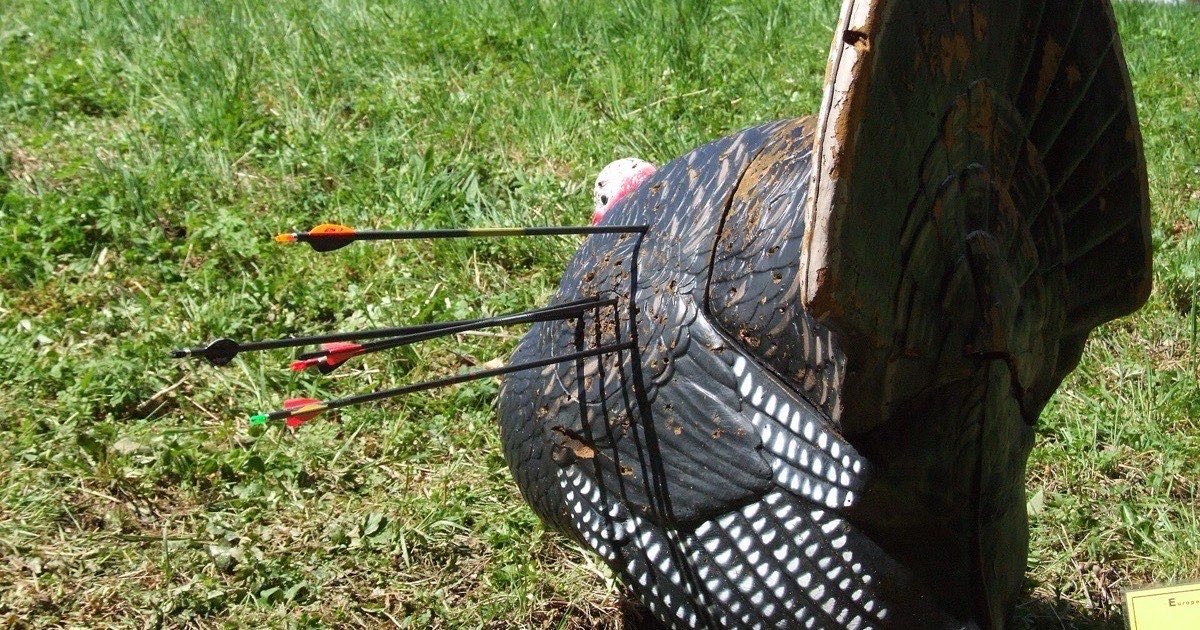
Practising on a 3D turkey target helps you learn where those aim points sit on a real outline from different angles.
If you want practice gear, you can browse turkey archery targets or large-cut mechanical broadheads on Amazon. Hunting deer as well? Our deer shot placement guide covers a very different animal.
Frequently asked questions
Where do you shoot a turkey with a bow?
On a broadside bird, NWTF's guide says slightly behind the wing joint and just beneath the spine, in the upper third of the body. On a strutting bird facing away, aim at the base of the fan where the quills meet. The vitals sit high, so a low hit in the chest may only wound.
Is a turkey head shot with a bow legal?
It depends on your state and your equipment. Rules often specify broadhead cutting edges and minimum width: North Dakota requires two sharp edges and at least a ¾ in cut, and bans barbed arrows. Read your state's current turkey regulations before using any head-shot method or specialist broadhead.
Do you need a special broadhead for turkey?
Not always, but it must meet your state's turkey rules. NWTF's writer prefers mechanicals for their larger cutting diameter and advises at least 1 inch of cut for fixed blades. Check local rules first, since some states limit broadhead types or widths for certain game.
Related articles
 Comparisons
Fixed-Blade vs Mechanical Broadheads: Pros, Cons and Rules
Fixed-blade vs mechanical broadheads compared: flight, tuning, cutting diameter, energy needs, durability, hybrid designs, regulations and which suits your bow.
Updated February 13, 2026 · 6 min read
 Guides
Where to Shoot a Deer With a Bow: Shot Placement
Bow shot placement for deer: where the heart and lungs sit, how to aim broadside, quartering away and from a tree stand, which shots to pass on, and why.
October 6, 2026 · 10 min read
 Guides
Javelina Bowhunting: Spot, Stalk and Shot Placement
Bow hunting javelina: why peccaries aren't pigs, how poor eyesight and a keen nose shape the stalk, how state seasons work and where to aim on a small animal.
Updated October 6, 2026 · 5 min read