
Deer Hunting With a Longbow: Weight, Arrows, Range
Longbow for deer hunting: legal minimum draw weights by state, arrow weight in grains per pound, honest 15 to 20 yard ranges and how to practise for the shot.

By Archery Insider Editorial Team
· 9 min read
In this article
A longbow for deer hunting needs three things, in this order: a draw weight that meets your state's legal minimum, a heavy arrow behind a sharp broadhead, and a shot inside the distance you can hit a paper plate every time. For most longbow hunters that last number is 15 to 20 yards, not the 40 a compound shooter might use. The "ideal" 45 to 55 lb you'll read on forums is opinion; the minimums below are law.
Legal minimums for a longbow for deer hunting
Check what your agency requires before anyone argues about the "right" weight. Several states ask more of a longbow than a compound, because it stores less energy at the same weight, and some regulate the arrow too. These four come from agency pages and regulation text we read.
| State | Minimum draw weight for deer | Other archery rules on the same page |
|---|---|---|
| Oklahoma | "Any recurve, longbow or self-bow of 40 pounds or more draw weight" (compounds: 30 lb or more) | Points "not less than 7/8 inches wide," including mechanicals when open |
| Maine | "Draw weight must be at least 35 pounds (there is no max)" | Arrowheads at least 7/8 inch wide for deer, bear and moose; 45 lb for moose |
| Alaska (5 AAC 92.085) | Not less than 40 lb peak draw weight for black-tailed deer (50 lb for moose, elk and brown bear) | Arrow at least 20 inches long and 300 grains, tipped with a broadhead that is not barbed |
| Texas | "There is no minimum draw requirement" | Longbows are listed as lawful archery equipment; the projectile "must be equipped with a broadhead hunting point" |
Rules checked on 7 October 2026; this isn't legal advice and regulations change, so confirm with your agency. Our draw weight for deer hunting guide covers Minnesota, Missouri and the energy side of the question.
How much draw weight you actually need
A longbow's weight is printed for a 28-inch draw. Brian Grossman, writing for the National Deer Association, puts it plainly: "advertised draw weights are based on a 28-inch draw. If your draw is longer... you'll be pulling more weight than listed." The reverse is also true: a 26-inch draw on a 40 lb bow pulls less than 40, which can put you under a legal minimum, so have a shop weigh the bow at your draw length.
Grossman "started with 40-pound limbs even though my Mathews compound is set at 65 pounds," and that's the right instinct: a longbow has no let-off, so you hold the full weight while a deer takes three more steps. The 45 to 55 lb that experienced longbow hunters settle on is consensus, not a rule, and plenty of deer fall to 40 to 45 lb bows shot well up close. The honest test: can you draw it slowly, seated and cold, hold for several seconds, and hit a small target with the first arrow?
Arrow build for a longbow
A longbow turns draw weight into speed less efficiently than a compound, so the arrow does more of the work. 3Rivers Archery's guidance: "It is normally recommended for a traditional bowhunter to have 8 to 10 grains for every pound of pull weight." Its example: "A 50# bow (at your draw) should be close to a 500 grains (including point and fletchings) arrow." The floor is firm too: "it is best to go no less than seven (7) grains per pound." The reason to go heavy: "The more weight you put behind your broadhead, the deeper the penetration."
| Draw weight at your draw | 8 grains per lb | 10 grains per lb | Never below (7 gpp) |
|---|---|---|---|
| 40 lb | 320 gr | 400 gr | 280 gr |
| 45 lb | 360 gr | 450 gr | 315 gr |
| 50 lb | 400 gr | 500 gr | 350 gr |
| 55 lb | 440 gr | 550 gr | 385 gr |
These are our multiplications of the 3Rivers rule, not measurements; all of them clear Alaska's 300-grain minimum.
Spine, length and fletching
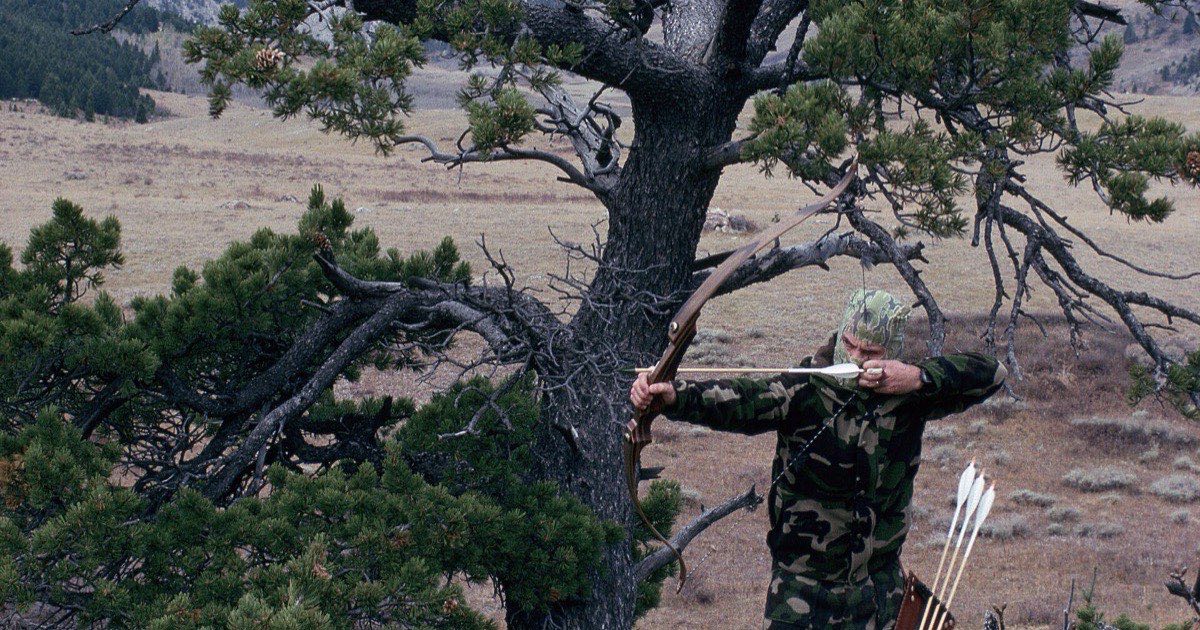
Spine comes first. 3Rivers says "nothing can have a bigger impact on your shooting accuracy than the arrow spine," and advises an arrow "at least one (1) inch longer than your draw length." For carbon, Grossman suggests that "for most new traditional archers shooting between 35 to 45 pounds of draw weight, a 500 spine arrow is a safe starting point." Rose City Archery lists cedar shafts in spine weights "from twenty to seventy pounds." Shooting off the shelf? Grossman recommends "feather vanes."
Broadheads and a worked energy example
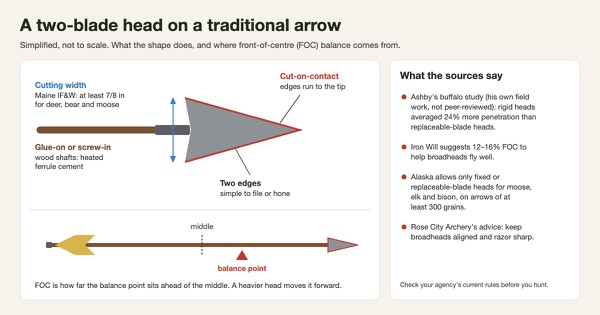
Longbow hunters mostly shoot two-blade, cut-on-contact heads; our broadheads for traditional bows guide explains why. Check cutting width against your state: Oklahoma and Maine both require at least 7/8 inch.
A worked example shows why arrow weight matters. Take a 45 lb longbow and a 450-grain arrow (10 gpp). If it chronographs at 165 feet per second (an illustration; measure your own), the kinetic energy is 450 × 165² ÷ 450,240, about 27 ft-lb. That sits inside the 25 to 41 ft-lb band Easton's widely quoted guide gives for deer-sized game, with little to spare, which is why a light arrow or a long shot throws it away.
Realistic longbow range for deer
Grossman writes that he is "keeping my shots with a recurve under 20 yards compared to around 40 with my compound," and adds: "Ideally, I want the deer within 15 yards if at all possible." Rose City Archery tells wood-arrow hunters to restrict themselves to high-percentage shots, "usually within thirty yards," and we'd treat 30 as the outer edge for a very practised shooter, not a goal.
A slower arrow gives a deer more time to react, and a bare bow's groups open faster with distance; our effective bow range for deer guide covers string-jumping and flight time. To find your own limit:
- Shoot at an 8-inch paper plate from 10 yards, in the position you'll hunt in.
- Step back in 5-yard stages. When any arrow misses the plate, step back in 5 yards. That's your limit for that position.
- Repeat cold, with the first arrow of the day, in hunting clothes.
- Re-test each season and after any change to bow, arrows or anchor.
Instinctive practice that transfers to the woods
Grossman describes three ways traditional hunters aim: instinctive, with no conscious aiming; gap shooting, using the arrow tip as a reference; and split vision, a mix of the two. The one you can repeat under pressure is the right one. Our longbow shooting form guide covers cant, anchor and release, so here's the practice that mimics hunting.
- One arrow, then walk. Deer give you one shot. Single-arrow sessions at unknown distances make the first one count.
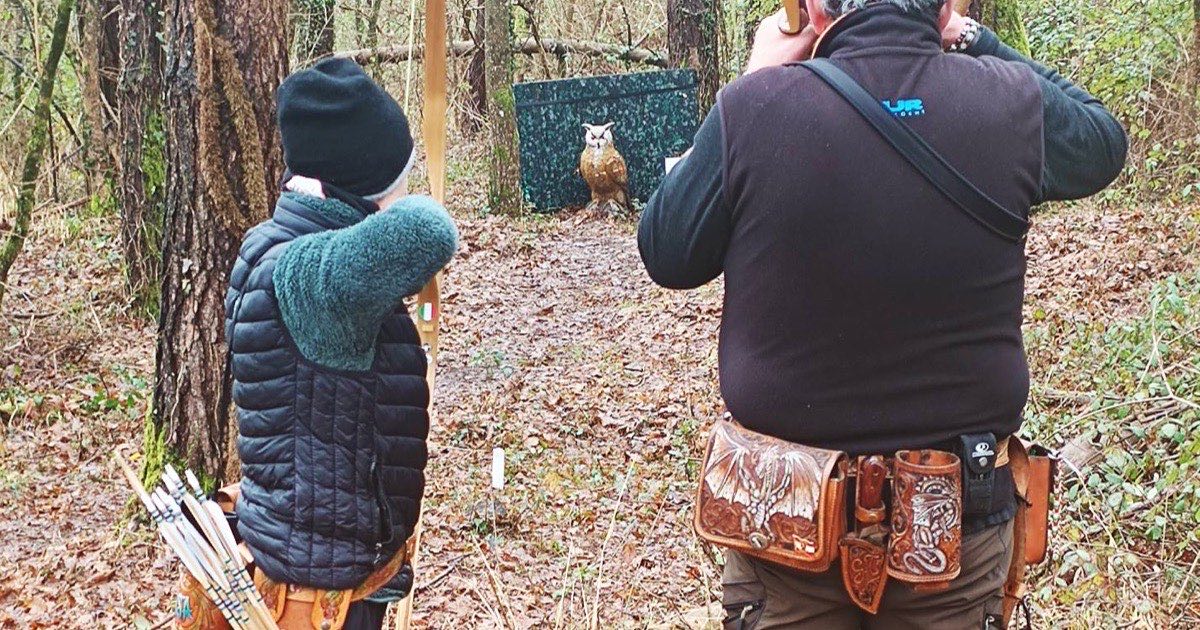
- Walk a 3D course. Foam deer among trees, uphill and down, teach range estimation.
- Shoot seated, kneeling and from stand height, and finish in low light, when a bare bow's aiming references disappear first.
Hunting from a stand or the ground
A longbow is long, often 62 inches or more, and that changes stand choice. Grossman found that in his climbing stand he "couldn't draw back without the string hitting the rail on the climber's seat." Before the season, climb into your stand with the bow and draw at every angle: ahead, hard left, hard right and steeply down, watching the lower limb tip as well as the string.
A hang-on without a front rail, a saddle, or a ladder stand with the rail removed all suit a longbow better than a railed climber. On the ground, a brush blind beats a pop-up with a small window, and level shots keep the vitals the size you practised on.
The ethics of the longbow hunter
Choosing a longbow is choosing a harder hunt, and it stays ethical only if you accept smaller shot windows. Take broadside or quartering-away shots inside your tested range and pass everything else, including the deer that stops at 25 yards when your limit is 20. A well-placed 450-grain arrow from a 45 lb bow kills cleanly; the same arrow pushed 10 yards too far wounds.
You can browse hunting longbows or wood arrows for traditional bows on Amazon. Check the marked weight, the length for your draw, and the arrow spine.
Frequently asked questions
Is a 40 lb longbow enough for deer?
Often, yes. It meets Oklahoma's 40 lb longbow minimum, Maine's 35 lb and Alaska's 40 lb peak rule for black-tailed deer, though always check your own agency. Make the most of it with a 360 to 400-grain arrow, a sharp two-blade broadhead, broadside shots and a limit of around 15 yards.
How far can you shoot a deer with a longbow?
Most experienced longbow hunters stay under 20 yards. The National Deer Association's Brian Grossman keeps recurve shots under 20 and prefers 15, and Rose City Archery describes high-percentage wood-arrow shots as "usually within thirty yards." Your real limit is the distance you can hit an 8-inch plate every time from a hunting position, cold.
What is traditional bow hunting?
Traditional bowhunting means hunting with a longbow or recurve, usually without a sight, release aid or stabiliser, often shooting off the shelf with feather-fletched arrows. Hunters aim instinctively, by gap, or with a mix of both. Because the arrows are slower and the bow is held at full weight, shots are taken much closer than with a compound.
What arrows should I use for longbow hunting?
Heavy ones, correctly spined. 3Rivers recommends 8 to 10 grains of total arrow weight per pound of draw weight, so a 45 lb bow wants roughly a 360 to 450-grain arrow with the broadhead fitted. Carbon shafts around 500 spine suit many 35 to 45 lb bows; cedar shafts come in spines from 20 to 70 lb. Use feathers off the shelf.
Related articles
 Guides
What Draw Weight Do You Need for Deer Hunting?
How much draw weight do you need for deer? Legal minimums, why arrow energy matters, compound vs traditional bows, elk, and choosing a weight you can shoot.
October 5, 2026 · 10 min read
 Guides
How Far Can You Shoot a Deer With a Bow?
Effective bow range for deer: what bowhunter education says, why long shots wound more, arrow flight times, jumping the string, and how to find your limit.
October 7, 2026 · 9 min read
 Gear
Broadheads for Traditional Bows: What Works
Traditional bow broadheads: why two-blade cut-on-contact heads suit recurves and longbows, plus head weight, FOC, sharpening, mechanicals and legal minimums.
Updated October 6, 2026 · 5 min read