
Archery Merit Badge: Requirements Explained
Archery merit badge requirements explained: safety rules, whistle commands, arrows, equipment, scoring and the scores Scouts need, and how parents can help.
By Archery Insider Editorial Team
· 5 min read
In this article
The Archery merit badge asks a Scout to learn range safety, arrows, equipment and scoring, then shoot a qualifying score with a recurve, longbow or compound bow under a certified instructor. The requirements below are as listed in Scouting America's official Scouts BSA Requirements book when we checked in 2026. Requirements change, so confirm the wording at scouting.org/merit-badges/archery or in Scoutbook, as the 2026 pamphlet advises.
What the badge involves
Our summary of the five requirements, as listed when we checked in 2026. Use the official text for sign-off.
| Requirement | What the Scout does |
|---|---|
| 1. Safety | Explain what a projectile is, the five range safety rules, the four whistle commands, how to remove arrows safely, and local and state laws on archery equipment |
| 2. Arrows | Name the parts; describe three or more types; name the "four principal materials" for shafts; make an arrow or repair one (at least three vanes, one point and one nock); explain arrow care |
| 3. Equipment | Explain tabs, arm guards, shooting gloves and quivers, plus the terms "draw length, draw weight, mechanical release, barebow" |
| 4. Scoring | Explain an end vs a round; field, target and 3-D archery; scoring the five-colour World Archery target and NFAA field and indoor targets |
| 5. Shooting | Under qualified supervision, complete Option A (recurve or longbow) or Option B (compound) |

Safety rules and range commands
The 2026 merit badge pamphlet lists the "Five Range Safety Rules": always walk on the range; keep arrows in the quiver until told to shoot; only release the string when an arrow is nocked and pointed at the target; leave dropped arrows until told to retrieve them; and alert the instructor immediately in an emergency.
The pamphlet's whistle commands are two blasts to step to the line, one blast to shoot, three blasts to retrieve arrows, and "four or more blasts" for "STOP!" Scouting America's 2026 Range and Target Activities Manual poster uses "5 or more whistle blasts" for an emergency instead, so learn the version your range uses. Both make one blast the only signal to shoot. Our range safety and whistle commands guide explains how these work on club ranges.
The pamphlet adds that only one archer at a time pulls arrows while others wait 6 feet back, that each participant must wear "an arm guard and either a finger tab or glove," and that broadhead arrows "are not permitted in Scouting target archery activities."
Scoring and shooting requirements
Before shooting, Option A asks the Scout to name the bow's parts, explain its care, demonstrate USA Archery's 11 "Steps of Shooting", string the bow and mark a nocking point with a bow square. Option B swaps stringing for explaining why a compound's string or cables should be replaced at an archery shop. Our archery form guide walks through the 11 steps.
Then the Scout chooses one way to qualify. For a recurve or longbow, choices include an NFAA field round of 14 targets (60 points), a Scouting America field round (80), a World Archery/USA Archery indoor round (80), an NFAA indoor round (50), or 30 arrows in five-arrow ends at 10 yards scoring 150. For a compound the scores rise, for example 15 arrows at 10 yards plus 15 at 15 yards for 160. JOAD achievement pins and an NFAA Progression Patch also count. Our scoring guide explains the five-colour target.
How parents can help
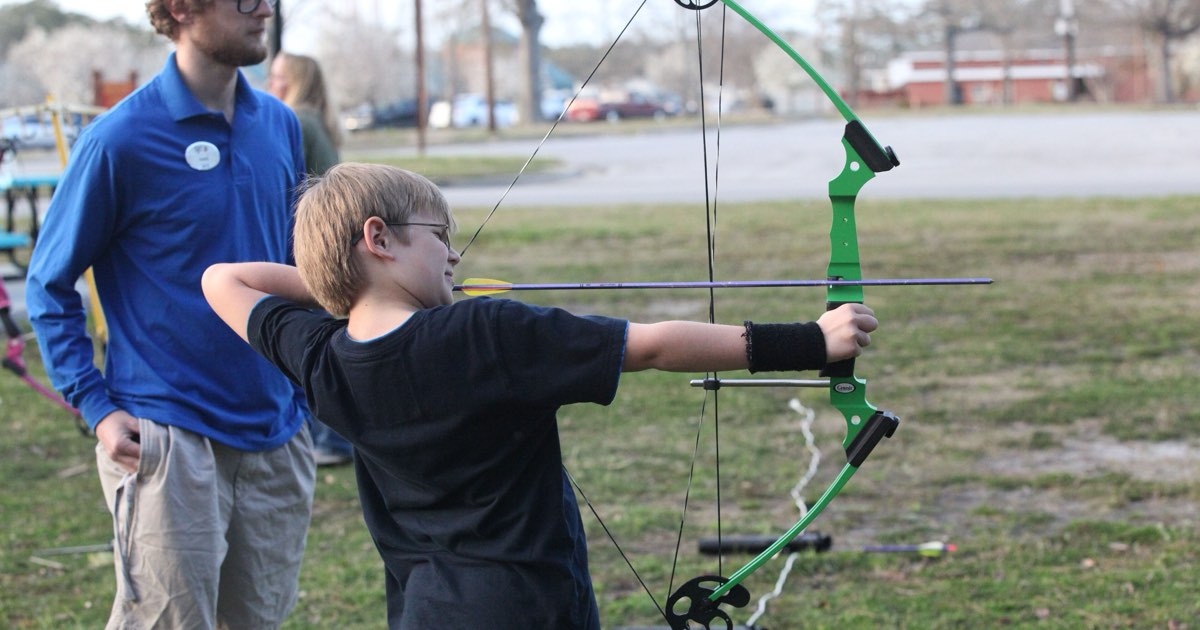
Requirements 1 to 4 are mostly explaining, so parents can quiz Scouts on the safety rules, whistle commands and equipment terms at home. Practise scoring on printed target faces. Leave the shooting to a qualified range: the manual's first range operation rule is "Never operate a range without adult supervision."
For home study, you can browse 80 cm target faces for scoring practice or youth arm guards and finger tabs on Amazon. Treat listings as examples to consider, and check with your troop what camp provides.
Frequently asked questions
How long does the Archery merit badge take?
There's no set time. The Scouts BSA Requirements book says "there is no time limit between starting and completing a badge," though a counsellor may ask for new requirements if a long time has passed. Most of the work is study; the shooting needs a supervised range.
Can you earn the Archery merit badge at home?
Only partly. Requirements 1 to 4 can be prepared anywhere, but requirement 5 must be done under a certified USA Archery Level 1 Instructor or trained long-term camp staff, such as a National Camping School Range Activities Director. Ask your troop which camp or range offers it.
What happens if the requirements change partway through?
The requirements book says a Scout who has started may usually keep using the requirements they began with, or switch to the revised ones. Some significant changes set their own procedure, so check with your counsellor before you finish the badge.
Related articles
 Guides
Archery Range Safety Rules and Whistle Commands Explained
Archery range safety explained: whistle commands, shooting and waiting lines, collecting arrows safely, equipment checks, and what the Fast call means.
Updated April 10, 2026 · 10 min read
 Guides
How Archery Scoring Works: Target Faces, Rings and Match Rules
How archery scoring works: ring values and colours, target face sizes, line cutters, X counts, the recurve set system, compound matches and shoot-offs.
Updated September 14, 2026 · 8 min read
 Training
Archery Form: 11 Steps to a Consistent Shot
Archery form step by step: stance, hook and grip, set-up, draw, anchor, transfer, aiming, release and follow-through, plus common faults and fixes.
Updated March 21, 2025 · 10 min read