
Wood Arrows: Pros, Cons and Who Shoots Them
Carbon arrows vs wood arrows: what cedar and other wooden arrows do well, where spine and weight vary, how to inspect them, and who should shoot them.
By Archery Insider Editorial Team
· · 5 min read

In this article
Wood arrows are solid shafts, most often Port Orford cedar, and they are cheap, quiet and traditional. The trade-off is that spine and weight vary more than in manufactured tubes, and wood needs regular care. In the carbon arrows vs wood arrows choice, wood suits traditional archers on longbows and lighter recurves who value feel over the last bit of precision.
Which woods make arrows
Rose City Archery hosts a guide by Mark Vogel that says "All Wood Arrows are made from quality Port Orford White Cedar" and that the Coquille Valley of south-west Oregon "is now the world's producer of the cedar".
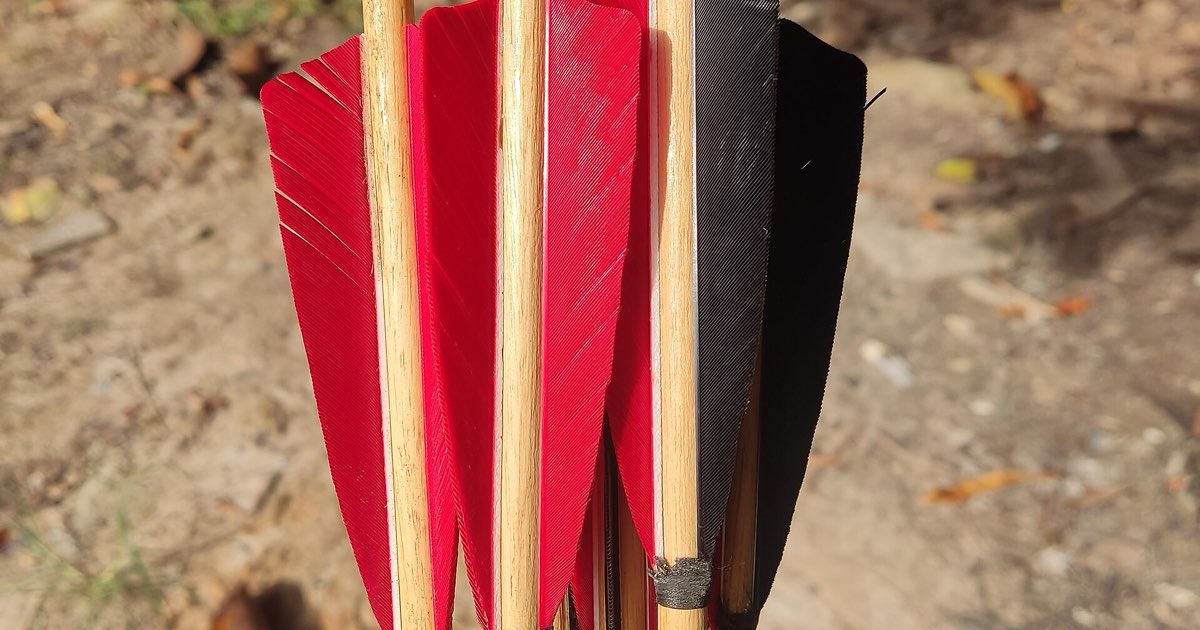
3Rivers Archery names Port Orford cedar as the most popular arrow wood, citing its "moderate weight and ability to take stain and finish", and adds that cedar shafts are "easy to hand straighten". It lists laminated birch, Douglas fir, Sitka spruce, bamboo and lodgepole pine as other shafting woods that "offer varying characteristics, weights and looks". Most wood arrows come in 5/16, 11/32 or 23/64 in diameters.
Spine and weight: the consistency problem
No two wooden shafts are identical. Vogel calls spine "the most important characteristic of the arrow shaft" and explains that it "is solely determined by the size of diameter of the shaft and the density of the wood". Get it wrong, he warns, and arrows "will not fly properly".
3Rivers says wood shafts "come in 5# spine groups as they can be a bit more 'touchy' on getting the right spine", and its weight-matched cedar shafting is sold in bands such as 40–45 and 55–60, "weight matched to 20 grain groups". Those pound figures are not the same scale as the 400 or 500 printed on carbon and aluminium; our guide to how arrow spine is measured explains the deflection system.
For recurves, Vogel says spine "should match the draw weight of your bow at full draw". He also advises orienting each shaft: "The edge of the grain should be against the bow window since the edge gives you maximum spine weight."
Wood arrow pros and cons
| Factor | Wood arrows | Who says so |
|---|---|---|
| Cost | Among the least expensive shafts | 3Rivers; Vogel calls wood "a whole lot cheaper" |
| Noise | Quiet, because the shaft is solid | 3Rivers and Vogel (maker and retailer view) |
| Looks and feel | Takes stain and finish; traditional appearance | 3Rivers |
| Consistency | Spine in 5 lb groups; weight matched to 20 grain groups | 3Rivers |
| Upkeep | Needs "constant maintenance"; bends on glancing hits, but can be hand straightened | 3Rivers, Vogel |
Care and inspection
Vogel says unsealed shafts "must be given a sealer coat of clear lacquer or color", and that points should be fixed with "a ferrule cement that is heated". 3Rivers warns that "often you must straighten the shafts" after misses, glancing shots or arrows driven into the ground.
After each session, sight down every arrow for bends, check along the grain for cracks and make sure points and nocks are tight. Straighten bends; break and bin anything cracked.
Who should shoot wood
Traditional archers are the natural fit, especially on longbows and self bows. In World Archery's longbow 3D class, wooden arrows with natural feathers are required; see our longbow vs recurve comparison and our guide to feathers vs vanes.
Traditional bowhunters still use cedar; Vogel's article is written for them and recommends helical fletching with broadheads.
Archers who want precision with little upkeep are better served by aluminium or carbon. Our carbon vs aluminium comparison covers those two.
You can browse Port Orford cedar arrows or wood arrows for traditional bows on Amazon. Check the listed spine group against your draw weight before buying.
Frequently asked questions
Are carbon arrows better than wood arrows?
For consistency and durability, usually yes: carbon is made to tight tolerances, while wood is sorted into 5 lb spine groups and bends on hard hits. Wood wins on cost and tradition, and it is required in some longbow competition classes, so "better" depends on your bow.
Are wooden arrows good for beginners?
They can be, on a traditional bow, as long as the spine group suits the draw weight. The catch is upkeep: beginners miss more, and 3Rivers notes wood often needs straightening after glancing shots. Our carbon vs aluminium guide suggests aluminium for most beginners.
How long do wood arrows last?
There is no fixed lifespan. A wooden arrow lasts until it cracks, splinters or bends beyond straightening. Inspect it before each session, keep the finish sealed and the arrows dry, and retire any shaft that fails inspection, however new it looks.
Related articles
 Comparisons
Carbon vs Aluminium Arrows: Which Should You Shoot?
Carbon vs aluminium arrows compared: weight, stiffness, durability, straightness, consistency, safety checks, cost and which suits target, hunting or youth.
Updated May 14, 2026 · 7 min read
 Comparisons
Longbow vs Recurve Bow: Differences for Traditional Archers
Longbow vs recurve compared: limb shape, draw feel, hand shock, speed, length, accessories, competition rules, hunting and which traditional bow suits you.
Updated September 30, 2026 · 6 min read
 Comparisons
Feathers vs Vanes: Which Arrow Fletching Should You Use?
Feathers vs vanes compared: weight, forgiveness off the shelf, speed, drag, weather, durability, noise, rests, broadheads and which fletching suits your bow.
Updated September 30, 2026 · 5 min read