
How Arrow Spine Is Measured: The Static Test
How arrow spine is measured: the 28-inch, 1.94 lb static test Easton and ASTM F2031 describe, how the number is read, and why dynamic spine differs.
By Archery Insider Editorial Team
· · 4 min read
In this article
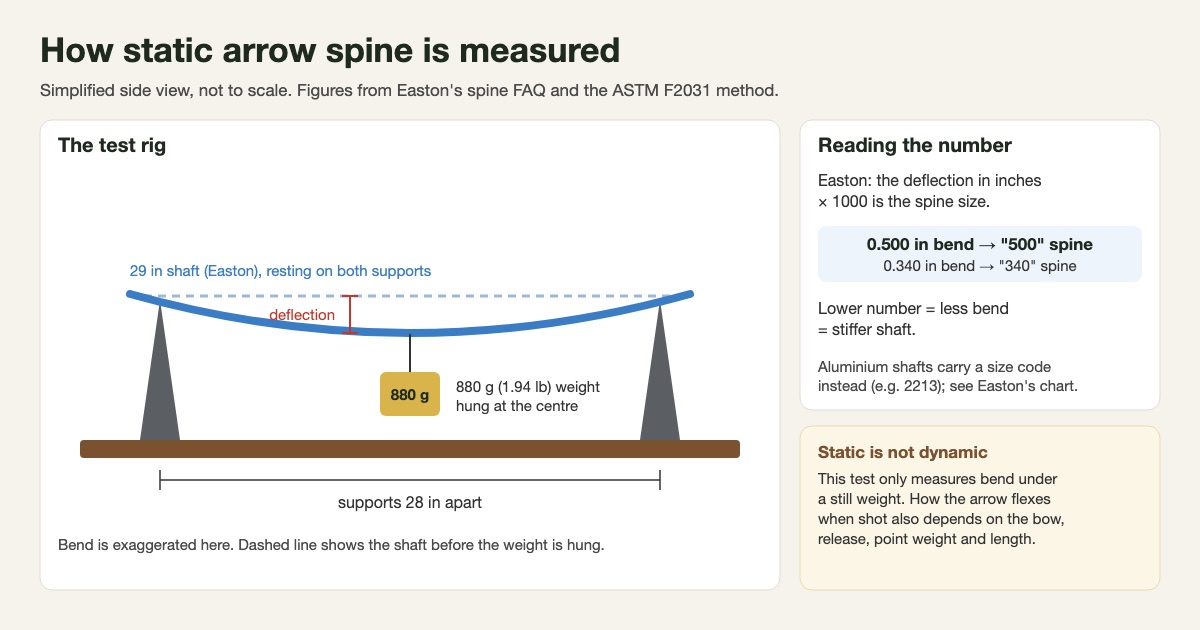
Arrow spine is measured with a static test: the shaft is laid across two supports 28 inches apart, an 880 g (1.94 lb) weight is hung from its centre, and the amount it bends is measured. Easton explains that the deflection in inches, multiplied by 1,000, is the spine number, so a 500 shaft bends half an inch.
The static spine test, step by step
Easton's FAQ describes the method: "STATIC spine is measured by the amount of flex in the arrow when an 880-gram (1.94 lbs.) weight is suspended from the center of the arrow." The arrow is 29 inches long and rests on two supports 28 inches apart. In Easton's words, "the number of inches the arrow deflects or bends due to the weight, is the spine size or measurement of an arrow."
Easton's 2014 article "Making Sense of Arrow Spine" adds: the deflection "X 1000" is the spine size, "so, a 500 arrow bends .5-inches when the weight is applied."
The same numbers appear in the industry standard. A 2019 engineering paper by R. Fish and colleagues summarises it: "The ASTM F2031-05 standard hangs an 880 g (1.94 lb) weight from the center of a 0.71 m (28 in) section of the arrow shaft and measures the maximum deflection." The authors also point out the catch in the naming: "higher spine ratings actually indicate a less stiff arrow."
Carbon vs aluminium: same test, different labels
Easton's FAQ describes a single static test. Between carbon and aluminium, the difference is mostly in the label.
| Carbon shafts | Aluminium shafts | |
|---|---|---|
| Label on the shaft | The spine number itself, e.g. 400 | A size code, e.g. 2213 |
| What the label means | Deflection × 1,000 (Easton) | Diameter in 64ths of an inch, then wall thickness in thousandths (Easton FAQ) |
| What sets stiffness | Shown by the number | Mainly diameter; wall thickness mainly sets weight (Easton guide) |
Easton's tuning guide says its aluminium tubes are drawn to an outside diameter tolerance of ±0.0003 in "to ensure a uniform spine from shaft to shaft," with uniform wall thickness "to give consistent spine 360° around each shaft." The Fish team, who tested carbon, aluminium and wood, noted "the myriad of naming systems for arrow spines between both manufacturers and materials."
Their small study also found carbon arrows had the lowest vibration damping (about 0.3), with wood and aluminium around 0.5. The static test can't see that, and the authors say a larger sample is needed.
Static vs dynamic spine
Dynamic spine is how the arrow actually bends coming off the bow, and Easton's FAQ lists the variables behind it: release method, the bow's energy, cam system, arrow weight, length, point weight, nock weight and fletching weight. "Because of the nearly unlimited variables in determining dynamic spine, arrows are usually measured using static spine."
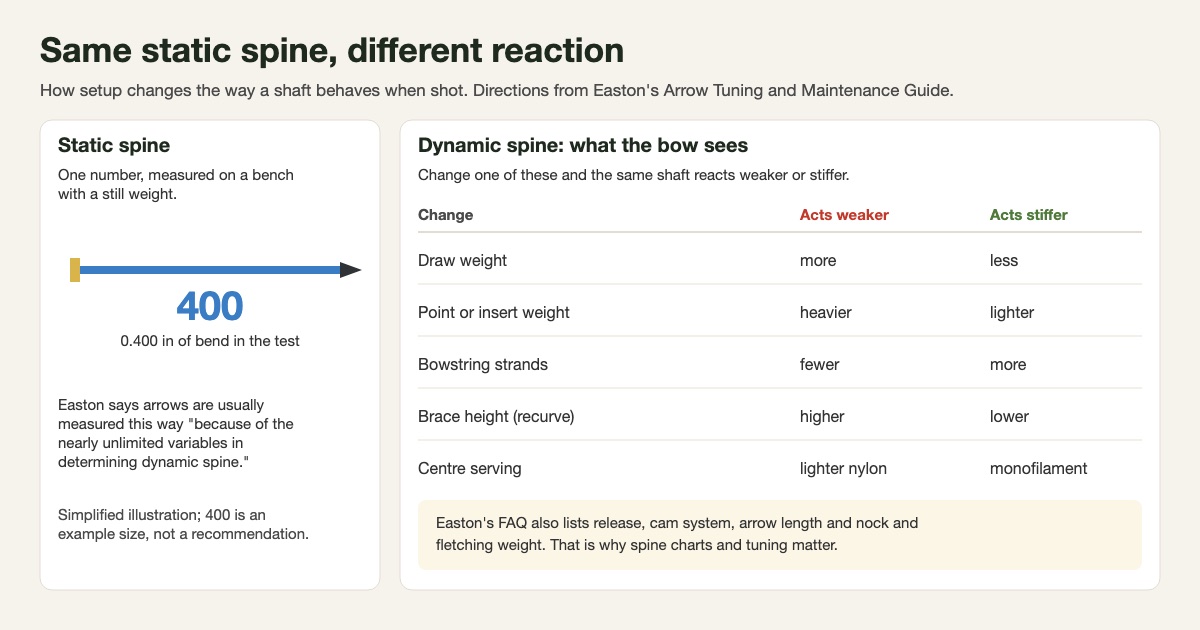
Easton's tuning guide shows how much setup matters: bowstring strand count alone can matter "enough to require a shaft size change of one full size weaker or stiffer." That's why you choose a spine from a chart and then confirm it by tuning. Our arrow selection guide explains how to read a spine chart.
Home spine testers and why shafts vary
A home spine tester copies the bench rig: two supports, a centre load and a dial that reads the bend. That makes it handy for checking that a set of shafts matches, or for sorting wood shafts, rather than re-rating factory carbon.
Shafts of the same nominal spine can still differ slightly. The Fish team listed "manufacturing variation between arrows" as one possible cause of spread in their own measurements. Easton's tolerances are its answer for aluminium; our carbon vs aluminium comparison covers the wider trade-offs.
If you do want one, you can browse arrow spine testers on Amazon.
Frequently asked questions
How do you measure arrow spine at home?
Use a spine tester that supports the shaft at two points, loads its centre and reads the deflection. A figure comparable to factory ratings needs Easton's setup: supports 28 inches apart and an 880 g (1.94 lb) weight. Home testers suit comparing shafts within a set.
Is a higher spine number stiffer?
No. The number is the bend in thousandths of an inch, so higher means more flexible. Easton's example is a 500 shaft, which bends 0.5 in under the test weight. A 340 bends less and is stiffer. Aluminium codes like 2213 describe diameter and wall thickness instead.
Why does my arrow act weaker than its spine rating?
Static spine ignores your setup. Easton's tuning guide says heavier points, higher draw weight, fewer bowstring strands and, on a recurve, a higher brace height all make an arrow react weaker. Change one thing at a time and confirm it with bare-shaft or paper tuning.
Related articles
 Guides
How to Choose Arrows: Spine, Length, Weight and Spine Charts
How to choose arrows: what spine means, reading a spine chart, measuring arrow length, arrow weight and FOC, fletching, and bare-shaft tuning to confirm it.
Updated June 26, 2026 · 9 min read
 Comparisons
Carbon vs Aluminium Arrows: Which Should You Shoot?
Carbon vs aluminium arrows compared: weight, stiffness, durability, straightness, consistency, safety checks, cost and which suits target, hunting or youth.
Updated May 14, 2026 · 7 min read
 Training
Nock Tuning: Rotating Nocks for Tighter Groups
How to nock tune arrows: number and shoot each shaft, rotate a flyer's nock one vane position, re-test, and avoid the vane clearance trap.
Updated October 8, 2026 · 5 min read