
Bow Sight Mounts: Dovetail, Picatinny and Brackets
Bow sight dovetail mount, Picatinny rail or standard bracket? How each attaches to the riser, whether bow sights are universal, and what to check before buying.
By Archery Insider Editorial Team
· 5 min read
In this article
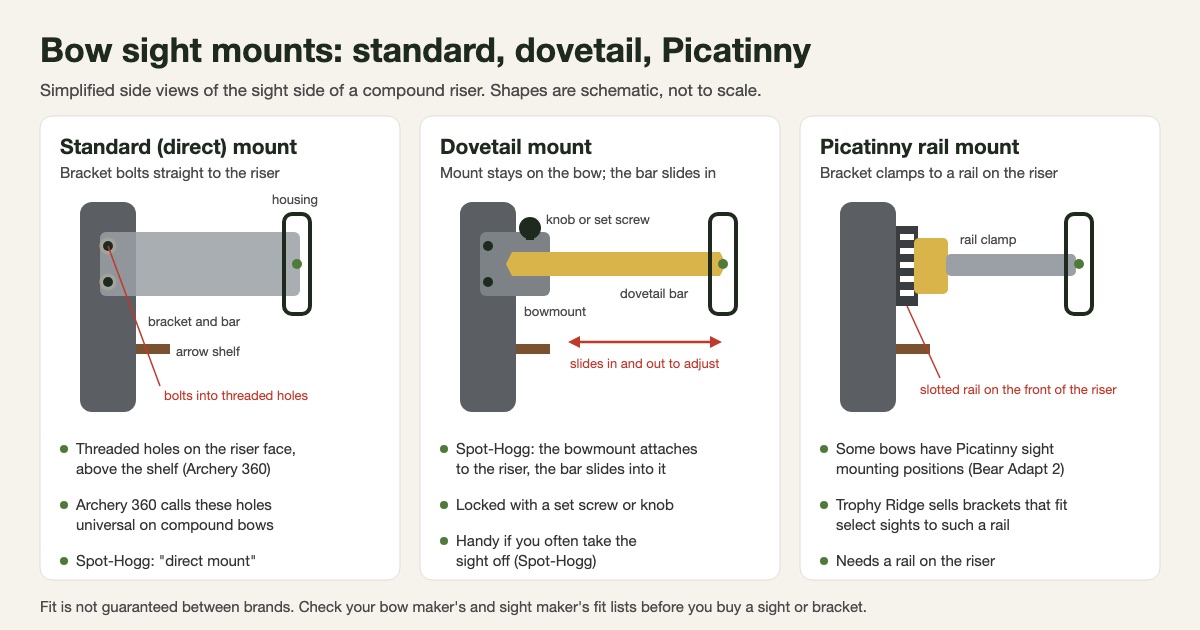
Most compound bow sights bolt straight to threaded holes on the riser through a fixed bracket. A bow sight dovetail mount adds a block on the riser that a sliding bar locks into, and a Picatinny mount clamps onto a slotted rail that some risers now have. Which you can use depends on your bow and your sight, so check both makers' fit lists.
The standard mount: threaded holes on the riser
Archery 360 puts it plainly: "All compound bows have a series of threaded holes on the face of the riser opposite and above the shelf. These holes are universal; any sight you buy for a compound bow can be attached using those holes."
Spot-Hogg calls this the direct mount: the bar attaches straight to the riser. Some brackets offer more than one position: Trophy Ridge says its Fatal sight has "multiple mounting holes for added adjustability and flexibility."
You'll often hear this called a "two-hole" mount. We couldn't find a published standard for the hole count or spacing, so compare your riser with the sight's instructions.

Dovetail, Picatinny and maker brackets
Dovetail
Spot-Hogg's FAQ explains the difference from a direct mount: "With the dovetail mount you have what we call the bowmount which attaches to your riser, then the bar slides into the mount and tightens with either a set screw or a knob. If you take your sight off your bow a lot, the dovetail is more convenient."
Dovetail parts are matched to particular sights. Trophy Ridge's Top Mount Dovetail kit "includes one right hand dovetail bar, one dovetail block, and one knob," and lists the React and SWFT models it fits.
Picatinny
Picatinny is a slotted rail system familiar from firearm accessories. Bear describes its Adapt 2 as having "picatinny sight mounting positions." Trophy Ridge sells a Picatinny Rail Front Mount Bracket to fit select sights "to any riser featuring a picatinny rail on the front of the riser."
Maker-specific brackets
Some risers use their maker's own system; Trophy Ridge sells a front BridgeLock bracket for Mathews risers with the BridgeLock system. Our Trophy Ridge React Pro review notes that sight comes in standard, IMS and Bridge-Lock versions, and that ordering the wrong one is a common mistake.
| Mount | How it attaches | Suits | Check before buying |
|---|---|---|---|
| Standard (direct) | Bracket bolts to threaded holes above the shelf (Archery 360) | Most compound bows | Hand, bolts, bracket position |
| Dovetail | Bar slides into a bowmount; set screw or knob (Spot-Hogg) | Archers who remove the sight often | Which bar and block your sight takes |
| Picatinny | Bracket clamps to a rail on the riser | Risers with a rail or Picatinny positions | Rail on your riser; sight listed for the bracket |
| Maker system (e.g. BridgeLock) | Bracket made for one maker's risers | Owners of those risers | Exact riser and sight model |
Are bow sights universal?
For standard compound holes, Archery 360 says yes. Beyond that, nobody we found promises cross-brand fit: Picatinny brackets need a rail, dovetail parts are listed for named sights, and integrated brackets for named risers. Even hand matters, since that Trophy Ridge dovetail bar is right-handed. Check your bow maker's and sight maker's fit lists, or ask a pro shop.
Recurve sight mounts
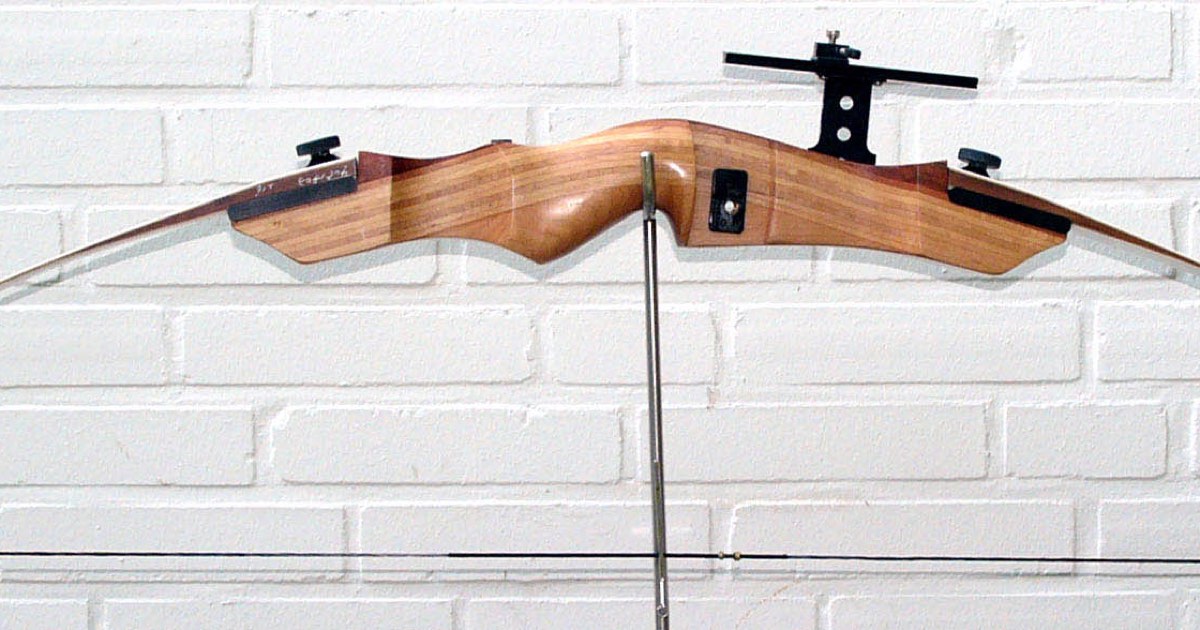
We couldn't find a maker standard for recurve sight mounts, so take this as general guidance. Target recurve risers usually have threaded holes for a target sight's mounting block; many traditional bows have none. Check your riser's manual before buying or drilling anything.
If you need parts, you can browse bow sight mounting brackets or Picatinny bow sight adapters on Amazon. Treat listings as examples to consider and confirm your riser and sight model. Our single-pin vs multi-pin comparison helps with choosing the sight, and our sight level guide with setting it up.
Frequently asked questions
Are bow sights universal?
Mostly, for compound bows with the standard threaded holes: Archery 360 says any compound sight fits them. Dovetail parts, Picatinny brackets and maker systems like BridgeLock fit named sights or risers only, so check both makers' fit lists.
What is a dovetail mount on a bow sight?
A two-part mount. Spot-Hogg describes a bowmount that attaches to the riser and a bar that slides into it, tightened with a set screw or knob, so you can remove and refit the sight without unbolting the mount.
Can I put a Picatinny sight on any bow?
No. A Picatinny bracket needs a rail on the riser. Trophy Ridge's front bracket fits select sights to risers "featuring a picatinny rail on the front of the riser," and Bear lists Picatinny positions on bows such as the Adapt 2. Without a rail, use a standard mount.
Related articles
 Comparisons
Single-Pin vs Multi-Pin Bow Sights: Which Should You Choose?
Single-pin vs multi-pin bow sights compared: fixed pins vs sliders, speed in the field, long-range precision, low light, gap shooting, hybrids and scopes.
February 25, 2026 · 5 min read
 Gear
GearBow Sight Extension: How Far Out Should It Be?
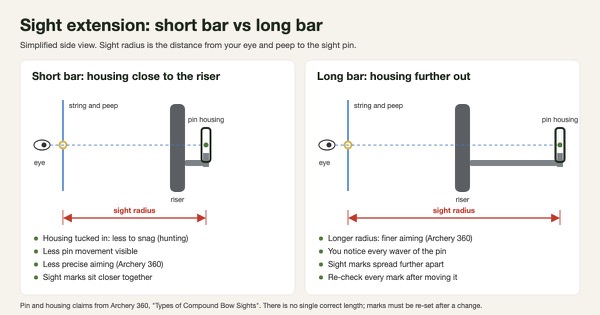
What a bow sight extension bracket changes: sight radius, pin movement, mark spacing and peep fit, plus how to choose a hunting or target setting.
Updated October 6, 2026 · 4 min read
 Gear
GearBow Sight Levels and 2nd and 3rd Axis Explained
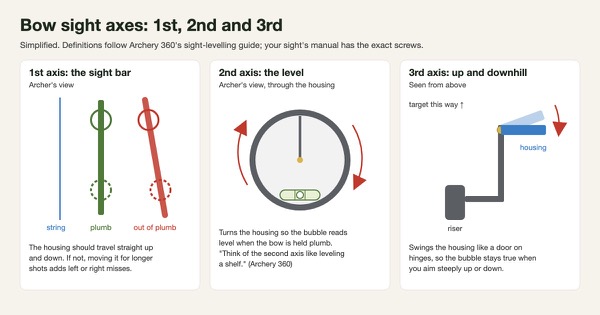
What a bow sight level does, how the 1st, 2nd and 3rd axis adjustments differ, a simple 2nd-axis check and who really needs a 3rd axis.
Updated October 7, 2026 · 5 min read