
Bow Sight Extension: How Far Out Should It Be?
What a bow sight extension bracket changes: sight radius, pin movement, mark spacing and peep fit, plus how to choose a hunting or target setting.
By Archery Insider Editorial Team
· · 4 min read
In this article
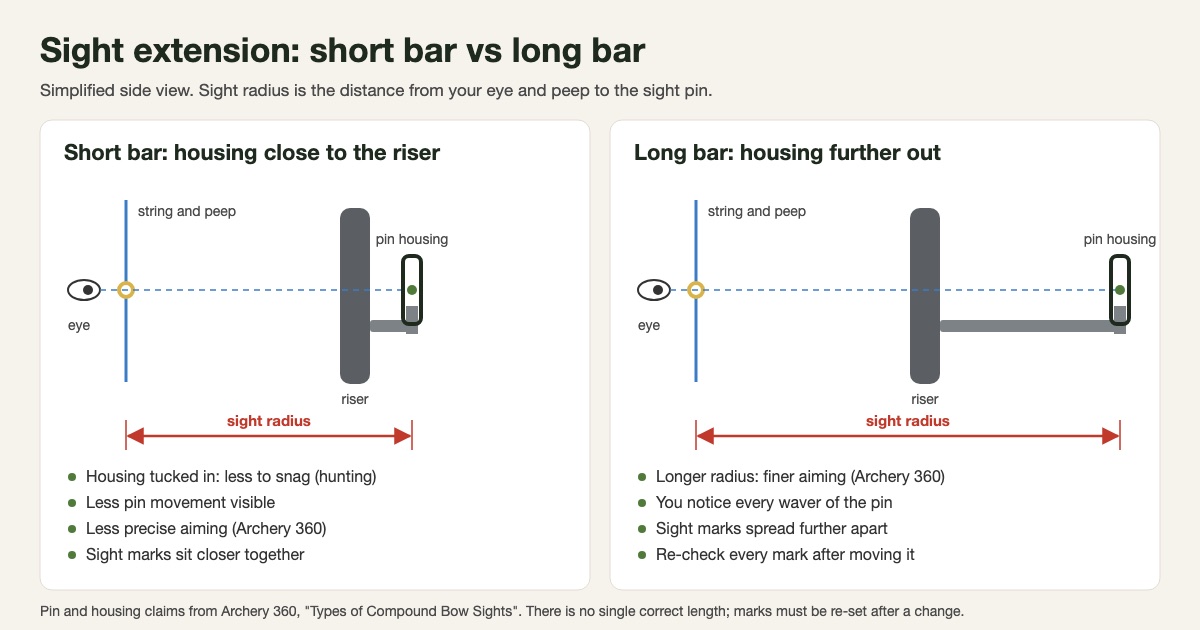
A bow sight extension is the bar or bracket that sets how far in front of the riser your sight housing sits. There's no official "correct" distance: a longer extension gives a longer sight radius and finer aiming, while a shorter one keeps the sight tucked in and shows less pin movement. Hunters often lean short and target archers long.
Sight radius explained
Sight radius is the distance from your eye (through the peep, on a compound) to the sight pin. On a bow, the extension bar is the main thing you can change.
Archery 360's guide to compound bow sights explains why it matters with a simple test. Hold a finger up as a pretend pin while you look at something in the distance. "When your finger is closer to your eye, you might completely cover your target. Move your finger, and you can really fine-tune where to paste your 'pin.' The same principle applies to bow sights."
The further out the pin sits, the smaller the slice of target it covers, so you can place it more exactly. Archery 360 notes that "today's bow sights offer bars of varying lengths" and that "sights with long bars are usually adjustable."

Longer means finer aim, shorter means a calmer picture
The trade-off works both ways. Archery 360 says "the shorter the sight bar, the less pin movement you'll see," and that "having a longer sight bar will encourage you to hold the bow steadier as you aim, because you will notice every waver of the pin." A long bar doesn't make you less steady; it shows movement a short bar hides.
Mark spacing changes too, by the same geometry as the finger test: further from your eye, a given change in aiming angle moves the pin further along the sight. So marks for different distances spread out on a long bar and bunch up on a short one, and a sight tape set at one extension won't fit another.
| Setting | What changes | Often suits |
|---|---|---|
| Short bar, housing close | Less pin movement visible; less precise aiming (Archery 360); marks closer together | Hunters who want a compact bow |
| Mid setting | A compromise you can fine-tune | A starting point on adjustable bars |
| Long bar, housing far out | Finer aiming (Archery 360); every waver shows; marks further apart | Target shooters chasing precision |
Peep and housing fit
Many compound archers centre the sight housing inside the peep as a reference. The further out the housing sits, the smaller it looks, so sliding it out changes that ring-inside-ring picture; sliding it in can make it fill the peep.
If the picture no longer lines up after a change, check peep height and anchor before blaming the sight. Our guide to installing a peep sight covers peep position and serving it in.
Hunting vs target settings
For hunting, Archery 360 says a short bar is "great for hunters who don't want accessories sticking out and catching tree branches." The cost is a little aiming precision.

For target shooting, a long bar's precision usually wins, with no branches to snag. Our single-pin vs multi-pin comparison covers pin layout.
If you compete, check your organisation's equipment rules before fitting a long extension; we don't quote limits here.
To choose your own setting:
- Start in the middle of the bar's range.
- Shoot groups at a mid distance, then try one step out and one step in.
- Keep the setting with the best groups and a picture you can relax into.
- Re-sight every distance afterwards.
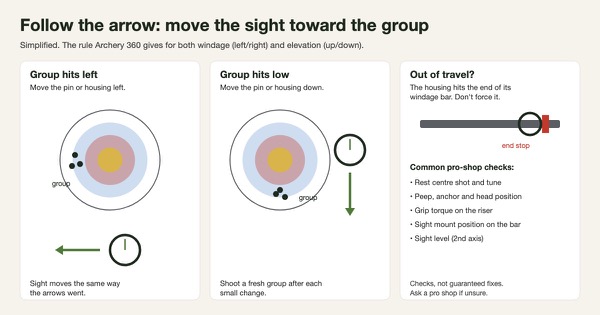
If windage runs out, the bar isn't the fix; see our maxed-out sight guide.
For more radius than a fixed short bar gives, you can browse bow sight extension bars or sight extenders for compound bows on Amazon.
Frequently asked questions
How far should a bow sight be from the riser?
There's no official figure. Archery 360 explains that a longer bar allows more precise aiming, while a shorter one shows less pin movement and keeps the bow compact. Start mid-range on an adjustable bar, compare groups one step in and out, and re-sight after any change.
Does a longer sight extension make you more accurate?
It can make aiming more precise, because the pin covers less of the target. Archery 360 also notes you'll "notice every waver of the pin." Whether groups improve depends on your form. Many archers shoot better with a longer bar only once their hold is steady.
What is a bow sight extension bracket?
It's the bar or bracket between the sight's riser mount and the housing. It sets how far forward the housing sits, which sets your sight radius. Some sights have a fixed bracket; others have a sliding bar you can lengthen or shorten, then lock in place.
Related articles
 Comparisons
Single-Pin vs Multi-Pin Bow Sights: Which Should You Choose?
Single-pin vs multi-pin bow sights compared: fixed pins vs sliders, speed in the field, long-range precision, low light, gap shooting, hybrids and scopes.
February 25, 2026 · 5 min read
 Gear
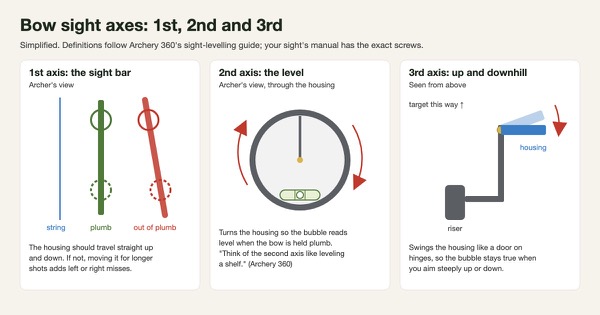
GearBow Sight Levels and 2nd and 3rd Axis Explained
What a bow sight level does, how the 1st, 2nd and 3rd axis adjustments differ, a simple 2nd-axis check and who really needs a 3rd axis.
Updated October 7, 2026 · 5 min read
 Training
Bow Sight Maxed Out? Fixes and the Follow Rule
Bow sight up or down, left or right? Follow the arrow: move the sight toward the group. Plus why a sight runs out of travel and the checks a pro shop makes.
Updated October 8, 2026 · 5 min read