
Bow Sight Levels and 2nd and 3rd Axis Explained
What a bow sight level does, how the 1st, 2nd and 3rd axis adjustments differ, a simple 2nd-axis check and who really needs a 3rd axis.

By Archery Insider Editorial Team
· · 5 min read
In this article
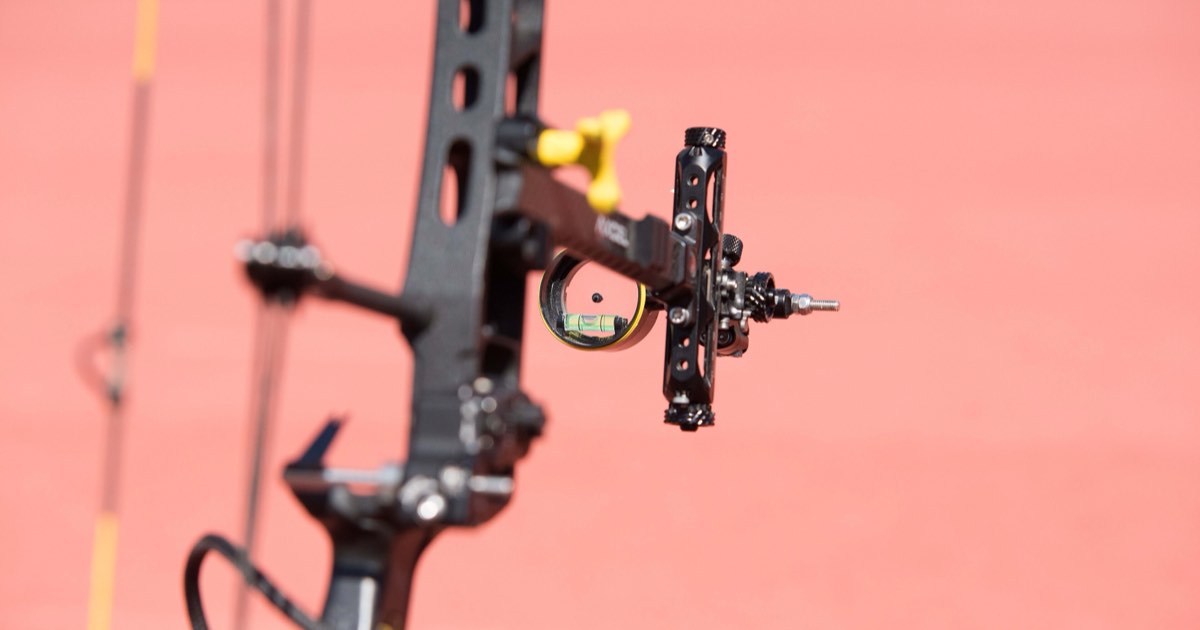
A bow sight level is the bubble vial in your sight housing that shows whether the bow is upright at full draw. The 2nd axis makes that bubble read true when the bow is plumb, and the 3rd axis keeps it true when you aim steeply up or down. Set them right and a centred bubble means an untilted bow, removing one cause of left and right misses.
Why the bubble matters, especially on slopes
A small tilt barely shows at short range, but it grows with distance: goHUNT's Dave Barnett describes groups that drift left or right "in increasing increments as the shot distance is increased."
Slopes make it worse. Barnett says the level becomes "increasingly important when shooting steep side hill shots as the shooter will tend to lean to the downhill side inadvertently." On a hillside, the bubble is your reference for true vertical.
That only works if the bubble itself is set correctly. A level that reads centred while the bow is tilted trains you to hold the bow wrong.
The 1st, 2nd and 3rd axis defined
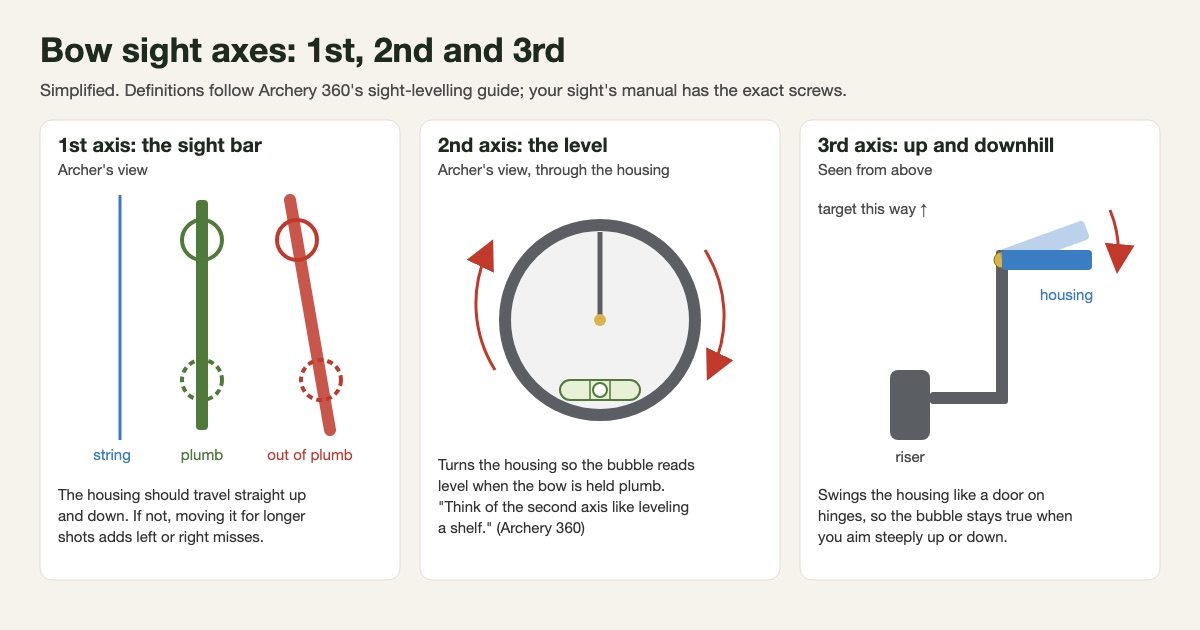
Archery 360's sight-levelling guide gives the clearest short definitions, summarised here:
| Axis | What it adjusts | When it's off |
|---|---|---|
| 1st | The sight bar, "so as you move your sight up and down you don't get left and right misses" | Sideways error that changes as you move the housing for longer shots |
| 2nd | The bubble level itself: "Think of the second axis like leveling a shelf" | Bubble reads centred while the bow is tilted; left or right misses |
| 3rd | The housing "for shooting up and downhill," swinging it like a door on hinges | Bubble drifts when you aim steeply up or down |
Not every sight adjusts all three, so check the manual or listing. Our Trophy Ridge React Pro review covers one five-pin sight with third-axis adjustment.
A simple 2nd-axis check
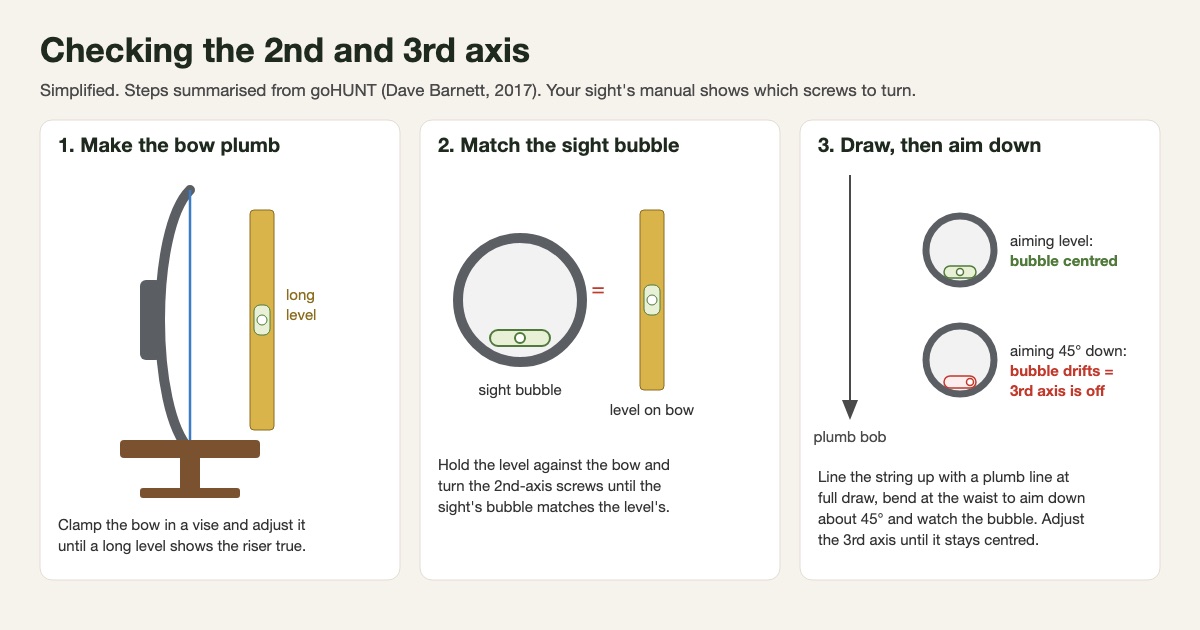
You need a bow vise (or a helper and a square wall) and a long level. These steps summarise goHUNT's method; your sight's manual shows which screws to turn.
- Make the bow plumb. Clamp it in a bow vise and lay a long carpenter's level along a straight vertical surface of the riser. Adjust until the riser reads true.
- Check the sight bubble. With the bow still plumb, look at the sight's level. If it's centred, your 2nd axis is fine.
- Adjust if needed. Find the 2nd-axis screws. Barnett's instruction: "While holding a level against your bow, turn the adjustment screws until the bubble on your sight matches the bubble on the level."
- Recheck after tightening. Snug the screws and confirm the bubble hasn't moved.
Who needs a 3rd axis?
On flat ranges you can usually leave the 3rd axis alone. It matters for steep shots: tree stands, mountain hunting and hilly 3D courses.
goHUNT's check uses a plumb bob hung from the ceiling or along a wall. At full draw, line your string up with the plumb line, then "bend at the waist and aim down about 45 degrees" while watching the bubble. "If your bubble moves to one side of the level or the other, then your third axis is off."
Archery 360 adds a shooting check for right-handed archers: "if your arrows are grouping right adjust the third axis by swinging the sight toward you. If your arrows hit left, swing the sight away from you." Confirm the direction in your own sight's manual, because designs differ. Archery 360 also suggests archery shop pros can set it for you.
Once the level is set, our single-pin vs multi-pin comparison and aiming guide cover using the sight itself.
You can browse bow sights on Amazon or look at bow levels for the setup.
Frequently asked questions
What is the first axis on a bow sight?
The first axis is the sight bar's alignment. Archery 360 says it adjusts the bar "so as you move your sight up and down you don't get left and right misses." If the bar isn't plumb with the bow, moving the housing for a longer shot also moves it sideways.
Do I need a third axis on my bow sight?
Only if you take steep uphill or downhill shots, such as from a tree stand or in mountains. The 3rd axis keeps the bubble true when the bow tilts forward or back. Flat-range target shooters can usually ignore it, but should still set the 2nd axis.
How do I know if my sight level is off?
Put the bow in a vise, make the riser plumb with a long level, and look at the sight bubble. If it isn't centred, the 2nd axis needs adjusting. Groups that drift further sideways as distance increases are another warning sign.
Related articles
 Comparisons
Single-Pin vs Multi-Pin Bow Sights: Which Should You Choose?
Single-pin vs multi-pin bow sights compared: fixed pins vs sliders, speed in the field, long-range precision, low light, gap shooting, hybrids and scopes.
February 25, 2026 · 5 min read
 Reviews
Trophy Ridge React Pro Review: The 5-Pin Sight That Sets Its Own Pins
Trophy Ridge React Pro bow sight review: React Technology pin setting, .019 and .010 pins, tool-less micro-click adjustments, third axis and who it suits.
September 3, 2025 · 6 min read
 Training
How to Install and Time a Drop-Away Rest
How to install a drop-away arrow rest on a compound bow: mounting, centre shot, cable or limb cord, timing and paper checks, plus when to use a pro shop.
Updated October 8, 2026 · 5 min read