
Tracking Blood at Night: Lights, Tips and Mistakes
How to follow a blood trail for deer after dark: wait times, marking the trail, headlamp vs handheld, and what claims about green and blue lights rest on.
By Archery Insider Editorial Team
· · 4 min read
In this article
Following a blood trail for deer at night comes down to patience, a good light and a careful method: wait, mark every spot of blood and search slowly. Coloured "blood tracking" lights are sold as making blood stand out, but the support for that is mostly theory and anecdote, so treat them as an extra, not a replacement for a good white light.
Before you take a step: wait and mark
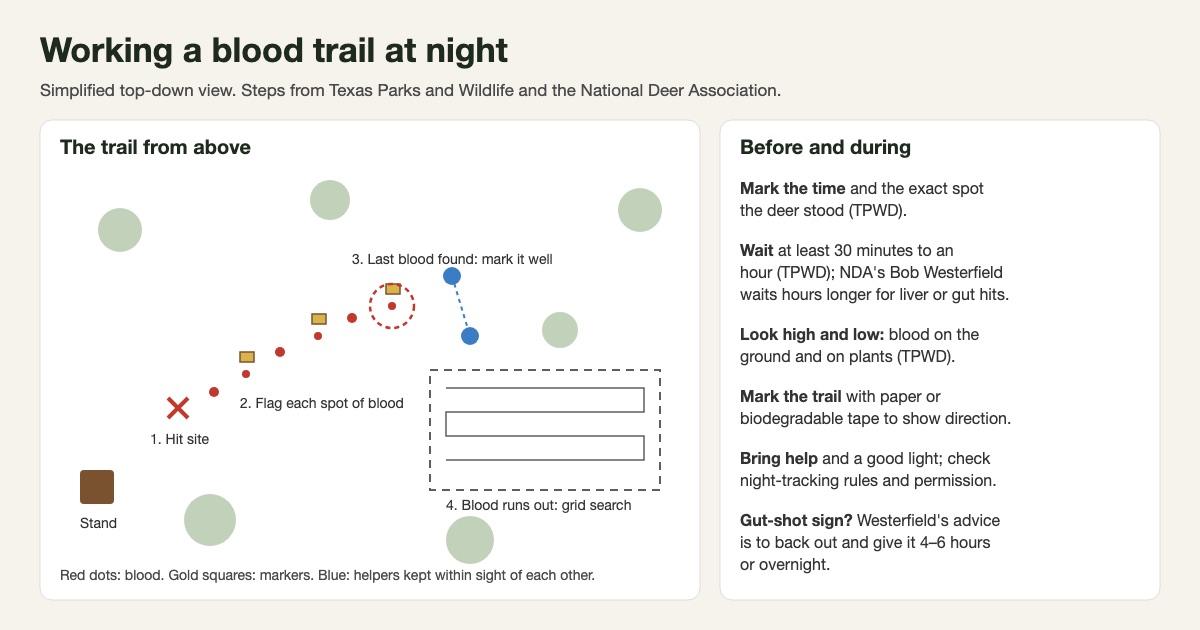
The biggest night-tracking mistake is starting too soon. Texas Parks and Wildlife's hunter education course says: "If the deer has run off, mark the time then wait for at least 30 minutes to an hour before beginning to trail." It also advises noting landmarks near where the deer stood.
What you find at the hit site changes the wait. In the National Deer Association's (NDA) guide, Bob Westerfield links blood to the likely hit and gives these waits:
| Sign at the hit site | Likely hit (NDA guide) | Suggested wait before trailing |
|---|---|---|
| Crimson, frothy blood | Lungs | About an hour for a hard-hit, arrow-shot deer |
| Bright red blood | Heart, or possibly a leg | About an hour for a heart hit |
| Dark red blood | Liver | At least 2 hours, sometimes 3 or 4 |
| Blood with green or brown matter and an odour | Gut | 4 to 6 hours, or leave it overnight |
After dark, a long wait can mean coming back at first light. If you aren't sure where you hit, our deer shot placement guide explains what each hit area means.
Do coloured lights really help?
Many blood-tracking lights add green, blue or red LEDs or filters. Brinyte, a maker of hunting lights, argues that green works best: "Dried blood absorbs green strongly and reflects almost nothing back, reading as a jet-black stain against reflective foliage." It cites hemoglobin absorption data from the Oregon Medical Laser Center.
That's a reasonable theory, but it's a seller's claim. Brinyte's page cites no field test comparing how much blood trackers actually find under each colour, and we found no independent study that does. Leaf litter, rain and your own eyes all play a part too, and brightness matters whatever the colour.
Headlamp vs handheld
A headlamp leaves both hands free to flag blood, part brush and carry your bow. A handheld light is easier to aim low and at different angles across the ground. Carrying one of each covers both jobs and means a dead battery doesn't end the search.
Working the trail and common mistakes
Once you start, slow down. TPWD advises looking for hair and blood at the hit site, and for blood "higher off the ground on plants" as well as on the ground. It suggests marking each find with toilet paper or biodegradable orange tape, tied "above or very near where you find blood sign." Westerfield drops a square of paper at each spot, which helps you "visualize the deer's line of travel."
Bring help. Westerfield recruits friends and tries "to keep everyone within sight." When blood runs out, he begins a grid search, and he suggests heading to the nearest water source.
Common mistakes:
- Starting too soon and pushing a wounded deer further.
- Walking on the trail, which smears or hides blood.
- Not marking the last blood, then losing your place.
- Ignoring the rules. Night tracking, carrying a bow or gun while tracking, and crossing property lines are regulated differently by state. Check your regulations and get landowner permission first.
For the broadhead side of the story, see our fixed-blade vs mechanical broadheads comparison.
You can browse blood tracking flashlights or neutral white hunting flashlights on Amazon. Treat any listing as an example to consider, and check lumens and run time.
Frequently asked questions
How do you track blood at night?
Mark the time and the spot, then wait: Texas Parks and Wildlife says at least 30 minutes to an hour, longer for poor hits. Use a bright light, flag every spot of blood, check plants as well as the ground, and keep helpers within sight of each other.
Which light colour shows a blood trail most clearly?
There's no independent answer. Light makers such as Brinyte say green light makes blood look darker against foliage, based on how hemoglobin absorbs light, but we found no field test proving it. A bright white light of at least 50 to 70 lumens, as the NDA suggests, is the dependable baseline.
How long should you wait before tracking a deer?
TPWD advises at least 30 minutes to an hour if the deer ran off. The NDA's guide suggests about an hour for a hard-hit lung or heart shot, at least 2 hours for liver hits, and 4 to 6 hours or overnight for gut hits.
Related articles
 Guides
Where to Shoot a Deer With a Bow: Shot Placement
Bow shot placement for deer: where the heart and lungs sit, how to aim broadside, quartering away and from a tree stand, which shots to pass on, and why.
October 6, 2026 · 10 min read
 Comparisons
Fixed-Blade vs Mechanical Broadheads: Pros, Cons and Rules
Fixed-blade vs mechanical broadheads compared: flight, tuning, cutting diameter, energy needs, durability, hybrid designs, regulations and which suits your bow.
Updated February 13, 2026 · 6 min read
 Comparisons
Tree Stand vs Ground Blind for Bowhunting
Tree stand vs ground blind for bowhunting deer: view, hiding your draw, scent, shot angle, safety and setup compared, with when to choose each.
Updated October 6, 2026 · 5 min read