
Crossbow Shooting in Wind: Drift and Holdoff
How to adjust a crossbow scope for wind: why crosswinds push bolts, what makes drift worse, holding into the wind vs dialling, and when to shorten the shot.
By Archery Insider Editorial Team
· · 4 min read
In this article
Wondering how to adjust a crossbow scope for wind? For most hunting shots, you don't. You keep the windage turret where your zero put it, hold slightly into a strong crosswind if practice has shown you need to, and shorten the shot when gusts make it hard to judge. Drift grows with distance, so range is the setting that matters most.
Wind drift basics
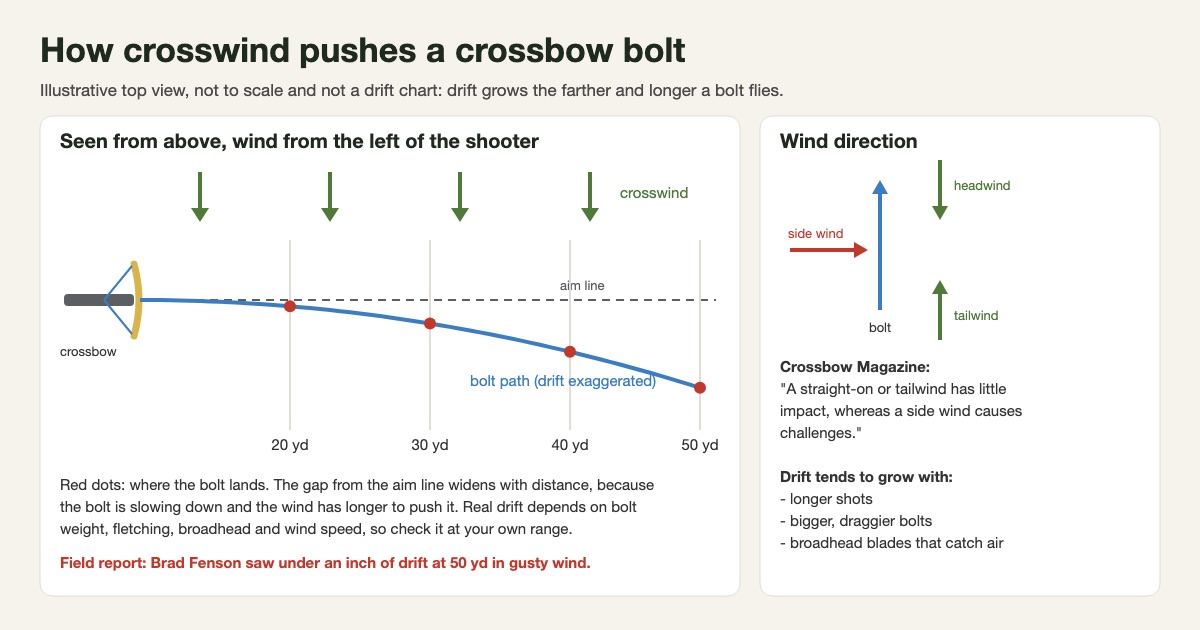
A crosswind pushes the bolt sideways for as long as it is in the air. The farther the shot, the longer the bolt flies and the more it slows, so the push keeps adding up with distance.
How much? We found no authoritative crossbow drift table, and any numbers would change with bolt, broadhead and wind speed. The best field evidence we found is informal. Writing for Grand View Outdoors, Brad Fenson describes shooting at 30, 40 and 50 yards in gusty wind with his hunting companions: "the heavier arrows moved so little you couldn't say drift was an issue." He adds: "The only bolt drift we could identify was at 50 yards, and the bolt was pushed less than an inch."
That's one group's experience, not a rule, so test your own setup.

What makes drift worse
| Factor | Effect on drift | Who says so |
|---|---|---|
| Distance | More drift the longer the bolt flies | Basic physics; see the diagram above |
| Wind direction | Side wind is the problem; head and tail winds matter little | Crossbow Magazine |
| Bolt size | "The bigger the arrow, the more wind grabs and influences its flight" | Crossbow Magazine |
| Broadheads | Blades "catch air as they fly" (planing) | Barnett's FAQ |
| Bolt weight | Heavy bolts "moved so little" in one informal test | Grand View Outdoors |
Fletching plays a part too, but we found no maker figures comparing vanes in wind. Shoot only bolts your crossbow's maker approves.
Hold into the wind, or dial windage?
Your scope's windage turret exists to set your zero. TenPoint's manual uses the windage dial to move your group onto the aim point at 20 yards during sighting in. If you dial it for a gust, you must dial it back, and a forgotten click moves every shot that follows. Our guide to sighting in a crossbow scope covers that zero.
Holding off is simpler for hunting:
- Keep your zero. Leave the turrets alone in the field.
- Learn your holdoff on the range. Crossbow Magazine advises: "Practicing long on windy days teaches you how much arrow drift will occur with any wind speed."
- Aim slightly into the wind by the amount you saw in practice, if any, and only for a steady side wind.
- Hold the crossbow level. The same article calls canting "one of the biggest mistakes", sending bolts "left or right, high or low".
- Wait out gusts. A lull is better than a guess.
Limit your range in wind
The surest wind correction is a shorter shot. Even if drift is small, strong wind makes a crossbow harder to hold steady and adds the planing effect of your broadheads. Shooting sticks or a rest can take some of the weight while you wait for a lull.
Fenson takes a different view in the same Grand View Outdoors piece. He argues that wind noise can let you "get away with taking a farther shot", and says he limits himself to 30 yards on "church-mouse-quiet days". Weigh that against your own practice results. Our guide to effective bow range for deer explains how to set a personal maximum.
For examples to consider, you can browse crossbow scopes on Amazon or look at hunting wind indicators, which show which way the breeze is moving at your stand.
Frequently asked questions
How do you adjust a crossbow scope for wind?
Usually you don't. Keep the windage turret set for your zero, and learn on windy range days how far to aim into a side wind at each distance. Dialling for every gust means dialling back afterwards. For hunting, shortening the shot is often the better adjustment than any scope change.
How much does wind affect a crossbow bolt?
It depends on distance, wind direction, bolt size and broadhead. In one informal test reported by Grand View Outdoors, heavy bolts were pushed less than an inch at 50 yards in gusty wind. Side winds matter more than head or tail winds, so check your own setup at your hunting distances.
Related articles
 Training
How to Sight In a Crossbow Scope, Step by Step
How to sight in a crossbow scope: safety, mounting, a 20-yard zero, multi-reticle and speed-dial scopes, broadhead checks and fixes for wandering groups.
October 6, 2026 · 9 min read
 Guides
How Far Can You Shoot a Deer With a Bow?
Effective bow range for deer: what bowhunter education says, why long shots wound more, arrow flight times, jumping the string, and how to find your limit.
October 7, 2026 · 9 min read
 Training
Do Crossbows Need Broadhead Tuning?
How to broadhead tune a crossbow: why broadheads can hit apart from field points, the spin test, nock indexing, and when to re-zero for hunting heads.
Updated October 6, 2026 · 5 min read