
Vortex Razor HD 4000 GB Review: Worth It for Bowhunters?
Vortex Razor HD 4000 GB review: what the GeoBallistics solver adds, real ranges by mode, the non-GB Razor HD 4000 compared, and who should buy it.

By Archery Insider Editorial Team
· 11 min read
Research-based: built from maker specs and official sources, fact-checked before publishing. How we review products
In this article
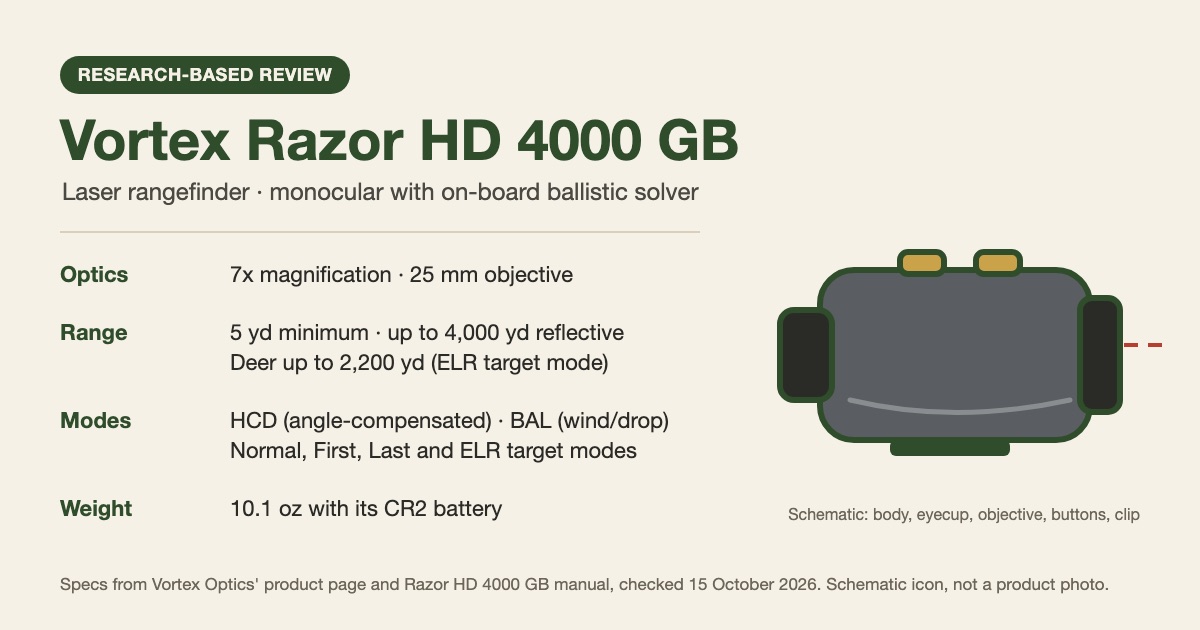
The Vortex Razor HD 4000 GB is a 7x25 laser rangefinder with a ballistic computer built in, and this Vortex Razor HD 4000 GB review looks at it through a bowhunter's eyes. In short: it's a superb rangefinder that happens to carry a rifle calculator, so it suits hunters who carry both a bow and a long-range rifle each year. If you only hunt with a bow, the plain Razor HD 4000 gives you the same glass, the same laser and the same angle-compensated readout without the ballistic extras.
You can see the Razor HD 4000 GB on Amazon, where the listing also offers the non-GB model, so check which version you've picked before you order.
Vortex Razor HD 4000 GB
Advantages
- HCD mode gives a slope-corrected distance that works directly with bow sight pins
- First and Last target modes plus a 10-second scan help in timber and brush
- 5-yard minimum range covers close tree-stand shots
- Unlimited, unconditional VIP lifetime warranty with no receipt needed
Trade-offs
- The ballistic solver is built for rifle bullets; there's no arrow profile in the manual
- Compass needs recalibrating after a battery change or a move of about 30 miles
- Vortex's own product page and manual disagree on eye relief and width
Vortex Razor HD 4000 GB
Vortex Razor HD 4000 GB specs
These figures come from Vortex Optics' product page (SKU LRF-252) and the specification table in the Razor HD 4000 GB manual. Where the two disagree, we show both.
| Spec | Vortex's listing |
|---|---|
| Magnification / objective | 7x / 25 mm |
| Reflective range | Up to 2,400 yd (Normal) · up to 4,000 yd (ELR) |
| Tree range | Up to 1,800 yd (Normal) · up to 2,500 yd (ELR) |
| Deer range | Up to 1,600 yd (Normal) · up to 2,200 yd (ELR) |
| Minimum range | 5 yd |
| Accuracy | Page: 0.5 yd at 100 yd. Manual: ± 0.5 yd under 200 yd, ± 1 yd to 1,000 yd, ± 2 yd beyond |
| Maximum angle reading | ± 89° |
| Field of view | 341 ft at 1,000 yd (6.5°) |
| Eye relief | Page: 17.5 mm. Manual: 19 mm |
| Size | 4.4 × 3.2 in; width 1.7 in (page) or 1.9 in (manual) |
| Weight | 10.1 oz (manual: with battery) |
| Battery | CR2 |
| In the box | Carry case, bungee lanyard, lens cloth, utility clip, 2 mm hex wrench, CR2 battery |
The product page only gives the headline 4,000, 2,500 and 2,200-yard figures. The manual makes clear those are Extended Laser Range (ELR) results, with Normal mode reaching shorter distances.
Design and features
HCD mode: the one bowhunters will use
The Razor HD 4000 GB has two ranging modes. HCD stands for Horizontal Component Distance, and the manual calls it "your primary mode when not using the on-board ballistic solver." It measures the shot angle and shows the horizontal distance, which is the distance gravity acts over. For a bow, that's the number your sight pins are set for.
Vortex spells it out for archers: the displayed HCD yardage "is corrected for shot angle and needs no extra user input", and archers "use the appropriate level ground sight pin for the range displayed." That's exactly what you want from a tree stand or on a steep western slope. There's no separate bow mode to set up, and nothing to enter about your arrow.
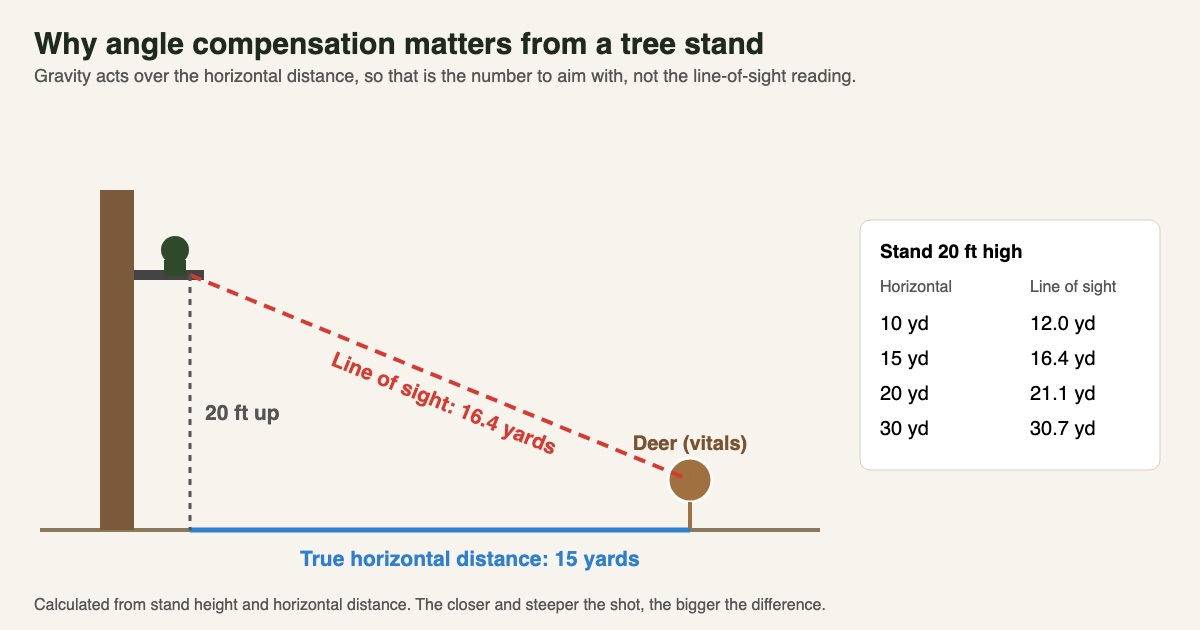
The difference is largest on close, steep shots. Our guide to choosing a bowhunting rangefinder has a worked table for a 20-foot stand.
BAL mode and the GeoBallistics solver
BAL mode is what the GB adds. It shows the line-of-sight range, the shot angle in degrees, and a wind and drop correction in MOA or MRAD for the selected profile. Profiles are labelled A, B and C; you build them in the GeoBallistics app on your phone and they sync over Bluetooth.
The profile fields make the target user clear. The app asks for bullet diameter, weight, ballistic coefficient, G1 or G7 drag model, barrel twist rate, sight height and muzzle velocity, and the manual adds that "Inches are not compatible" as a solution unit. The three default profiles are .308 Win, 6.5 Creedmoor and .223/5.56. None of the profile fields or defaults are set up for arrows.
Behind the solver sit on-board sensors for compass direction, temperature, angle, pressure and humidity. The rangefinder can also pair with a Kestrel weather meter, and Vortex's patented Wind Bearing Capture mode lets you face into the wind, press a button, and have the unit track that wind direction as you turn to range.
Target modes and the scan feature
There are four target modes. Normal returns "the strongest range result" and is Vortex's recommendation for most situations. First reports the closest object, which helps when a deer stands in front of a hillside. Last reports the farthest, which is the one to pick when you're ranging past twigs and grass in timber. ELR is for small, less reflective targets a long way off; the manual warns it can need "a longer response time" and recommends a tripod.
Hold the Measure button and the Scan feature takes continuous readings for ten seconds, with "SCAN" blinking on the display. For a bowhunter, scanning along a trail and noting the yardage of a few landmarks before light fades is a practical use.
What the headline ranges really mean
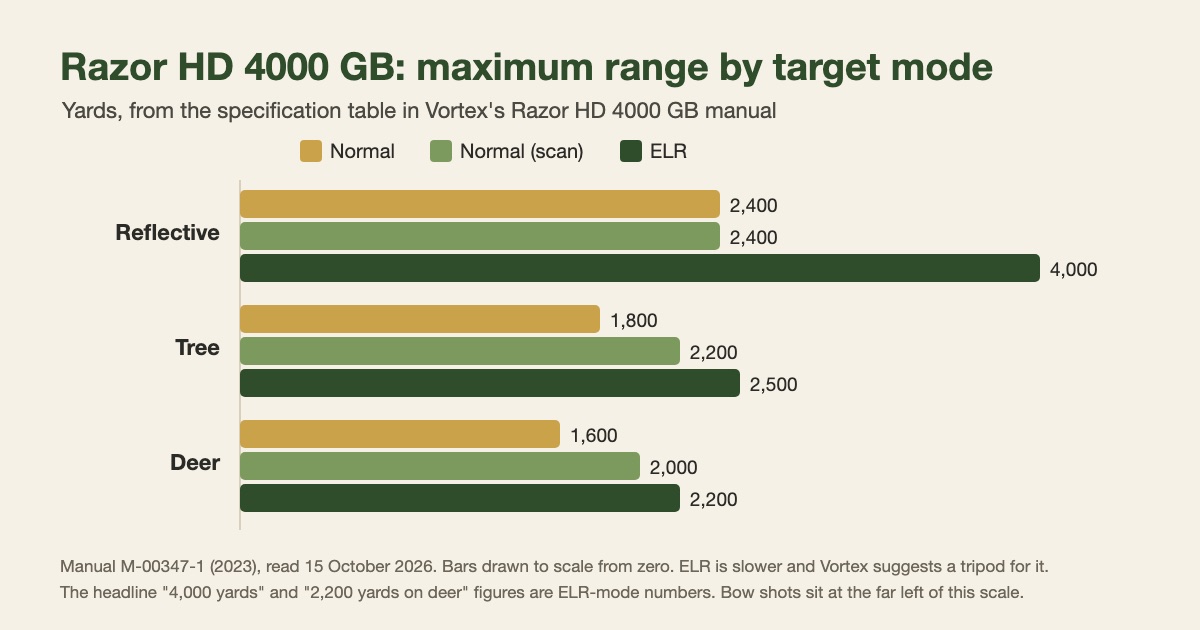
None of these distances matter much for archery. Treat them as a measure of the laser's reach in good conditions: the manual's own ranging tips note that dark, dull or textured surfaces, curved or angled targets, rain, fog and bright sun all reduce ranging ability, and that solid objects such as rocks reflect better than bushes. Shot distance with a bow is a separate question, which our effective bow range for deer guide covers.
Optics, display and build
Vortex describes an HD optical system with XR Plus anti-reflective coatings, dielectric prism coatings and its ArmorTek scratch-resistant outer coating. The display is illuminated with five brightness settings, and auto-shutoff can be set to 30, 45, 60 or 180 seconds. The body has a magnesium chassis, rubber armour, a utility clip you can move to either side, and a tripod socket. Vortex lists it as waterproof and shockproof but doesn't publish an immersion depth.
Fit, setup and what else you need
Here's the setup order from Vortex's manual:
- Fit the battery. Unscrew the cap and insert a CR2 with the positive side facing out.
- Set the eyecup and dioptre. Keep the eyecup extended without glasses, twist it in with them, then turn the dioptre until the image is sharp.
- Choose your modes. Hold Menu for four seconds, then step through target mode, ranging mode (HCD or BAL), units, brightness and auto-shutoff. The factory settings are HCD, Normal, brightness level 4, 30 seconds and yards.
- For BAL only: turn on Bluetooth, pair with the GeoBallistics app, then calibrate the compass outdoors, away from metal, by turning the unit in three directions.
If you'll only use HCD, you can stop after step 3. The manual says the compass needs recalibrating after replacing the battery and after moving "typically 30 miles or more", and its app troubleshooting section recommends iOS 13+ or Android 6.0+.
To carry it on a hunt, the included lanyard and clip work, or use a chest harness pouch so it doesn't knock against your riser. A spare CR2 battery belongs in your pack.
Vortex Razor HD 4000 vs GB
This is the comparison most buyers need. Vortex sells both, and its product pages show how close they are.
| Razor HD 4000 GB (LRF-252) | Razor HD 4000 (LRF-250) | |
|---|---|---|
| Optics | 7x25, 341 ft at 1,000 yd | 7x25, 341 ft at 1,000 yd |
| Range (reflective / deer) | 4,000 / 2,200 yd | 4,000 / 2,200 yd |
| Minimum range | 5 yd | 5 yd |
| Ranging modes | HCD, BAL (with scan) | HCD, LOS (with scan) |
| Target modes | Normal, First, Last, ELR | Normal, First, Last, ELR |
| Ballistic solver | GeoBallistics, 3 profiles | No |
| Sensors and Bluetooth | Yes, plus Kestrel pairing | Not listed |
| Weight | 10.1 oz | 9.9 oz |
| Height | 3.2 in | 3.1 in |
| Warranty | VIP lifetime | VIP lifetime |
The non-GB model's page says its HCD ranging gives "bow and rifle shooters the critical distance data needed to make accurate shots." For a bowhunter, the GB adds nothing to HCD ranging. It adds the solver, the sensors, Bluetooth and two-tenths of an ounce.
You can also see the non-GB Razor HD 4000 on Amazon.
How it compares with Leupold and Maven
Two other 7x rangefinders worth setting beside it are Leupold's RX-2800 TBR/W and Maven's RF.1. Here are the makers' figures, checked on 15 October 2026.
| Vortex Razor HD 4000 GB | Leupold RX-2800 TBR/W | Maven RF.1 | |
|---|---|---|---|
| Magnification / objective | 7x25 | 7x27 | 7x25 |
| Max reflective range | 4,000 yd (ELR) | 2,800 yd | 4,500 yd |
| Deer range | 2,200 yd (ELR) | 1,800 yd | 2,700 yd |
| Minimum range | 5 yd | 6 yd | 5 yd |
| Ballistics | Full solver, 3 profiles | TBR: 25 ballistic groups to 800 yd | None listed |
| Weight | 10.1 oz | 7.9 oz | 10 oz |
| Battery | CR2 | CR123 | CR2 |
Leupold RX-2800 TBR/W. Leupold's own page now marks this model as discontinued, so you'd be looking at remaining or used stock. It's the lightest here at 7.9 oz and has a red OLED display. Its True Ballistic Range mode uses 25 ballistic groups for shoot-to ranges up to 800 yards, rather than custom profiles. Its spec table lists both Bow Mode and Horizontal Distance (TRIG-H) as "No", so its angle compensation is built around rifle ballistics rather than a plain horizontal yardage for your pins.
Maven RF.1. Maven lists 5–4,500-yard ranging (2,700 yards on deer), line-of-sight and angle compensation, a Field/Forest obstruction filter, five reticle options and five brightness levels, and recommends it "for archery hunters, rifle hunters, and long range hunters/shooters". There's no ballistic solver. Maven describes its model as direct to consumer, so expect to buy it from Maven's own site rather than a local shop.
Who should buy it, and who shouldn't
Good fits:
- Western hunters who carry a bow early in the season and a rifle later. One rangefinder handles HCD for elk or mule deer bowhunting and full wind and drop solutions for the rifle season.
- Long-range rifle shooters who also bowhunt. If you already use Kestrel meters or the GeoBallistics app, the GB slots into that kit.
- Hunters who glass open country and want to range distant landmarks while planning a stalk.
Look elsewhere if:
- You only hunt with a bow. The non-GB Razor HD 4000 covers every feature you'll use.
- Weight matters most. Leupold's RX-2800 TBR/W lists 7.9 oz against 10.1 oz, though Leupold has now discontinued it.
- Your shots are close and on level ground, such as whitetails from a ground blind. A far simpler unit can do that job; our guide to whether a golf rangefinder works for bowhunting explains when a basic model is enough and when angle compensation matters.
Warranty and where to buy
Vortex's VIP warranty is described on the product page as "Unlimited. Unconditional. Lifetime." The manual adds that you "do not have to register, save the box, or a receipt", and that it doesn't cover loss, theft, deliberate damage or cosmetic damage that doesn't affect performance. That makes buying online straightforward.
The Amazon listing offers both versions under one page, so check that "Razor HD 4000 Geoballistics" is the selected option if you want the GB. You can check current Razor HD 4000 GB availability on Amazon, or ask a local optics or archery shop that stocks Vortex.
Frequently asked questions
Is the Vortex Razor HD 4000 GB good for bowhunting?
Yes, as a rangefinder. Its HCD mode shows angle-corrected distance, and Vortex's manual tells archers to use the level-ground sight pin for the number displayed. The 5-yard minimum range and First and Last target modes suit tree stands and timber. Its ballistic solver, though, is designed for rifle bullets, so bow-only hunters gain nothing from it.
What is the difference between the Vortex Razor HD 4000 and the GB?
They share 7x25 optics, a 5 to 4,000-yard range, ± 89° angle reading and four target modes. The GB adds the GeoBallistics solver with three profiles, environmental sensors, Bluetooth, Kestrel pairing and Wind Bearing Capture. It replaces the LOS mode with BAL mode, which shows line-of-sight range plus a solution, and weighs 10.1 oz against 9.9 oz.
How far can the Razor HD 4000 GB range a deer?
Vortex's manual lists up to 1,600 yards on deer in Normal mode, 2,000 yards in Normal mode while scanning, and 2,200 yards in Extended Laser Range mode. ELR can take longer to return a reading, and Vortex recommends a tripod for it. Real results depend on light, weather and how reflective the animal and background are.
Can the GeoBallistics solver calculate arrow drop?
Vortex's manual doesn't describe an arrow profile. Profiles are built from bullet data such as calibre, ballistic coefficient, G1 or G7 drag model and barrel twist rate, and the defaults are .308 Win, 6.5 Creedmoor and .223/5.56. For archery, use HCD mode and your own sight tape, checked at known distances on the range.
Related articles
 Gear
How to Choose a Rangefinder for Bowhunting
How to choose a bowhunting rangefinder: angle compensation, bow modes, scan and target priority, display, magnification, bow-mounted units and field use.
October 11, 2026 · 9 min read
 Guides
How Far Can You Shoot a Deer With a Bow?
Effective bow range for deer: what bowhunter education says, why long shots wound more, arrow flight times, jumping the string, and how to find your limit.
October 7, 2026 · 9 min read
 Guides
Mule Deer Bowhunting: Spot-and-Stalk Basics
Mule deer hunting with a bow: how muleys differ from whitetails, glassing, a step-by-step spot-and-stalk, wind and thermals, shot angles and state tag rules.
November 26, 2026 · 8 min read