
CBE Trek Pro Review: Pins, Adjustments and Verdict
CBE Trek Pro review: 1, 3 and 5 pin versions, the carbon bar, two floating pins, the 2V and Micro 3V, and how it compares with Spot Hogg and Axcel.

By Archery Insider Editorial Team
· 12 min read
Research-based: built from maker specs and official sources, fact-checked before publishing. How we review products
In this article
Put a three-pin housing on a slider and you get a sight that shoots like a fixed-pin sight at 20, 30 and 40 yards, then dials like a single pin for the longer shot. That's the idea behind this CBE Trek Pro review. Custom Bow Equipment's flagship hunting slider comes with one, three or five Blade Pins, a carbon fibre extension bar, and two pointers so either your top or bottom pin can float. It suits hunters who want a full-featured mover and don't mind an ounce or two for it. You can compare CBE Trek Pro sights on Amazon alongside CBE's own store and dealers.
CBE Trek Pro
Advantages
- Two pointers let either the top or bottom pin act as a floater
- 1st, 2nd and 3rd axis adjustment, plus micro windage with engraved marks
- Carbon fibre bar with four click-detent positions for setting sight radius
- Sight light and four colours of peep alignment ring included
Trade-offs
- Pins come in .010 or .019 in only; no .029 in option
- Heavier than CBE's own Trek, which weighs 8.6–9.1 oz
- CBE doesn't publish the bar's length or adjustment range
CBE Trek Pro (5-pin .019, right-hand)
CBE Trek Pro specs and versions
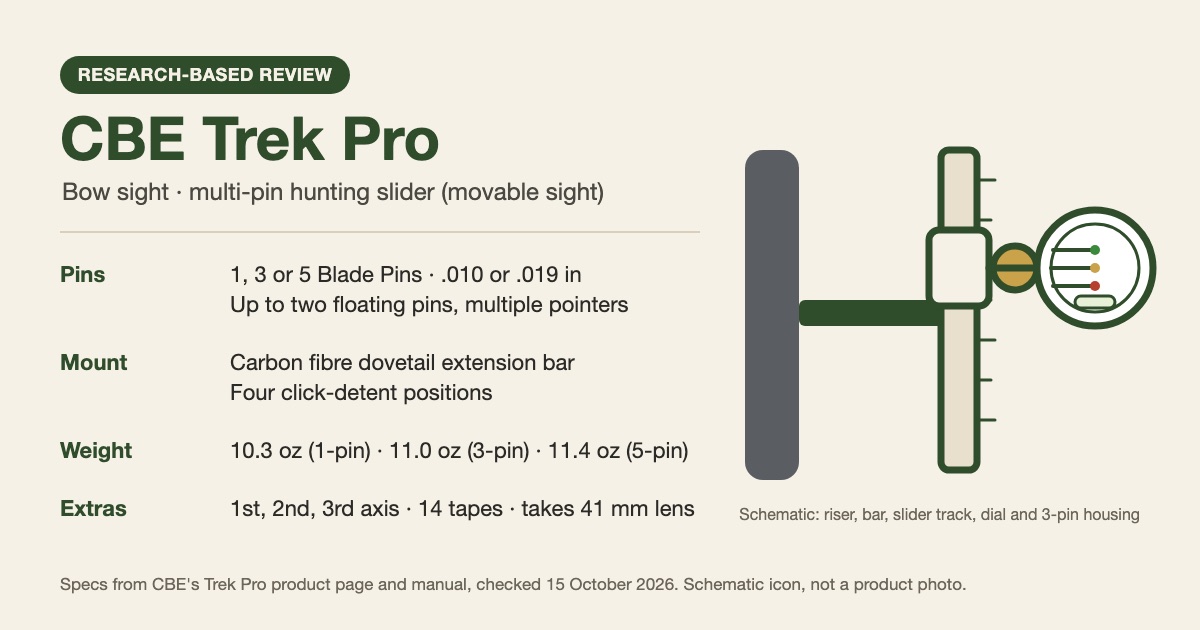
These figures come from CBE's Trek Pro product page and instruction sheet, checked on 15 October 2026.
| Spec | CBE's listing |
|---|---|
| Pins | 1, 3 or 5 Blade Pins, micro-adjustable |
| Pin size | .010 or .019 in |
| Fibre | 12 in of fibre, protected inside the Blade Pin design |
| Hand | Right or left |
| Mount | Carbon fibre dovetail extension bar, four click-detent positions |
| Body | 6061-T6 aluminium, fully machined |
| Elevation | Hybrid drive with Rapid Drive, lock lever and top-pin hard stop |
| Windage | Micro, with laser-engraved marks and lock lever |
| Levelling | 1st, 2nd and 3rd axis |
| Tapes | 14 laser-engraved aluminium tapes to choose from |
| Extras | Sight light, sliding rheostat cover, 41 mm lens option, four peep rings |
| Weight | 10.3 oz (1-pin), 11.0 oz (3-pin), 11.4 oz (5-pin), with mount |
CBE's store lists every version as its own part number, from CBE-TKP-1-RH-10 (1-pin, right hand, .010 in) to CBE-TKP-5-LH-19 (5-pin, left hand, .019 in). The store listing went live on 1 January 2022, and it was still current when we checked in October 2026.
Design and features
Two floating pins and the hard stop
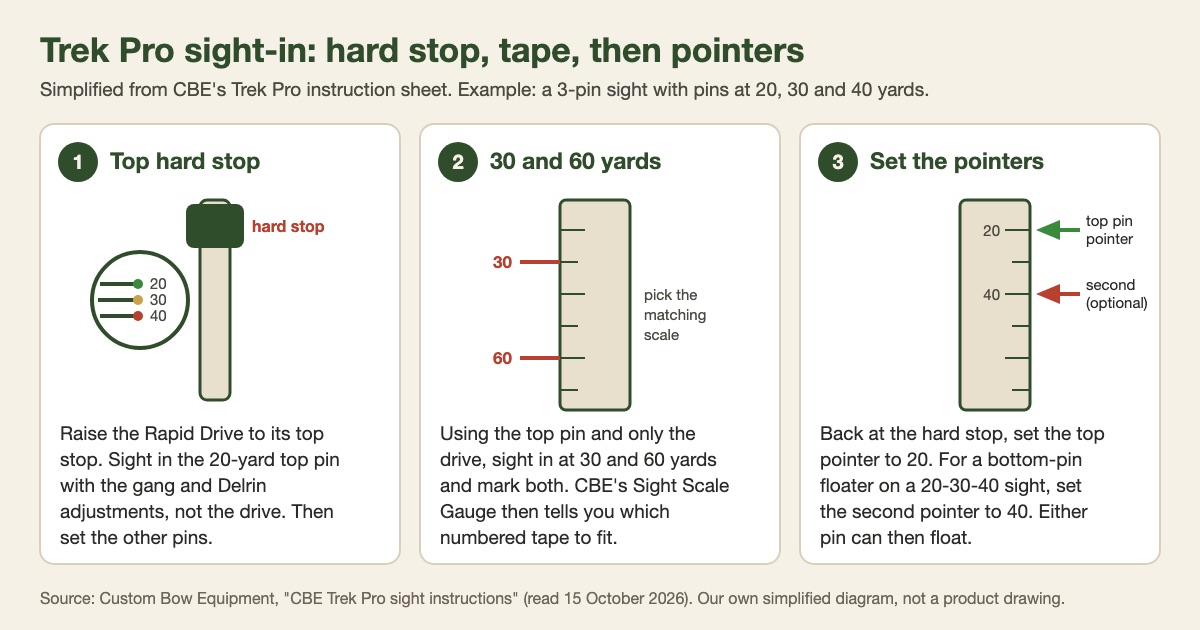
The Trek Pro's party trick is in CBE's own description: "the ability to set up two floating pins with multiple indicator pointers." The instruction sheet explains how. You sight in your 20-yard top pin with the housing at its top hard stop, then set the top pointer to 20 on the tape. That makes the top pin a floater: dial the housing down and the pointer reads your top pin's distance.
The second pointer is optional. CBE's example uses a 3-pin sight with pins at 20, 30 and 40 yards. Set the lower pointer to 40 while the top one stays on 20, and "this will allow the user to utilize the top or bottom pin as a floater." The hard stop matters too: after a long shot, rack the housing up until it stops and your fixed pins are back on their distances.
Carbon bar and mount
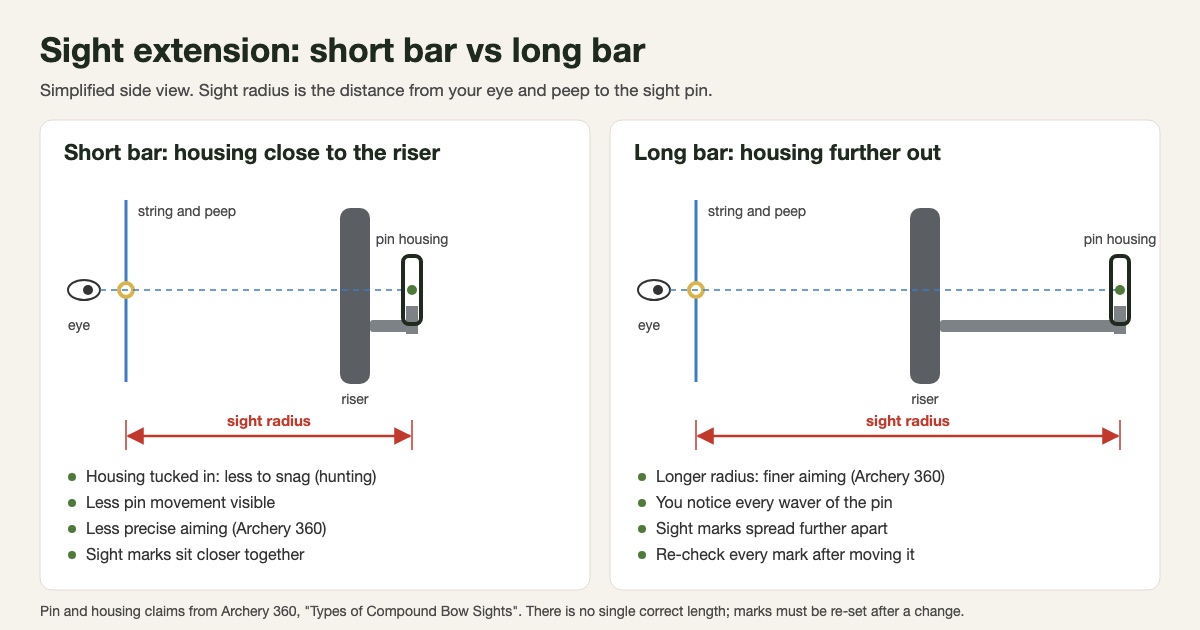
The Trek Pro's mount is the big difference from the cheaper Trek. CBE calls it a "Carbon Fiber Extension Dovetail Sight Bar with Ball Detent and 'Click' on the Carbon Bar Position." The instruction sheet says there are four click-detent locations, locked with a 5/16 in set screw, so you can move the housing out for a longer sight radius or in to keep it tucked against the riser. The bracket also has two #10-24 holes for a quiver.
Hybrid drive, windage and the three axes
Elevation runs through what CBE calls a hybrid drive: unlock a lever, turn the knob, and the Rapid Drive moves the housing. Windage is micro-adjustable with laser-engraved marks and its own lock lever. Gang adjustments move all the pins together, and a Delrin mount adjustment fine-tunes the housing position.
All three axes adjust, each held by a pair of screws. The 1st axis uses two slots on the carbon bar mount, and the 2nd and 3rd axes use 7/64 in hex screws.
Pins, brightness and the lens
CBE says 12 in of fibre is protected within its Blade Pin design, and you move pins individually through what CBE calls a micro pin system. The sheet says to back out the pin's lock screw about 3.5 turns to engage the lead screw, turn the pin knob, then lock it again, with a plain warning: "Do Not Over-tighten."
For brightness, a sliding cover shades the fibres: slide it over to dim the pins, slide it back to brighten them. CBE includes a sight light, and the housing takes a 41 mm lens if you want magnification. Interchangeable fluorescent peep alignment rings come in green, with red, yellow and grey in the box.
Fit, setup and compatibility
Mounting on your bow
The Trek Pro bolts to a standard riser with the two #10-24 x 5/8 in screws in the box. For other risers, CBE sells two adapters:
- Picatinny: the CBE Picatinny Sight Mount Adapter lists the Trek Pro as compatible and adds 1st axis adjustment.
- Mathews Bridge-Lock: the CBE Bridge-Lock Technology Conversion Bar also lists the Trek Pro, and CBE says it recentres the windage for "the ideal range of movement."
Sight tapes
CBE's tapes are laser-engraved aluminium. Its tape page says they give marks "out to 100 yards" and work with all CBE hybrid sights, using the same 30 and 60 yard method. If you've never matched a tape before, our guide to using a bow sight tape explains how the marks spread out at longer range.
Setting it up
CBE's instruction sheet sets out a clear order. Condensed:
- Mount the sight and pick a bar position. Level the 2nd axis, then set the 1st and 3rd axes.
- Raise the Rapid Drive to its top hard stop. Place the top pin in the housing, leaving room for the others below.
- Sight in the top pin at 20 yards using only the gang elevation and Delrin adjustments, not the drive.
- Set your other pins at their distances, with the drive still at the top.
- Sight in the top pin at 30 and 60 yards using only the drive. Mark both on the scale, then use CBE's Sight Scale Gauge to choose the matching tape and fit it.
- Set the pointers. Return to the hard stop, point the top indicator at 20, and set the second indicator if you want a bottom-pin floater.
Then confirm every distance you plan to hunt.
How the Trek Pro compares
CBE Trek Pro vs Spot Hogg, Axcel Landslyde and Black Gold
Figures from each maker's product page, checked in October 2026.
| CBE Trek Pro | Spot Hogg Fast Eddie XL | Axcel Landslyde Carbon Pro | Black Gold Ascent Verdict | |
|---|---|---|---|---|
| Pins | 1, 3 or 5 | Single or double | Single, Ranger-Pin, or 3 or 5 (AccuStat II) | 1, 3 or 5 |
| Pin sizes | .010 or .019 in | .010, .019 or .029 in | .010, .019 or .029 in (single) | .019 in |
| Bar | Carbon fibre dovetail | 6 in dovetail, quick-release mount | Carbon fibre | X-Frame or 4 in dovetail |
| 1st axis | Yes | Not listed | Yes | Yes |
| Pointers | Up to two | One (double pointer on double pin) | Two, adjustable | One needle |
| Weight | 10.3–11.4 oz | Not listed on the page | Not listed on the page | 9.4–9.7 oz |
CBE Trek Pro vs Spot Hogg: the Fast Eddie is a single or double-pin slider with micro 2nd and 3rd axis but no 1st axis listed, and it offers a .029 in pin the Trek Pro doesn't. Pick it if you only want one or two pins on a simpler frame. Our Spot Hogg Fast Eddie review covers the MRT, XL and PM versions. The Trek Pro is the better fit if you want three or five fixed pins.
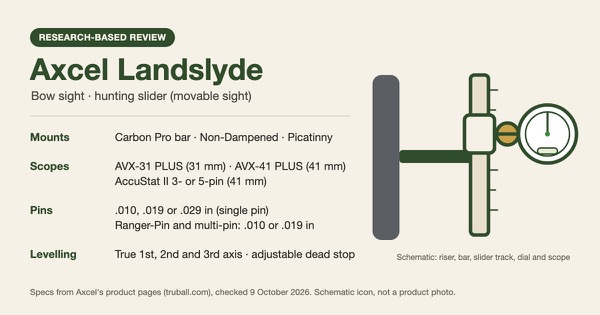
CBE Trek Pro vs Axcel Landslyde: these two are the closest match. Both use a carbon bar, adjust all three axes, have two pointers and offer multi-pin housings. The Landslyde lets you swap scopes, from the 31 mm AVX-31 PLUS to the 41 mm AccuStat II, and adds a .029 in pin. The Trek Pro builds its pins into one housing. Our Axcel Landslyde review explains the scope choices.
Black Gold Ascent Verdict: the same multi-pin-plus-floater idea, a little lighter, but only .019 in pins and one needle. See our Black Gold Ascent Verdict review.
CBE Trek Pro vs Engage Hybrid
The Engage Hybrid was CBE's earlier dovetail slider. An Internet Archive copy of its page from August 2022 lists the same 1, 3 or 5-pin housings, .010 or .019 in Blade Pins, hybrid elevation and Rapid Drive. It mentions 2nd and 3rd axis adjustment but no 1st axis, and a weight of 13.2 oz. By October 2026 it no longer appeared in CBE's sights collection. If you're choosing between a used Engage Hybrid and a new Trek Pro, the Trek Pro is about 2–3 oz lighter and adds a 1st axis.
Trek Pro vs Trek, 2V and Micro 3V
| Trek Pro | Trek | Trek Pro 2V | Trek Pro Micro 3V | |
|---|---|---|---|---|
| Pins | 1, 3 or 5 horizontal | 1, 3 or 5 horizontal | One vertical pin, two fibre dots | Three vertical pins |
| Mount | Carbon dovetail bar | Aluminium Smart Mount | Multi-position mounting holes | Carbon dovetail bar |
| 41 mm lens | Yes | Not listed | Yes, plus sunshade | Yes, plus sunshade |
| Weight | 10.3–11.4 oz | 8.6–9.1 oz | 9.472 oz | 9.856 oz |
The Trek puts the same idea on CBE's aluminium Smart Mount, a direct-mount bracket with a triple-hole layout. The vertical-pin models are covered in the FAQ below.
Who should buy it, and who shouldn't
Good fits:
- Whitetail hunters who sometimes get a long shot. Fixed pins handle the stand, and a floating pin covers the field edge.
- Western hunters who range most shots but want a quick pin for close encounters.
Look elsewhere if you are:
- A tree-stand hunter shooting inside 30 yards. A fixed-pin sight is simpler and lighter.
- Set on a .029 in pin. CBE lists only .010 and .019 in.
- Counting every ounce. The Trek or a vertical-pin Trek model weighs less.
The Trek Pro ships with a sight light. Hunting rules for lighted sights differ from state to state, so read our guide to whether lighted bow sights are legal before your season.
Where to buy
CBE sells the Trek Pro on its own store and through dealers listed on its dealer finder. Its warranty page describes a limited lifetime warranty: you need a returns number (RMA) and a photo of the product before sending anything back.
If you buy through Amazon, check the pin count, pin size and hand before you order, since each version is a separate part number, and check who the seller is.
Frequently asked questions
Is the CBE Trek Pro worth it over the regular Trek?
Only if you want the carbon fibre bar or a lens. The Trek shares the pin options, hybrid drive, micro windage, three-axis adjustment and dual-floater set-up, but sits on an aluminium Smart Mount and weighs 8.6–9.1 oz against the Trek Pro's 10.3–11.4 oz. The Trek Pro adds four bar positions, and its page lists a 41 mm lens option that the Trek's page doesn't mention.
CBE Trek Pro vs Spot Hogg Fast Eddie: which should I pick?
Pick the Fast Eddie if you want a dedicated single or double-pin slider, or a .029 in pin; Spot Hogg offers .010, .019 and .029 in. Pick the Trek Pro if you want three or five fixed pins that also dial, two pointers and a listed 1st axis adjustment. Both come in right and left hand.
What is the CBE Trek Pro Micro 3V?
It's a vertical-pin version of the Trek Pro. CBE describes three vertical pins with a fixed middle pin and micro-adjustable top and bottom pins, on a carbon fibre dovetail bar. It weighs 9.856 oz, takes a 41 mm lens or sunshade, has dual pointers, and comes in .010 or .019 in pins, right or left hand.
Is the CBE Trek Pro 2V a good sight?
It suits hunters who like a single-pin sight picture but want a second aiming point. CBE puts two fibre dots on one slim vertical pin at a fixed gap. It weighs 9.472 oz, takes a 41 mm lens or sunshade, and has dual pointers. We haven't shot it, so treat this as a description, not a test.
Does the Trek Pro fit a Picatinny riser or a Mathews Bridge-Lock?
Yes, with CBE's adapters. The CBE Picatinny Sight Mount Adapter lists the Trek Pro as compatible and adds 1st axis adjustment. CBE's Bridge-Lock Technology Conversion Bar also lists the Trek Pro and recentres the windage for Mathews bows. On a standard riser, it bolts on with two #10-24 screws.
Related articles
 Reviews
Spot Hogg Fast Eddie Review: Pins, Adjustments and Verdict
Spot Hogg Fast Eddie review: single vs double pin, MRT, XL and PM versions, the Rack Stop, how it compares with the Boonie, Tommy Hogg and Black Gold.
Updated October 27, 2026 · 11 min read
 Reviews
Axcel Landslyde Review: Pins, Adjustments and Verdict
Axcel Landslyde review: the three mounts, AVX PLUS and AccuStat II scopes, pin sizes, true 3rd axis, how it compares with the Driver, and who should buy it.
October 9, 2026 · 12 min read
 Reviews
Black Gold Ascent Verdict Review: Pins, Dial and Fit
Black Gold Ascent Verdict review: 1, 3 and 5 pin versions, the Assault, the Dial of Death, setup steps, and how it stacks up against the Mountain Lite.
November 7, 2026 · 12 min read