
Are Lighted Bow Sights Legal for Hunting?
Are lighted bow sights legal? How fibre-optic, battery-lit and self-luminous pins differ, how state rules treat them, with Wyoming and Kansas examples.
By Archery Insider Editorial Team
· 9 min read
In this article
Deer move most at dawn and dusk, exactly when a bow sight's pins become hard to see. That is why lighted sights are popular, and why hunters often ask whether they are legal. The short answer is that it depends on your state and on what kind of "lighted" sight you mean. Fibre-optic pins with no battery are accepted almost everywhere. Battery-powered sight lights are allowed in many states, often with conditions, and restricted or banned in others.
This guide explains the different ways sight pins glow, how state rules tend to treat each one, two examples of official state wording, and how to check the rules where you hunt. It is general information, not legal advice: always read your state's current regulations.
Three ways sight pins glow
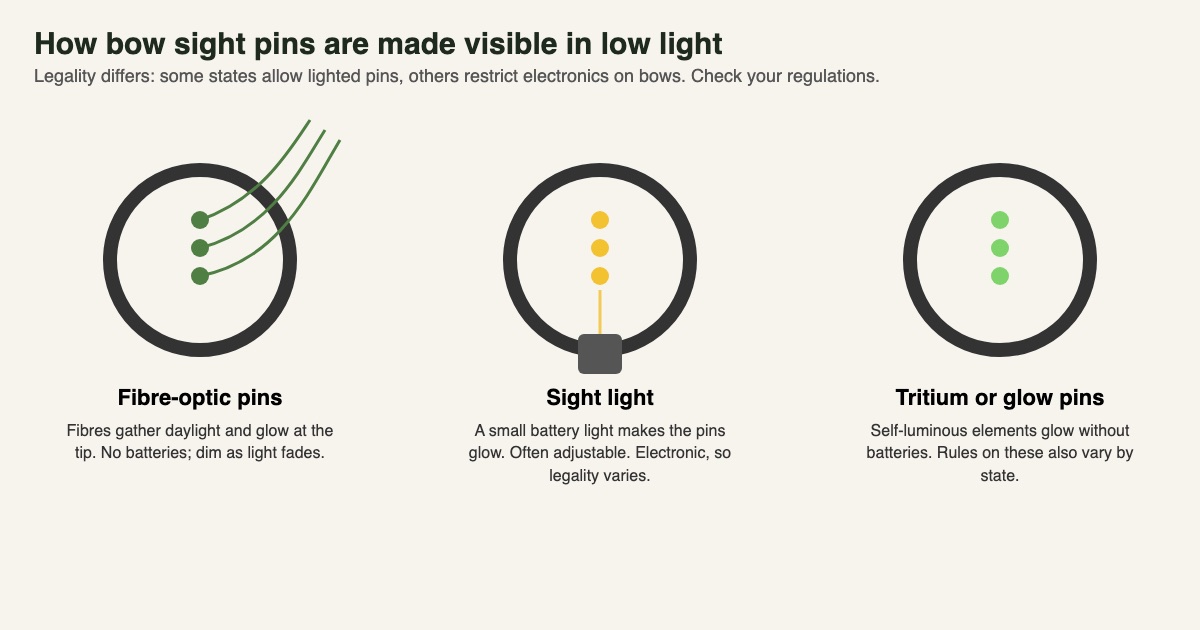
When hunters talk about a "lighted" sight, they can mean very different things. Our diagram above shows the three common types.
1. Fibre-optic pins
Most modern bow sights use fibre-optic pins. A length of coloured fibre is wrapped around or through the sight housing and gathers ambient light along its length, then concentrates it at the pin's tip as a bright dot. There is no battery and no electricity, which is why fibre-optic sights are accepted in almost every hunting jurisdiction. Longer fibres collect more light and stay bright later into dusk, but can look large and "bloom" in bright sunlight.
2. Battery sight lights
A sight light is a small battery-powered unit that screws into the sight housing and lights the fibres or pins from the side, often with a rheostat to adjust brightness. Some sights have integrated battery-powered pins. These keep pins visible well into low light, which is exactly why some states regulate them. A key distinction in many regulations is whether the light stays inside the sight or projects outward toward the target.
3. Self-luminous pins
Some sights use tritium or other self-luminous materials that glow without batteries or sunlight. They are less common on bow sights than on firearm sights. Some regulations treat them like any non-electronic sight, others treat them as "lighted," so they need checking specifically.
Why states regulate lighted sights
State rules on archery equipment usually try to balance two goals: keeping archery seasons as a primitive or short-range opportunity, and preventing practices that are unfair or unsafe, such as using artificial light to find or hold animals. Rules commonly address:
- Electronic or battery-powered devices attached to the bow or arrow.
- Light projected toward the target or animal, which may fall under rules against spotlighting or using artificial light to hunt.
- Devices that control the arrow's flight, which are generally prohibited.
- Lighted nocks, which many states now allow even where other electronics are restricted.
What the regulations say: two examples
Wyoming
Wyoming Game and Fish Department states that "the use of lighted sight pins is allowed as well, as long as the light mounted to the sight illuminating the pins does not project any light outside of the bow sight." In the same answer it notes: "There is no regulation prohibiting the use of lighted arrow nocks."
Kansas
Kansas regulation K.A.R. 115-4-4, covering archery equipment for big game, states: "No bow or arrow shall have any electronic device attached to the bow or arrow that controls the flight of the arrow." It then lists devices that are allowed: "Devices that may be attached to a bow or arrow shall include lighted pin, dot, or holographic sights; illuminated nocks; rangefinders; film or video cameras; locking draws; and radio-frequency location devices."
Elsewhere
Other states take different approaches. Some, particularly in the West, have historically prohibited electronic or battery-powered devices attached to a bow or arrow, and some of those have recently relaxed rules for lighted nocks only. Others allow lit pins but forbid anything that casts a beam. Many states also have separate rules for archers with a disability permit, which may allow equipment that is otherwise restricted. Because these rules change, we have not listed every state here. Check your state wildlife agency's current regulations.
Legal sights do not change legal shooting hours
A lighted sight does not extend the time you are allowed to shoot. Every state sets legal shooting hours, commonly tied to sunrise and sunset, and you must not shoot outside them however well you can see your pins. Just as important, you must be able to see the animal, the vital area and what lies beyond it clearly. Our shot placement guide explains why a clear view of the vitals matters.
Ethics of low-light shots
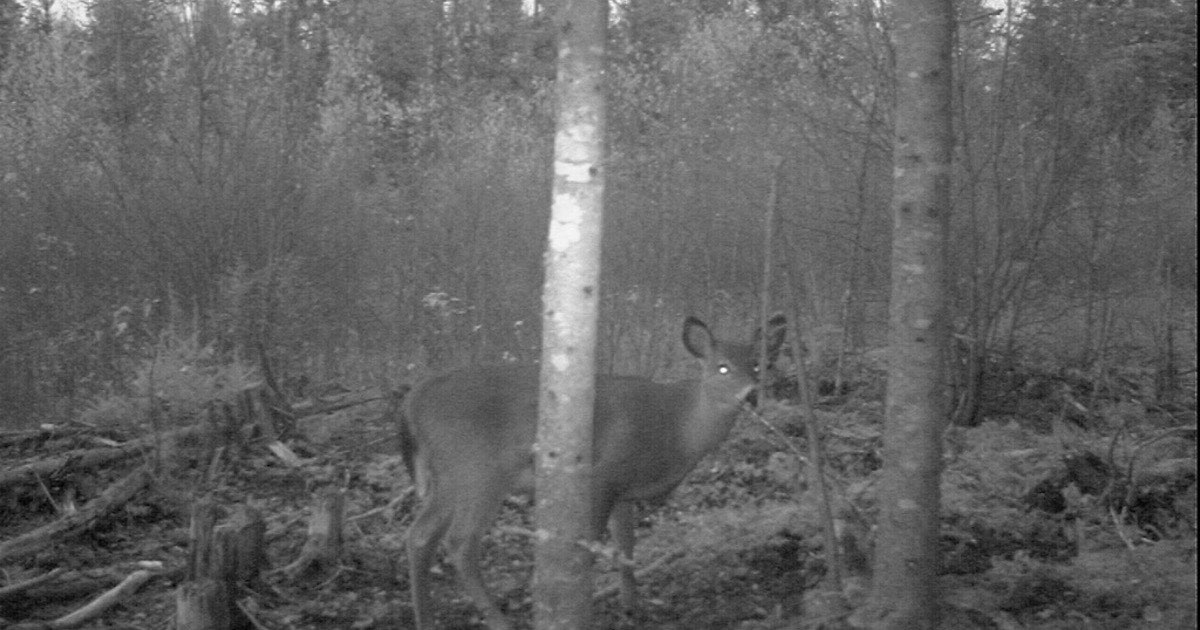
Even inside legal hours, low light makes everything harder:
- Judging the angle of the animal is harder, which affects shot placement.
- Seeing the arrow's flight and hit is harder; lighted nocks help here and are allowed in many states.
- Tracking is harder after dark; our tracking guide explains how to wait and follow a blood trail.
A lighted pin can make the pin visible after you can no longer see the animal properly. That is the point to stop, not to shoot.
How to check whether your sight is legal
- Find your state's current hunting regulations on the wildlife agency's website, usually in the archery or legal equipment section.
- Look for terms such as "electronic devices," "battery-powered," "artificial light," "illuminated sights," "lighted nocks" and "devices attached to a bow."
- Check season-specific rules. Some states have different rules for archery-only seasons, muzzleloader seasons or crossbow use.
- Check special permits. Disability permits may change what is allowed.
- Ask the agency if wording is unclear. Many publish FAQs, like Wyoming's.
- Re-check every season. Rules change, and last year's answer may be out of date.
If you hunt in more than one state, check each state separately and keep a sight light you can remove easily.
Choosing a sight with legality in mind
- Fibre-optic pins only keep you legal almost everywhere.
- A removable sight light lets you use it where it is legal and take it off where it is not.
- Single-pin vs multi-pin: single-pin sights have one bright, often longer fibre that can stay visible later, while multi-pin sights have more pins in the view; our single-pin vs multi-pin comparison explains the trade-offs.
- Pin size: smaller pins (such as .010 inch) cover less of the target at distance but gather less light; larger pins (such as .019 inch) are brighter in low light.
Our review of the Trophy Ridge React Pro shows a typical fibre-optic hunting sight with a sight light option.
Setting up a sight light properly
Where a sight light is legal, a careful setup keeps it effective and within the rules:
- Mount it on the housing, where the manufacturer intends, so the light shines into the fibres or pins and not forward.
- Check for spill. In a dark room or at dusk, draw the bow (or hold it at shooting position) and look for any glow on the ground or target in front of you. If light escapes forward, adjust or shield it.
- Use the dimmest setting that keeps the pin visible. A pin that is too bright blooms into a large blob that covers the target and makes precise aiming harder.
- Practise turning it on silently and by feel, before an animal arrives.
- Check the level bubble is still visible; some lights also illuminate the bubble.
Batteries and cold weather
Small batteries drain faster in cold weather, which is exactly when many late-season hunts happen. Fit a fresh battery before the season, carry a spare in a warm pocket, and turn the light off when you are not hunting the last minutes of light. A sight light that fails at dusk leaves you with ordinary fibre-optic pins, so make sure you can still shoot accurately with them.
Lighted sights vs lighted nocks
Hunters often group lighted sights and lighted nocks together, but regulations frequently treat them separately. A lighted nock sits at the back of the arrow and lights up when the arrow is shot, helping you see the arrow's flight, where it hit, and find the arrow afterwards. It does not help you aim. Because of this, several states that restrict electronic devices on the bow have chosen to allow lighted nocks while still banning other electronics. Check each item separately in your regulations.
Practising in low light
If you plan to use a lighted sight, practise with it in the conditions you will hunt. Shoot a few arrows at dusk at your usual range, within any local rules for shooting after dark, to see how bright the pins look, whether they bloom, and how well you can see the target behind them. Many hunters find their real limit is seeing the target, not the pin.
Crossbow scopes with illuminated reticles
Many crossbow scopes have illuminated reticles, usually battery powered. Rules for crossbows can differ from rules for vertical bows, so read the crossbow section of your regulations. Where illuminated reticles are allowed, the same principles apply: they must not project light at the animal, and they do not extend legal hours.
Common mistakes
- Assuming "fibre optic" and "lighted" mean the same thing in your state's rules.
- Using a sight light that spills light forward where rules forbid projecting light.
- Relying on last season's rules without checking for changes.
- Hunting another state with the same setup without checking its rules.
- Shooting because the pin is visible when the animal is not clearly visible.
Using a lighted sight where legal
Advantages
- Pins stay visible later at dusk and earlier at dawn
- Adjustable brightness avoids pin bloom
- Removable lights let you comply in different states
Trade-offs
- Restricted or banned in some states and seasons
- Batteries can fail in cold weather
- Can tempt hunters to shoot in poor light
You can browse fibre-optic bow sights or bow sight lights on Amazon.
Frequently asked questions
Are fibre-optic bow sights legal?
Fibre-optic pins, which use no battery, are accepted in almost every state. Check your regulations to be sure.
Are battery sight lights legal for bowhunting?
In many states, yes, often only if the light does not project beyond the sight. Some states restrict battery-powered devices on bows.
Can I use a lighted sight in Wyoming?
Wyoming allows lighted sight pins as long as the light "does not project any light outside of the bow sight."
Does a lighted sight let me hunt later?
No. Legal shooting hours still apply, and you must be able to see the animal clearly.
Are lighted nocks legal?
Many states allow them, including Wyoming and Kansas. A few have restricted them in the past, so check current rules.
Do lighted sights work with peep sights?
Yes. Make sure the pin is not so bright that it blooms inside the peep, and practise at dusk to check you can still see the target clearly through the peep.
Related articles
 Comparisons
Single-Pin vs Multi-Pin Bow Sights: Which Should You Choose?
Single-pin vs multi-pin bow sights compared: fixed pins vs sliders, speed in the field, long-range precision, low light, gap shooting, hybrids and scopes.
February 25, 2026 · 5 min read
 Reviews
Trophy Ridge React Pro Review: The 5-Pin Sight That Sets Its Own Pins
Trophy Ridge React Pro bow sight review: React Technology pin setting, .019 and .010 pins, tool-less micro-click adjustments, third axis and who it suits.
September 3, 2025 · 6 min read
 Guides
Where to Shoot a Deer With a Bow: Shot Placement
Bow shot placement for deer: where the heart and lungs sit, how to aim broadside, quartering away and from a tree stand, which shots to pass on, and why.
October 6, 2026 · 10 min read