
Urban Bowhunting: Can You Hunt Deer in City Limits?
Can you shoot a deer with a bow in city limits? How state urban archery seasons, city discharge ordinances and landowner permission fit together, with examples.

By Archery Insider Editorial Team
· 8 min read
In this article
Can you shoot a deer with a bow in city limits? Sometimes, and only where three layers line up: your state's hunting law says the season is open there, the city or county ordinance allows archery discharge on that parcel, and the landowner has said yes. No place is open by default, so this guide shows how to check, using programme rules we read.
Can you shoot a deer with a bow in city limits? The three-layer rule
Most bad answers come from checking only one layer. The basics of bowhunting law, licences and bowhunter education are in our can you hunt deer with a bow guide; in town, all three layers below apply.
| Layer | Who sets it | What to check | Where to find it |
|---|---|---|---|
| State hunting law | Wildlife agency | Is there an urban archery season, and is this locality in it? Licence, antlerless-only rules, reporting | Agency website and regulations booklet |
| Local ordinance | City or county | Is archery discharge allowed? Distance from dwellings and roads, minimum acreage, elevated-stand rules, permits | Municipal code online, police non-emergency line, city clerk |
| Landowner permission | Property owner | Written permission for the parcel, plus neighbours whose land a deer could cross | Ask, in writing, before the season |
North Carolina shows the second and third layers at work: its urban archery season "is available for cities, towns and villages that submit to the Wildlife Resources Commission by April 1 of each year a letter of intent to participate in the season," and the season "does not obligate private landowners to allow hunting on their property." The state opens the door; the town decides whether to walk through it; the landowner decides whether you can.
Rules checked on 7 October 2026; this isn't legal advice and regulations change, so confirm with your state wildlife agency and your city before you hunt. Participating localities and dates change every season.
What urban archery hunts are: a Virginia worked example
Virginia's Department of Wildlife Resources runs the clearest model. Its page states the purpose outright: "The objective of the urban archery season is to reduce human/deer conflicts in urban areas by concentrating archery-hunting pressure in urban/suburban areas." For 2026 to 2027 the season runs "September 5, 2026 through October 2, 2026 and January 3, 2027 through March 28, 2027" within participating localities, before and after the regular seasons.
- Antlerless only. "Only antlerless deer may be taken during the Urban Archery Deer Seasons." That covers does, button bucks and bucks that have shed.
- Equipment. "Crossbows are defined by law as a type of bow and are therefore legal during all archery deer seasons," alongside compounds and traditional bows.
- Licence. "An archery license is required to hunt with archery tackle during the Urban Archery Deer Seasons."
- Opt-in localities. "The season is only 'open' in those towns, cities, and counties that requested to participate in writing," and each keeps its own ordinances. The list we read included Richmond, Charlottesville and Lynchburg, and counties such as Fairfax and Chesterfield.
The page also summarises local rules: some localities require stands "at least ten (10) feet above the ground," some allow ground hunting with landowner permission, and setbacks vary widely.
Discharge setbacks: three real examples
A setback is the minimum distance from a building or road at which you may release an arrow. The locality sets it, and these three examples show how far apart they sit.
| Place | Rule we read | Source |
|---|---|---|
| Virginia localities (various) | Examples quoted by the DWR: not "within one hundred (100) feet of any dwelling except with written consent"; not "within 100 yards of an occupied dwelling"; not "within 300 feet of any residence" | Virginia DWR urban archery page |
| Liberty, Missouri | Bow hunting "within portions of the city" on "five acres or more of unplatted land," "with permission of the landowner," "during state hunting season," with a "conventional bow and arrow"; "No hunting shall be permitted within 250 feet of any roadway, residential structure or place where domestic animals are kept" (Ordinance 22-23) | City of Liberty FAQ |
| Fairfax County, Virginia | Reports "no acreage or distance minimums for discharge of archery equipment," relying on screening and elevated stands instead | Fairfax County archery programme page |
Two lessons. "Except with written consent" clauses are common: a neighbour's signature can shrink a setback, and a missing one can make a legal-looking shot illegal. And acreage minimums like Liberty's five acres rule out most suburban lots, however willing the owner.
Permission, proficiency tests and managed programmes
Fairfax County doesn't just open a season; it runs a programme. Its archery deer management "is conducted in partnership with the Fairfax County Park Authority, Northern Virginia Regional Park Authority, and other public landholders," and "all archery activity is closely monitored by the Fairfax County Police Department." Archers "go through a screening process and qualifications with their bows to be eligible," and "must follow strict rules of engagement, standards of conduct, and reporting requirements." The 2026 to 2027 programme runs "Saturday, September 12, 2026 - Saturday, February 13, 2027."
The county's reason for trusting archery is safety: "Since Virginia began tracking hunting injuries in 1959, no bystanders have been injured by an archer hunting deer anywhere in the Commonwealth." That record is the argument every urban archer makes to a nervous neighbour, and one sloppy shot would end it.
A pre-hunt checklist, in order:
- Read the state page for the urban season: dates, localities, antlerless rules, licence and reporting.
- Read the municipal code for "discharge," "archery" and "hunting," and phone the police non-emergency line if anything is unclear.
- Get written permission from the landowner, and from neighbours whose yards fall inside a setback or that a hit deer might cross.
- Apply to any managed programme and complete its qualification shoot.
- Walk the parcel and mark every house, road, path and pet run inside your setback. Decide your shooting lanes on paper and set a hard maximum range, shorter than in the woods.
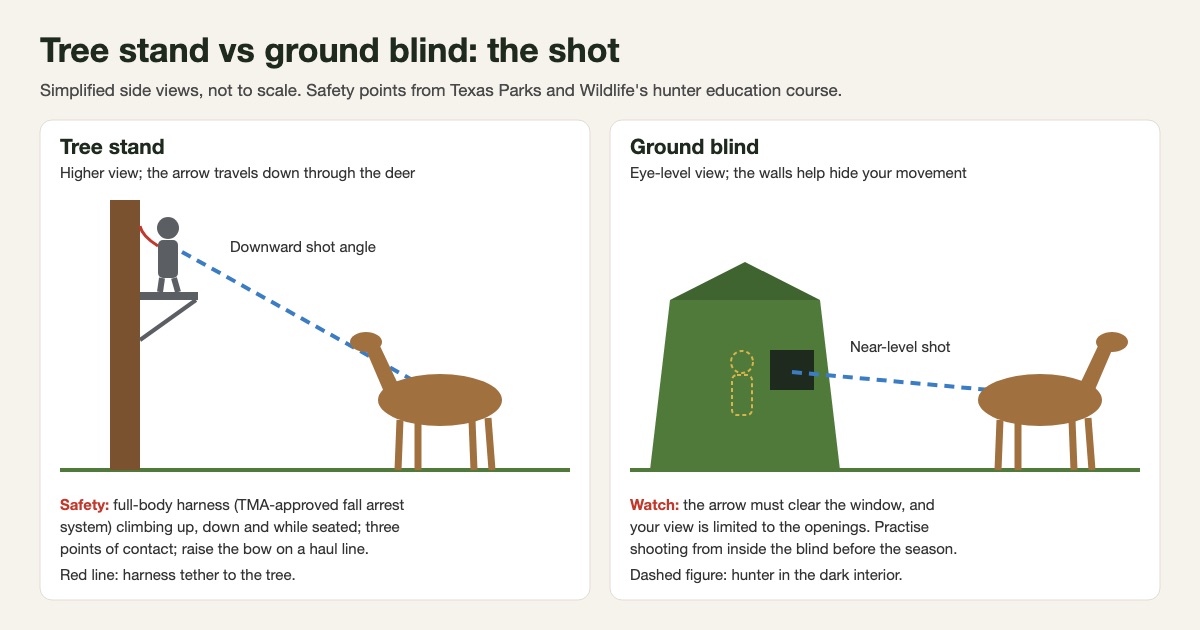
- Set up elevated, with a harness, so the arrow's path ends in the ground. Our tree stand safety guide covers the climbing routine.
Tracking a deer in a neighbourhood
The hunt isn't the hard part of urban bowhunting; the recovery is. A well-hit deer can still cross three properties and a road before it lies down. Our deer tracking guide covers blood sign and wait times; these are the extra rules for streets and yards.
- Pre-arrange recovery permission with every adjoining landowner; it's an easier conversation in August than at 7 pm in November.
- Never enter a yard without permission, however good the blood. Knock, phone or wait, and if no one answers call the police non-emergency line.
- Keep the kit discreet: a cart, a dark tarp, and field dressing out of sight of the street.
- Choose shots that end trails early. Broadside, quartering-away, two holes, inside your maximum.
- Carry the landowner's written permission and report promptly through the state system.
Ethics in town
Urban deer programmes exist because residents asked for fewer deer, and they continue only while residents stay comfortable with how it's done. Take antlerless deer where the rules say so, even when a buck walks past. Shoot only deer standing broadside in a lane you've measured, and pass any that could run into a road. Stay on your parcel, dress so you don't alarm dog walkers, and answer questions politely. Most hunters who lose a city permission didn't break a rule; they just looked like they might.
A harness and a rangefinder are the two purchases this hunt rewards. You can browse treestand safety harnesses or bowhunting rangefinders on Amazon. Check the harness's TMA listing and that the rangefinder has an angle-compensation mode.
Frequently asked questions
Can you shoot a deer with a bow in city limits?
Only where the state season is open in that locality, the municipal ordinance allows archery discharge on that parcel, and the landowner has agreed in writing. Virginia and North Carolina run opt-in urban archery seasons, and cities such as Liberty, Missouri allow bowhunting on larger unplatted parcels with setbacks. Nowhere is open by default.
What is an urban archery hunt?
A deer season or managed programme that uses archers to reduce deer numbers in towns and suburbs. Virginia describes the aim as reducing "human/deer conflicts in urban areas by concentrating archery-hunting pressure." They're usually antlerless-only, run before or after the regular season, and apply only in localities that asked to take part.
Do you need a proficiency test for bowhunting in town?
Not under a state season on its own, but managed programmes often require one. Fairfax County says its archers "go through a screening process and qualifications with their bows" and must follow "strict rules of engagement." Even without a test, treat your own tested maximum range as a rule; a miss in a neighbourhood has consequences a miss in the woods doesn't.
Can you track a deer into a neighbour's yard?
Not without permission. The deer may be yours under the law, but the yard isn't. Arrange recovery permission with adjoining owners before the season, knock or phone before you step onto a lawn, and use the police non-emergency line if you can't reach anyone. Shot selection that produces a short, heavy blood trail is the real answer.
Related articles
 Guides
Can You Hunt Deer With a Bow? A Beginner's Guide
Yes, you can hunt deer with a bow. Learn the legal basics, which bows work, how hard it is, effective range, gear, shot placement and a first-season plan.
October 6, 2026 · 13 min read
 Guides
Tree Stand Safety for Bowhunters
Tree stand safety for bowhunters: wear a full-body harness from the ground up, use a lifeline and haul line, inspect your stand and plan for a fall.
October 12, 2026 · 10 min read
 Guides
Tracking a Deer After the Shot: Blood and Hit Signs
How to track a deer after a bow shot: watch, listen and wait; how long to wait for each hit; reading blood, hair and arrow sign; grid searches and dogs.
October 10, 2026 · 10 min read