
Arrow Spine Numbers: 300 vs 350 vs 400 vs 500
Arrow spine 400 vs 500, 300 vs 350: what the numbers on a shaft mean, why lower is stiffer, and how aluminium size codes like 2213 differ.
By Archery Insider Editorial Team
· · 5 min read
In this article
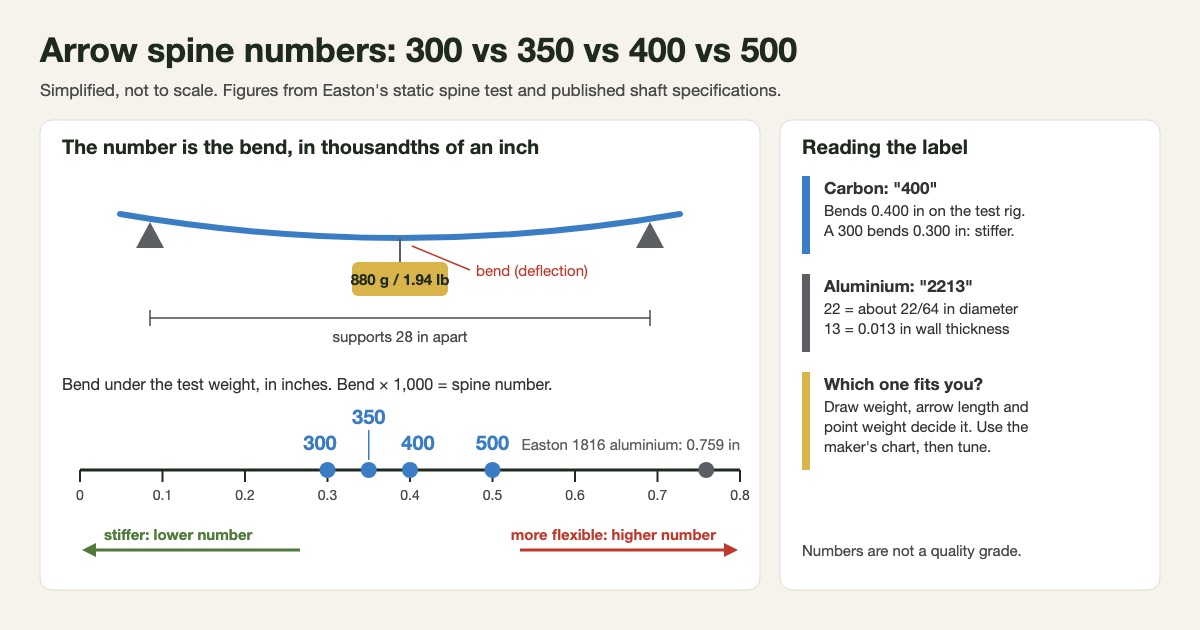
An arrow spine number tells you how far the shaft bends under a standard test weight, in thousandths of an inch. So in the arrow spine 400 vs 500 question, the 400 bends 0.400 in and the 500 bends 0.500 in: the lower number is the stiffer shaft. Neither is "better". The right one depends on your draw weight, arrow length and point weight.
What the spine number actually measures
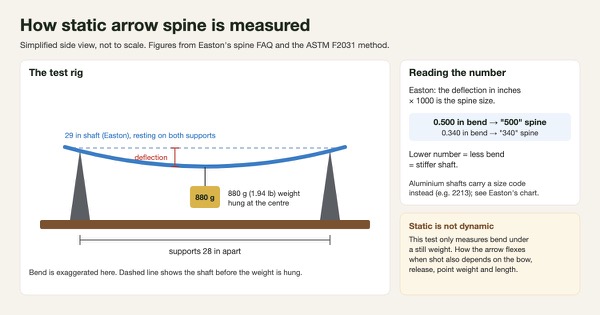
Easton defines static spine as "the amount of flex in the arrow when an 880-gram (1.94 lbs.) weight is suspended from the center of the arrow." Its article "Making Sense of Arrow Spine" turns that bend into the label: "The number of inches the arrow deflects or bends X 1000 due to the weight is the spine size." A 500, in Easton's example, bends half an inch.
Our guide to how arrow spine is measured covers the test rig itself. For reading labels, remember Easton's rule: "the lower the number, the stiffer the arrow."
300 vs 350 vs 400 vs 500 at a glance
Because the number is a measurement, you can compare shafts directly.
| Label | Bend under the test weight | What it means |
|---|---|---|
| 300 | 0.300 in | Stiffest of these four |
| 340 or 350 | 0.340 or 0.350 in | Slightly more flexible than a 300 |
| 400 | 0.400 in | More flexible than a 340 or 350 |
| 500 | 0.500 in | The most flexible of the four |
| Easton 2016 aluminium | 0.567 in | Published spine for the Jazz 2016 |
| Easton 1816 aluminium | 0.759 in | Published spine for the Jazz 1816 |
Not every brand uses the same steps. Gold Tip's own examples run 300, 340, 400 and 500, so one maker's 340 may sit where another offers a 350. That gap is small: 0.010 in on the test rig.
So which do you need, 400 or 500? The number alone can't tell you. Gold Tip notes that "the correct spine depends on your setup, including draw weight, arrow length and point weight." Easton's FAQ explains the direction: more draw weight or a heavier point makes an arrow act weaker, so it needs a stiffer, lower number.
Easton's tuning guide recommends starting with "a shaft recommended by one of Easton's Arrow Shaft Selection Charts" and confirming it by tuning. Our arrow selection guide shows how to read one.
Aluminium size codes like 2213 work differently
Aluminium shafts are labelled with a size code rather than a spine number. Easton's FAQ explains that in a code such as 2213, "the first two numbers are the APPROXIMATE outside diameter to the nearest 64ths of an inch. The second two numbers are the wall thickness in thousands of an inch." So a 2213 is about 22/64 in across with a 0.013 in wall.
Easton's tuning guide adds that outside diameter "is the main factor in determining shaft stiffness," while wall thickness "is the main factor in determining the shaft weight." So two shafts of equal stiffness can differ in weight, and the fatter, thin-walled one "will be much lighter."
To compare aluminium with carbon, look up the published spine. Easton lists the XX75 Jazz 1816 at 0.759 in and the 2016 at 0.567 in, both over a 28 in span: far more flexible than a 500 carbon shaft. Our Easton XX75 Jazz review lists the full range, and our carbon vs aluminium comparison covers the wider trade-offs.
Other numbers on the shaft
Gold Tip explains that straightness appears as a tolerance in inches, so ".001 STR is a tighter tolerance than .006 STR". A label such as "500 SP / .006 STR" therefore gives both. Gold Tip stresses that these "are separate specifications": a straighter shaft is not a stiffer one.
Once the chart gives you a number, you can browse 300 spine arrows or 500 spine carbon arrows on Amazon. Check that the listing states the spine and uncut length.
Frequently asked questions
Is 400 or 500 spine stiffer?
The 400 is stiffer. Spine numbers record how far the shaft bends under Easton's test weight, in thousandths of an inch, so a 400 bends 0.400 in and a 500 bends 0.500 in. Lower numbers suit setups that load the arrow harder, such as higher draw weights.
What is the difference between a 300 and a 350 spine arrow?
A 300 bends 0.050 in less on the test rig, so it is a little stiffer. Some brands step from 300 to 340 instead of 350, so compare the exact numbers on each maker's chart rather than assuming every brand uses the same steps.
What arrow spine do I need?
Use the arrow maker's spine chart with your measured draw weight, arrow length and point weight. Gold Tip says the correct spine "depends on your setup," and Easton recommends starting from its selection charts and confirming the choice by tuning, rather than relying on a rule of thumb.
Related articles
 Guides
How to Choose Arrows: Spine, Length, Weight and Spine Charts
How to choose arrows: what spine means, reading a spine chart, measuring arrow length, arrow weight and FOC, fletching, and bare-shaft tuning to confirm it.
Updated June 26, 2026 · 9 min read
 Guides
How Arrow Spine Is Measured: The Static Test
How arrow spine is measured: the 28-inch, 1.94 lb static test Easton and ASTM F2031 describe, how the number is read, and why dynamic spine differs.
Updated October 6, 2026 · 4 min read
 Comparisons
Carbon vs Aluminium Arrows: Which Should You Shoot?
Carbon vs aluminium arrows compared: weight, stiffness, durability, straightness, consistency, safety checks, cost and which suits target, hunting or youth.
Updated May 14, 2026 · 7 min read