
Safe Archery Targets for Kids
Choosing an archery target for kids: toy suction targets vs real foam or straw, backstops and netting, safe spacing and distances, and supervision.

By Archery Insider Editorial Team
· · 5 min read
In this article
A safe archery target for kids matches the arrows they shoot. Toy suction-cup sets come with play targets, but a real youth bow needs a foam, straw or bag target with a backstop or open space behind it. No target makes shooting safe on its own: an adult has to run every session.
Toy targets vs real targets
"Kids archery target" covers two different products. A toy set, with suction-cup or foam-tipped arrows, usually includes a play target. A real youth bow shoots real arrows, which need a target built to stop them.
In the US, the Consumer Product Safety Commission says "certain toys that can fire projectiles must meet certain performance requirements, such as ensuring the projectiles are not small parts or that they cannot exert excessive force when impacting a surface." A toy target isn't built for real arrows, so never mix the two.
| Toy set target | Real youth target | |
|---|---|---|
| Arrows | Suction-cup or foam tips that come with the toy | Real arrows with field points |
| Material | Plastic, card or a smooth surface | Foam block, straw boss or stuffed bag |
| Behind it | Clear play space; follow the toy's instructions | A backstop, netting or a large clear zone |
| Rules that apply | Toy safety rules; follow the age label | Range rules and adult supervision |
For real arrows, Scouting America's National Camping School guide says "targets for beginners should be about 48 inches in diameter and made of straw or Ethafoam", mounted on tripods "about 6 inches off the ground". Keeping targets low means "missed arrows will not go far" and younger archers "can reach the highest arrows easily". Our guide to archery target height covers the competition standard.
Backstops and netting
Plan for misses. The Scouting guide suggests baled straw stacked behind the target, or "several layers of burlap, old canvas, or rugs hanging loosely over a horizontal pole or plank," which "will stop arrows that miss the target."
If you stack straw bales as a target, tie them back to a post "so they will not fall forward on someone pulling arrows".
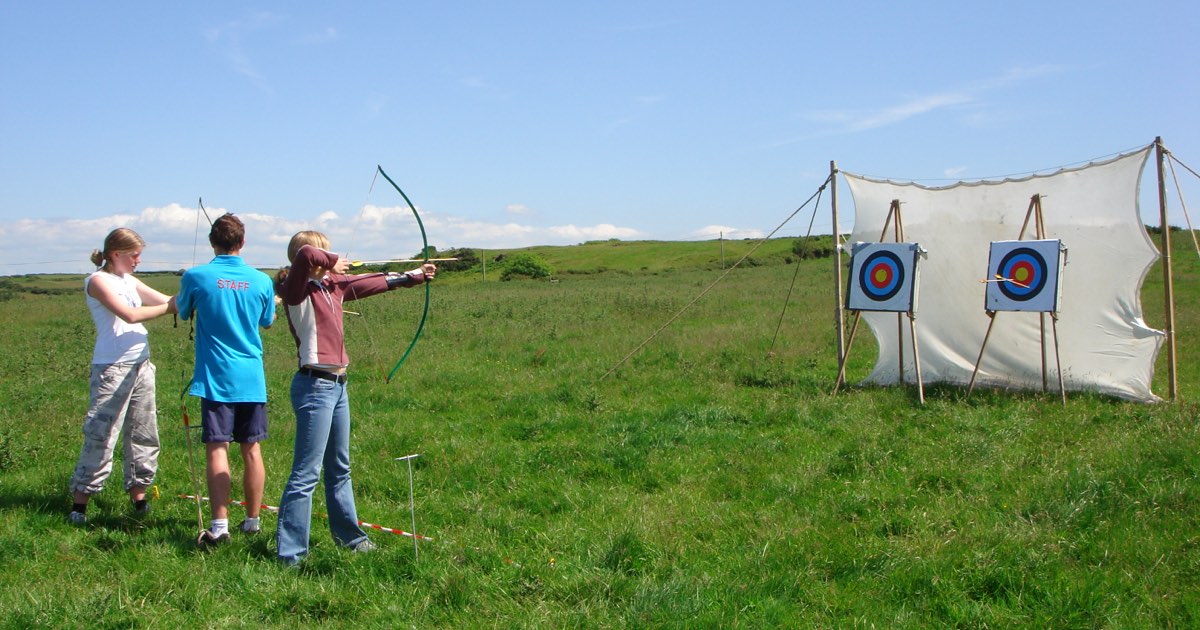
Indoors, the guide wants a backstop at least 8 feet tall, 2 to 10 feet behind the targets. Our backyard range guide covers home builds.
Placing the target
Scouting America's guide says to look for a natural berm to stop arrows; "if there is no berm, provide a minimum of 150 feet of open area behind the targets." The shooting line is "placed 15-30 feet from the Target Line", with a waiting line 15 feet behind it, and targets go "five feet, or two arrow lengths" apart, centre to centre.
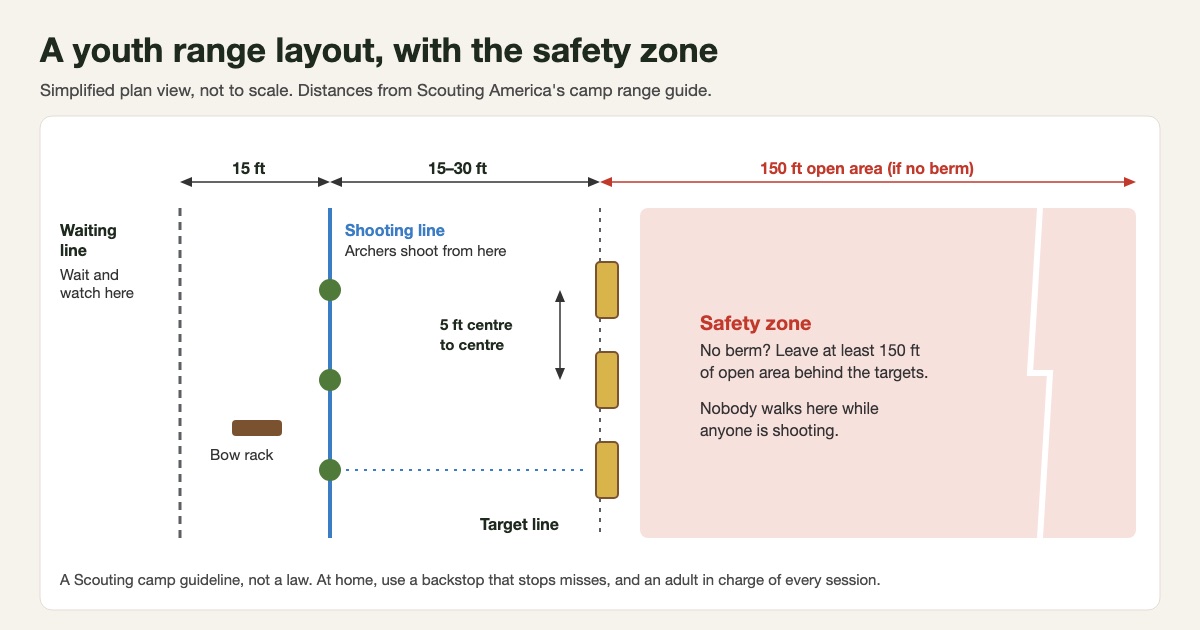
That's a Scouting camp guideline, not a law, and most gardens can't offer 150 feet, which makes a solid backstop even more important. Face targets away from paths and neighbours, and check local rules first.
Supervision, light bows and eye safety
The National Archery in the Schools Program (NASP), for grades 4 to 12, uses one bow: the Genesis compound, which "has no let-off and is adjustable from 10-20 pounds in draw weight", and every instructor must complete NASP's Basic Archery Instructor training. Scouting America's guide says beginners should use a bow with "no more than a 25-pound pull". For sizing, see our guide to choosing a bow for a child.
Scouting's rules add that nobody may hold a target for an archer, and shooting stops at once if anyone crosses in front of or behind the targets.
For toy sets, the American Academy of Ophthalmology advises: "Make sure children are appropriately supervised when playing with potentially hazardous toys or games that could cause an eye injury." With sports equipment, it suggests giving "the appropriate protective eyewear with polycarbonate lenses."
You can browse youth foam block targets or kids' target stands on Amazon; treat listings as examples to consider. Our Morrell target review compares a bag and a foam block for backyard use.
Frequently asked questions
What should a youth archery target be made of?
Scouting America's camp guide recommends targets about 48 inches across made of straw or Ethafoam, set about 6 inches off the ground. It notes that plastic foam "is messy and does not last long." Check it's rated for your child's arrows, and add a backstop.
Can kids use a suction-cup target with a real bow?
No. Suction-cup targets are part of toy sets and are made for toy arrows only. A real youth bow shoots real arrows with points, which need a foam, straw or bag target and a backstop or clear zone behind it, plus an adult running the session.
How far should kids stand from the target?
Scouting America's range guide places the shooting line 15 to 30 feet from the target line, close enough for beginners to succeed, and says it can move back as archers improve. Spectators and waiting archers stand behind a waiting line 15 feet further back.
Related articles
 Gear
Kids Bow and Arrow Sets: Toy vs Real Youth Bows
Kids bow and arrow sets explained: toy sets vs real youth bows, US toy safety rules, eye safety, makers' age ranges and draw weights, and what to look for.
October 30, 2026 · 10 min read
 Guides
How to Choose a Bow for a Child: Sizing, Draw Weight and Safety
How to choose a bow for a child: when to start, recurve vs youth compound, draw weight and bow length by size, matched arrows, safety gear and where to learn.
November 19, 2025 · 9 min read
 Guides
How to Set Up a Safe Backyard Archery Range
How to set up a safe backyard archery range: legal checks, safe buffer distances, backstops and netting, choosing a target, layout and house rules.
April 8, 2026 · 8 min read