
Hunting Arrows vs Target Arrows
Hunting arrows vs target arrows: maker specs for weight, diameter, straightness, fletching and inserts, can you hunt with target arrows, and reuse checks.

By Archery Insider Editorial Team
· 7 min read
Research-based: built from maker specs and official sources, fact-checked before publishing. How we review products
In this article
Hunting arrows and target arrows are made of the same carbon and aluminium. The real differences are a hunting arrow's heavier build, threaded insert for a broadhead, bigger fletching and mid-grade straightness, against a target arrow's tighter tolerances, slimmer or barrelled shaft, pin nocks and small vanes. Legally, in the states we checked, the point makes a hunting arrow, not the shaft. So you can often hunt with target arrows, provided they take a legal broadhead and weigh enough for your bow.
Hunting arrows vs target arrows: the comparison table
Figures are from the makers' product pages, read in October 2026.
| Spec | Hunting arrows (examples) | Target arrows (examples) | Why it differs |
|---|---|---|---|
| Weight per inch | Easton 5mm Axis: 7.2 GPI at 600 spine to 12 GPI at 200 | Easton X10: 5.8 GPI at 900 spine, 7.8 at 500, 9.2 at 325 | Mass for momentum vs a flat trajectory |
| Diameter | Axis: 5 mm inside, .253 to .286 in outside by spine; Gold Tip Hunter XT: .246 in inside; Victory VAP: .166 in | X10: barrelled, .182 to .221 in outside at the mid-point; Victory VXT: .166 in | Slim shafts drift less and penetrate better |
| Straightness | Axis and Hunter XT: ±.003 in; VAP: ±.001 (Elite), ±.003 (Gamer), ±.006 (Sport) | X10: ±.001 in; VXT: ±.001, ±.003 or ±.006 | Gold Tip: ".001 STR is a tighter tolerance than .006 STR" |
| Weight tolerance | Hunter XT: ±2 grains; VAP: ±0.5 grains per dozen | X10: ±0.5 grains per packaged dozen; VXT: ±0.5 grains per dozen | Matched weight means matched speed at 70 metres |
| Fletching | Hunter XT ships with 2-inch Rapt-X vanes (4-inch feathers optional); Axis has factory helical fletching | Usually sold bare; the archer fits small vanes or spin vanes | Broadheads need more steering |
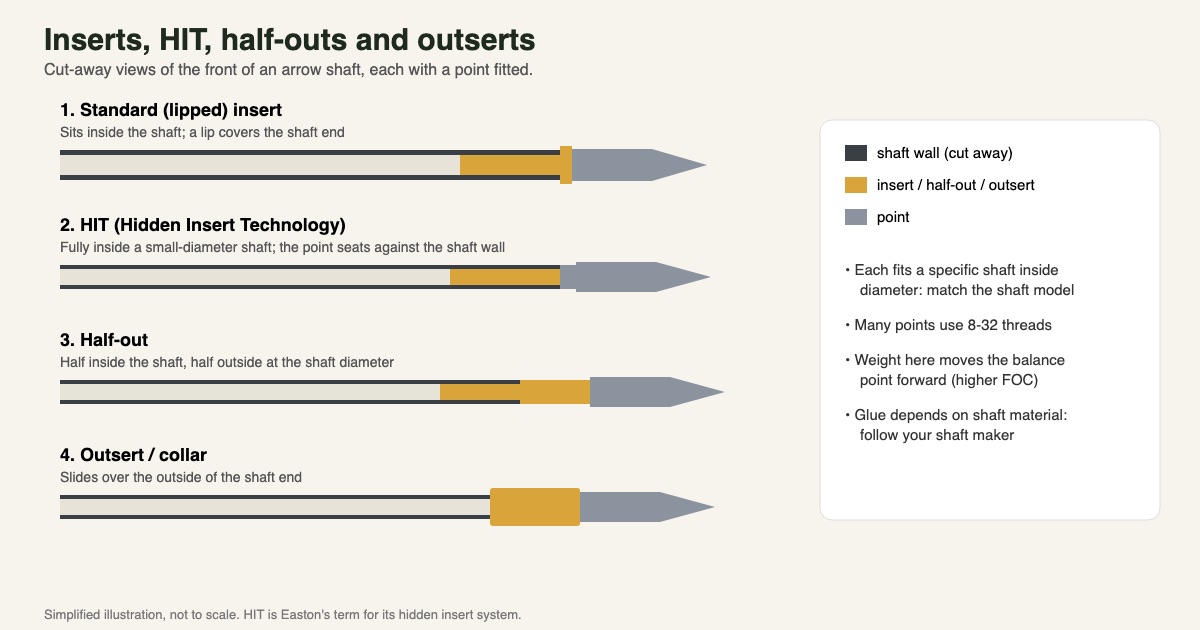
| Inserts and points | Axis: 5mm HIT 8-32 insert (16 grains) or stainless half-out (55 grains); VAP: 50-grain aluminium Shok TL insert; Hunter XT: .246 insert | X10: dedicated X10 points fit the shaft directly; VXT: optional stainless break-off points, 3-grain or 12-grain pin bushings | A screw-in broadhead needs a thread |
Diameter and straightness no longer split the two camps, since Victory sells .166-inch shafts in ±.001 for both jobs; what's consistent is weight, inserts, fletching and the tolerances most models are sold at.
What forums say, and what the spec sheets say
A common claim is that hunting shafts have thicker walls and target arrows "snap in an animal." We couldn't confirm it: none of the Easton, Gold Tip or Victory pages we read publishes wall thickness, and none says a target shaft fails on game. What they do show is weight per inch and outside diameter, and a heavier shaft of the same diameter must carry more material in its walls. Our carbon vs aluminium comparison covers how each material fails.
Why hunting arrows are built the way they are
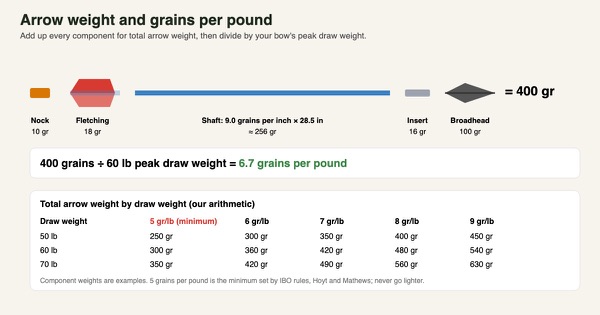
Mass. A heavier arrow carries more momentum into an animal. Easton's Axis weighs 9 to 12 GPI in the spines most hunters shoot, before the insert and broadhead. Our arrow weight for hunting guide explains grains per pound and the five grains per pound minimum.
Components. The Axis ships with an HIT insert that sits fully inside the shaft, or a stainless half-out; the VAP with a 50-grain aluminium insert. Both take a screw-in broadhead. Gold Tip describes the Hunter XT as "a mid-weight arrow that features a balance of speed and penetration."
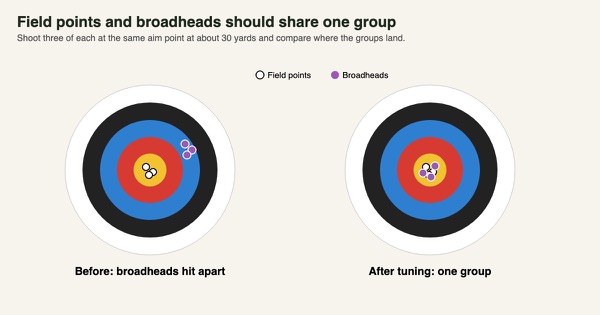
Fletching. Broadhead blades act like small wings at the front, so hunting arrows carry bigger or helical vanes to keep the back of the arrow in charge. Our field points vs broadheads guide explains why broadheads group differently.
Why target arrows are built the way they are
Consistency. Easton sorts X10 shafts to ±.001 inch and ±0.5 grains per dozen, and markets it as "the ultimate recurve competition shaft."
Shape. The X10 is barrelled, from .221 inch at the mid-point on the stiffest spine to .182 inch on the lightest. Victory's VXT uses "a front-parallel, rear-taper design."
Points and nocks. Target points glue in or screw into bushings and are often break-off designs so the archer can set the weight; the VXT comes with 3-grain aluminium and 12-grain pin bushings for pin nocks.
Can you hunt with target arrows?
In the states we checked, the shaft isn't regulated; the point is. Texas Parks and Wildlife says that for wild turkey and game animals other than squirrels "a projectile must be equipped with a broadhead hunting point," and sets no minimums on arrow length, material or weight. Texas also allows "arrows/bolts with field, target, or judo points in the quiver with the broadhead hunting points." Oklahoma requires "hunting type points not less than 7/8 inches wide, including mechanical broad-heads meeting this width requirement when fully open." Rules checked on 7 October 2026; this isn't legal advice and regulations change, so confirm with your agency.
So the practical questions are:
- Can it take a legal broadhead? A target shaft with glue-in points has no thread, and an insert that accepts a screw-in head may not exist for it.
- Is the finished arrow heavy enough? Add shaft, insert, broadhead, nock and fletching and check against your bow maker's minimum grains per pound.
- Is the spine right? A heavier point weakens dynamic spine; a 100-grain broadhead on a shaft spined for an 80-grain target point can fly poorly, and small target vanes may not steer it.
Reusing hunting arrows after a hunt
An arrow that has been through an animal, hit the ground or struck another arrow needs inspecting before it's shot again. Easton's warning page gives the procedure for carbon, and specifically lists arrows "shot into a game animal" among those needing it:
- Clean it and look along the shaft for nicks, cracks, splits and dents.
- Flex it. "Grasp the shaft just above the point and below the nock, then flex the arrow in an arc (bending it away from you and others) with a deflection of 1 to 2 inches (2.5 to 5 cm)." Do this "four to six times, rotating the arrow slightly between each flex," listening and feeling for cracking.
- Twist it. Holding both ends, "twist the shaft in opposite directions. If the arrow 'relaxes' or twists easily, the carbon has been damaged."
- Check the nock and insert. Easton says never to shoot an arrow with a damaged nock, and to make sure it's fully seated and tight.
- If anything fails, discard it. Easton's instruction is in capitals: "DISCARD THE ARROW."
Examples to consider
For a standard-diameter hunting shaft, the Gold Tip Hunter XT is the kind of mid-grade arrow most compound hunters start with; our Hunter XT review walks through spine choice, and you can browse carbon hunting arrows on Amazon. For practice, Easton Match Grade field points in the same weight as your broadheads keep sight marks honest. We haven't tested either.
Frequently asked questions
Can hunting arrows be reused?
Yes, if they pass inspection. Clean the shaft, look for nicks and cracks, then follow Easton's flex and twist test: flex it 1 to 2 inches, four to six times around the shaft, then twist the ends in opposite directions. Any cracking, or a shaft that twists easily, means discard it.
Hunting arrows vs practice arrows: what's the difference?
Usually only the point. Most hunters practise with their hunting arrows fitted with field points of the same weight as their broadheads, which keeps arrow weight, spine and sight marks identical. Check broadhead flight with the exact arrows you'll hunt with.
Are target arrows lighter than hunting arrows?
At the same spine, usually. Easton's X10 target shaft runs from 5.8 to 9.2 grains per inch across its range, while the 5mm Axis hunting shaft runs from 7.2 to 12. Hunting arrows then add a heavier insert and broadhead, so the finished-arrow gap is bigger than the shaft figures alone suggest.
Related articles
 Guides
Arrow Weight for Hunting: Grains per Pound Explained
Arrow weight for hunting explained: what grains per pound means, the 5 GPP minimum, a weight table by draw weight, light vs heavy arrows, and starting points.
October 27, 2026 · 10 min read
 Comparisons
Carbon vs Aluminium Arrows: Which Should You Shoot?
Carbon vs aluminium arrows compared: weight, stiffness, durability, straightness, consistency, safety checks, cost and which suits target, hunting or youth.
Updated May 14, 2026 · 7 min read
 Training
Field Points vs Broadheads: Why Impact Changes
Why broadheads hit differently from field points, and how to fix it: paper tuning, spin-testing, micro-tuning the rest at 30 yards, FOC and re-sighting.
October 14, 2026 · 9 min read